
After the Dallas Mavericks’ triumphant Christmas Day victory over the Phoenix Suns, I wrote the following:
While Monday night’s performance was a national statement that Doncic remains one of the three most talented offensive players in the world, it also reinforced an observation that has been pervasive throughout the year: this is a scary Mavericks team that can make legitimate noise this season.
I channeled my inner Charles Dickens to write a Christmas Carol version of the Dallas Mavericks, including proclaiming that this year’s Mavericks’ roster didn’t resemble that of last year’s. Fast forward a month (and a week) and it appears I got a bit too carried away. Since that win over the Suns, the Mavericks have gone 8-10 and that record feels a bit kind given their on court performances. An extremely unfortunate run of horrible injury luck has certainly played a role in Dallas’ downturn and, as a result, we have seen the same issues that plagued previous Mavericks’ teams return this season. Role players alongside Luka Doncic have been extremely inconsistent. The defense plummeted to 27th in the month of January. Over their past ten games, the Mavericks are last in defensive rating (allowing 126.3 points per 100 possessions, over two points worse than 29th placed Charlotte) and 27th in net rating. To think the Mavericks are 4-6 in that ten game stretch points to extreme fortune, as that mark has largely been buoyed by individual offensive performances you cannot base your team success of off:
- New York Knicks (128-124 W) Kyrie Irving scored 44 points on 15-26 FGs, Tim Hardaway Jr. scored 32 points on 10-20 FGs. The Knicks shot just 33% from 3-PT range for the game and barely lost
- New Orleans Pelicans (125-120 W) Kyrie Irving scored 42 points on 13-28 FGs (13-15 FTs), Tim Hardaway Jr. scored 41 points on 11-23 FGs (including nine 3-PT). The Pelicans shot just 30% from 3-PT range and barely lost
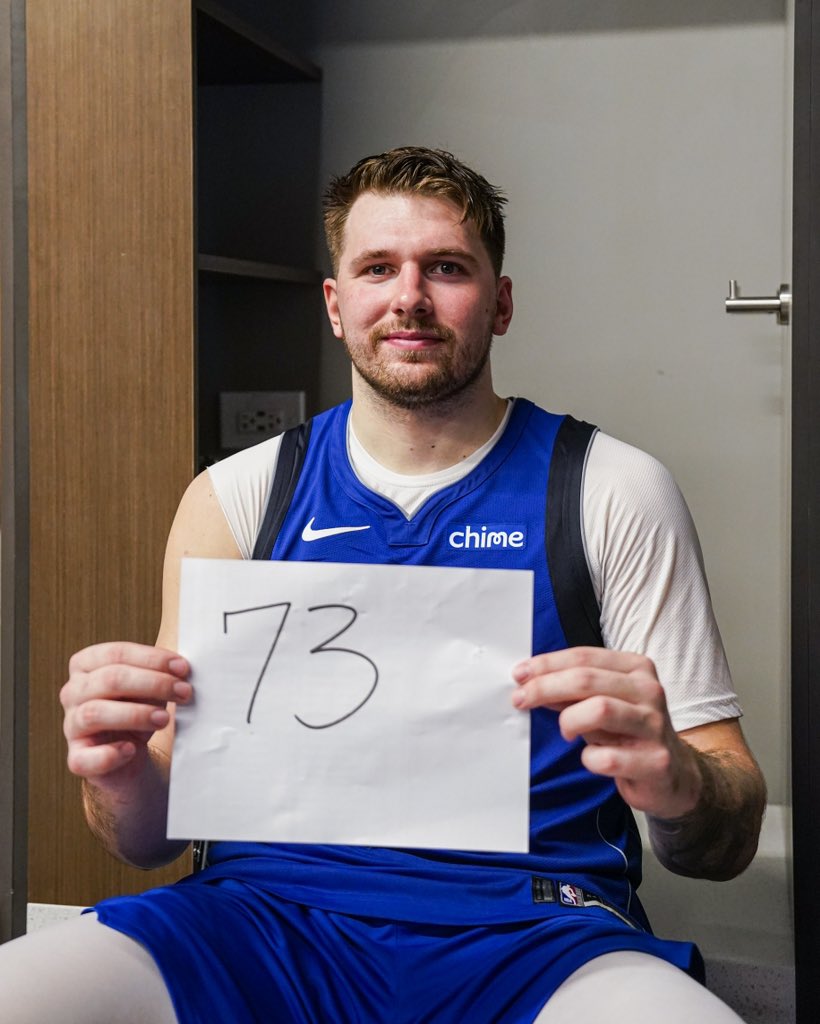
- Atlanta Hawks (148-143 W) Luka Doncic scored 73 points on the most efficient shooting performance in NBA history. Dallas won by five
- Orlando Magic (131-129 W) Luka Doncic scored 45 points on 12-23 FGs, Tim Hardaway Jr. scored 36 points on 11-17 FGs.
Despite the relative unknown regarding what Dallas’ ceiling could truly be if this roster was fully healthy, we certainly have enough evidence to proclaim that this Mavericks’ team is nowhere near good enough to win the NBA Finals. They have the top end talent you see on title winning teams, but their roster tapers off significantly behind Doncic and Kyrie Irving. You’d be hard pressed to find a team in recent memory that won the NBA Finals and didn’t supplement their primary star with multiple, high-level starters:
2022-23 Denver Nuggets: Nikola Jokic (MVP), Jamal Murray, Aaron Gordon, Michael Porter Jr., Kentavious Caldwell-Pope, Bruce Brown
2021-22 Golden State Warriors: Stephen Curry (MVP), Klay Thompson (AS), Andrew Wiggins (AS), Draymond Green (AS), Jordan Poole, Kevon Looney
2020-21 Milwaukee Bucks: Giannis Antetokounmpo (MVP), Khris Middleton (AS), Jrue Holiday (AS), Brook Lopez, PJ Tucker, Bobby Portis
2019-20 Los Angeles Lakers: LeBron James (MVP), Anthony Davis (AS), Kyle Kuzma, Kentavious Caldwell-Pope, Alex Caruso, Danny Green
2018-19 Toronto Raptors: Kawhi Leonard (Former Finals MVP), Kyle Lowry (AS), Pascal Siakam (AS), Marc Gasol (AS), Fred VanVleet, Danny Green
The Mavericks have the top-5 type of talent you see on title teams (Luka Doncic, albeit he realistically needs to be more consistent with his defensive effort / composure to take that MVP-level step), and they have the elite co-star (Kyrie Irving), but where they noticeably depart from their predecessors is their talent down roster. Specifically, the Mavericks sorely lack what we could refer to as a third option; another player who is a fringe All-Star (at worse) level player who would start for 30/30 NBA teams. The Mavericks desperately need to find their Aaron Gordon, Andrew Wiggins, Jrue Holiday, Kyle Kuzma, or Pascal Siakam. Without that player, it likely won’t matter what else the Mavericks do or how good their offense can be. They will continue to fall short of the ultimate goal of winning the NBA Finals.
With the Trade Deadline rapidly approaching, Nico Harrison and his team certainly have their work cut out for them. The team-building strategy in Dallas for years has centered around chasing superstars; obviously, the Mavericks’ whiffs are fairly well-documented, but this past year has seen Harrison focus on prioritizing the depth and supporting cast of the team. Derrick Jones Jr. and Dante Exum were terrific offseason signings, Dereck Lively was a home run draft pick, and Olivier Maxence-Prosper has certainly shown some flashes. The Mavericks do not need to go star hunting over the next several months, but they also need to be shopping a few tiers above where Harrison operated this summer.
When evaluating the Mavericks’ big picture, what is notable is the urgency Harrison needs to work with in finding his #3 guy. Theoretically, the Mavericks are ideally building a title team around the Doncic / Irving duo; if that is the case, their timeline for a championship is significantly condensed. After this season, Irving is only under contract for two more seasons and will turn 32 in the coming months. Given that Dallas has no cap space to sign a player of All-Star caliber this summer, this elusive #3 will have to come via the trade market and will have to be acquired by this summer at the absolute latest to juice as much as possible out of this Doncic / Irving duo.
Therefore, Dallas’ strategy at the deadline should be driven by their need for their “third option”. Harrison’s great work this summer has made attaining that player more realistic; the Mavericks only have one first round pick available to trade currently (because of protections on their remaining first owed to the New York Knicks), but have a good array of young players and salary filler to facilitate a trade for said player: Jaden Hardy (20), Olivier Maxence-Prosper (21), Josh Green (23), and Grant Williams (24) should all be available in this scenario, along with Dallas’ remaining picks. The Mavericks also can work deals of nearly any salary range with Richaun Holmes ($12M) and Tim Hardaway Jr. ($17.8M) salaries as the matching mechanism.
While Dallas’ talent pool has improved, they still have significantly less treasure in their chest than other teams who are also shopping in the same tier (or a tier above). Pascal Siakam, for example, would have been a perfect fit for the Mavericks. The Pacers traded three first round picks and Bruce Brown Jr. (who, reports indicate could net Toronto an extra first round pick) for Siakam; the Mavericks don’t even have two first round picks available to trade, let alone three. It’s not realistic to think the Mavericks can outbid opposing teams for highly sought after players; teams such as the New York Knicks, Oklahoma City Thunder, Utah Jazz, and Houston Rockets all have a terrific hoard of assets to utilize, but don’t forget about teams like the Sacramento Kings, Miami Heat, New Orleans Pelicans, Golden State Warriors, and Philadelphia 76ers who all also have more to offer than the Mavericks. Teams have clearly shifted their priorities in a return trade package in the form of draft capital, not players.
Combining all of Dallas’ circumstances, alongside the nature of the NBA landscape as a whole, the Mavericks strategy should be derived from the following beliefs:
- Dallas needs a better third player on the roster to realistically compete
- Kyrie Irving’s age (nearly 32) and shorter contract duration increases the urgency to acquire a better third player to maximize his contract years with Luka Doncic
- With no cap space this summer, the Mavericks will need to trade for this third player
- Given Dallas’ lack of draft capital compared to the rest of the league, they will need to take a gamble on a third player: trading for a player currently struggling, a player with potential to grow into a third option role, a player on a bloated contract, or some combination of the three. They won’t be able to acquire a player who comes on a good contract with multiple All-Star level campaigns who multiple teams are pursuing
Over the next week, Nico Harrison’s decisions should be driven by those foundational guidelines. Priority A, B, and C is to find that third option; here are some players that seem available for trade and could fill that role:
The Third Option Shopping List
NOTE: Shams Charania reported Zach LaVine is having season-ending foot surgery. Therefore, my section around LaVine below is primarily a moot point; the Mavericks shouldn’t trade for him during the season. However, I’d still be interested in acquiring him this summer.
Zach LaVine (G-Chicago Bulls)
Age: 28 (turns 29 on March 10)
Remaining Contract: 3 Years, $138 Million (Player Option for final year at $49M)
2023-24 Stats: 19.5 PPG, 5.2 RPG, 3.9 APG; 45.2% FG, 34.9% 3-PT, 85.4% FT
Based off the intel dropped by the best NBA reporters in the game, it feels like the worst kept secret is how Zach LaVine is available for trade. It seems like a mutual parting is desired, as LaVine wants out of Chicago while the Bulls want off his massive contract that will be on the books for three more seasons. LaVine’s fit in Dallas is neither clean nor ideal, but given the Mavericks’ available assets, could they acquire a player close to LaVine’s talent? Likely not, which is why I think he should firmly be in play.
Acquiring LaVine would be a massive risk for the Mavericks; he’s an injury prone player (he’s played 65+ games in just 4/10 seasons), a poor defender, has an extremely bloated contract, and has been in negative news this year around his discontentment and subsequent play in Chicago. LaVine has really struggled on the court this year as well. He’s averaging his lowest PPG total since he was 22 years old, his efficiency has dipped in meaningful fashion, his defense (and subsequent effort) has bottomed out, and he’s only played in 25 games. There is a reason why recent reporting has indicated that teams around the league view LaVine as a negative asset that the Bulls may need to attach a sweetener to in order to trade him.
All of these factors, combined with the Mavericks’ situation, makes this an ideal opportunity to be aggressive. Ideally, the Mavericks’ third option would be a rangier forward who gives the roster some desperately needed size. They don’t need another score-first player, especially one with durability concerns and a 6’5 frame. But, when healthy and engaged, LaVine is extremely talented. LaVine is a 2x All Star, has boasted above average scoring efficiency over his previous six seasons (per Cleaning The Glass), and has operated as a legitimate #1 scoring option who has greatly improved his playmaking ability. They may not get many (if any) stops, but a trio of Irving / Lavine / Doncic will be nightmarish for opposing teams to defend. Frankly, we’ve seen two teams construct their rosters around high-octane offensive trios with the following results:
- Brooklyn Nets (2020-21): Kyrie Irving / James Harden / Kevin Durant trio was +7.2 per 100 possessions played together
- Phoenix Suns (2023-24): Devin Booker / Bradley Beal / Kevin Durant trio is +12.5 per 100 possessions played together
Now, none of the proposed Irving / LaVine / Doncic trio is as good of a defender as Kevin Durant, and none of them are as tall as Durant (who stands at 7’0), but we’ve seen these trios boast dominant numbers when healthy. The league’s shift towards benefitting offense plays into the strategy here as well, along with LaVine’s history of production. Take a look at LaVine’s statistics from previous seasons:
| Season | PPG | eFG% | 3-PT% | %FGM UAstd | AST% | TOV% |
| 2022-23 | 24.8 | 55.8% (70th) | 37.5% (57th) | 57% (95th) | 18.6% (91st) | 10.9% (52nd) |
| 2021-22 | 24.4 | 55.6% (72nd) | 39.3% (82nd) | 58% (95th) | 20.8% (94th) | 11.0% (37th) |
| 2020-21 | 27.4 | 60.2% (91st) | 42.6% (93rd) | 59% (97th) | 22.5% (97th) | 13.8% (17th) |
| 2019-20 | 25.5 | 53.0% (57th) | 38.1% (63rd) | 54% (92nd) | 21.8% (94th) | 13.4% (19th) |
| 2018-19 | 23.7 | 52.4% (64th) | 37.9% (70th) | 62% (95th) | 22.5% (95th) | 13.9% (16th) |
Adding a player with a track record of highly efficient, high-powered offense from all three levels would be a massive boon to Dallas’ roster, even if it’s a clunky fit that doesn’t lead to optimal team building. In an ideal world (which you would gamble on), two of Irving / LaVine / Doncic will always be on the court together; that would be a huge improvement in terms of the Mavericks’ overall playmaking and scoring ability. Just two years ago, the Mavericks made the Conference Finals while spearheaded by a three-guard lineup of Jalen Brunson, Spencer Dinwiddie, and Luka Doncic. Why not attempt to recreate that, except with Irving and LaVine replacing Brunson and Dinwiddie?
The wrinkle around LaVine is what the actual trade would look like. Chicago Bulls’ insider K.C. Johnson had written a few proposed packages around what a potential Detroit Pistons / LaVine deal could look like:
- Bojan Bogdanovic, Joe Harris, draft capital for Zach LaVine
- Bojan Bogdanovic, Isaiah Stewart, 2nd round pick(s) for Zach LaVine
- Bojan Bogdanovic, Monte Morris, Mike Muscala, draft capital for Zach LaVine
Those packages are certainly in the realm of what the Mavericks can offer in terms of their own assets. A Dallas trade would be built around Tim Hardaway Jr. and Richaun Holmes to make the salaries work, and the Mavericks could include Seth Curry and protections on their 2027 first round pick to truly make the math work:

Would the Mavericks toss in their extra second round picks to also add Andre Drummond to the deal?
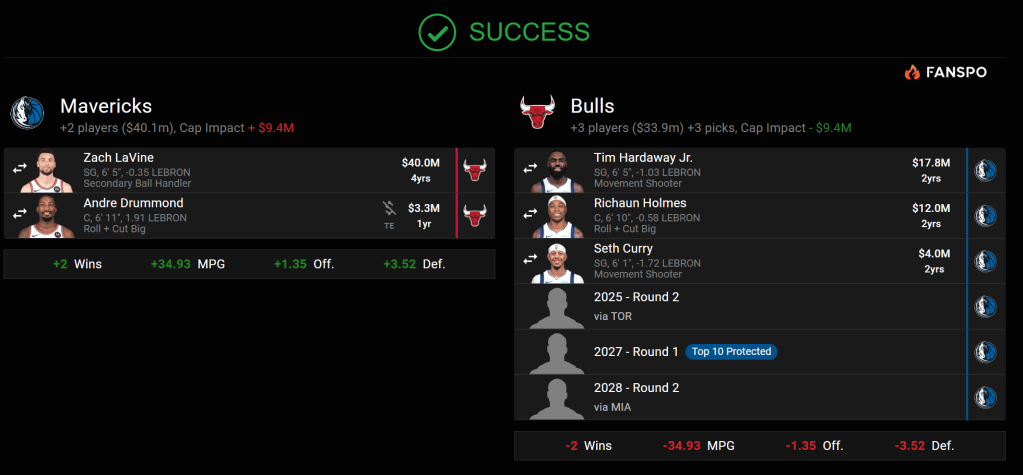
That would be a home run deal for the Mavericks in my opinion; the Mavericks essentially replace Hardaway with LaVine in the rotation but add the best rebounding big in Andre Drummond for much needed size and insurance behind Dereck Lively. For as good as Hardaway Jr. has been this year, a healthy LaVine is certainly an upgrade and, in theory, shouldn’t see a defensive dip overall. Dallas keeps all of their young players as well and, outside of Irving / LaVine / Doncic, have a plethora of above average defensive guards and wings to rotate in with lineups. It doesn’t fill their biggest needs of defense and size, but it would instantly elevate Dallas’ roster to a level much more in line with past champions.
(A bonus point here, this is the type of “depressed asset” deal the Mavericks could realistically swing and offers them a much higher ceiling than their current roster. The choice Dallas faces in this scenario isn’t “acquire LaVine and possibly implode or stand pat and play it safe”. The Mavericks will fumble away Luka Doncic’s prime years if they don’t swing for a third star. If LaVine does work out in Dallas, he also gives the Mavericks a natural hedge around Kyrie Irving’s free agency in two seasons when he’ll be 34).
Jerami Grant (F-Portland Trail Blazers)
Age: 29 (turns 30 on March 12)
Remaining Contract: 4 Years, $132.4 Million (Player Option for final year at $36.4M)
2023-24 Stats: 20.8 PPG, 3.6 RPG, 2.5 APG; 46.1% FG, 40.3% 3-PT, 80.9% FT
On paper, Jerami Grant is a much better fit for the Dallas Mavericks than Zach LaVine is. Iztok Franko has pointed out that only one team has seen a fewer percentage of minutes played by players 6’8 or above than the Mavericks, and that is the Chicago Bulls. Grant, who is 6’9, would immediately give Dallas some much needed size in the frontcourt. When comparing Grant to third options of other title teams, he is certainly in the same tier as Aaron Gordon, Andrew Wiggins, and Kyle Kuzma.
Over the past several seasons, Grant has taken on a more prominent role in terms of offensive creation and workload. As a result, Grant’s raw offensive numbers have increased, but it has come at the expense of his efficiency. Acquiring Grant would assuredly reduce his offensive burden while increasing his defensive importance; in essence, Dallas would be betting on him reverting more towards the player we saw in Denver, rather than how he played in Detroit and how he currently operates in Portland. Grant’s usage, efficiency, and share of assisted field goals over his past seven seasons paints a really interesting profile:
| Team / Season | USG Rate | eFG% | % FGM UAstd |
| 2017-18 (OKC) | 14.8% (39th) | 58.3% (75th) | 24% (42nd) |
| 2018-19 (OKC) | 13.1% (18th) | 56.8% (65th) | 15% (14th) |
| 2019-20 (DEN) | 16.1% (55th) | 55.5% (55th) | 16% (14th) |
| 2020-21 (DET) | 26.9% (93rd) | 49.2% (21st) | 35% (70th) |
| 2021-22 (DET) | 24.5% (92nd) | 49.7% (12th) | 36% (83rd) |
| 2022-23 (POR) | 21.6% (87th) | 55.5% (61st) | 29% (62nd) |
| 2023-24 (POR) | 24.8% (86th) | 52.6% (35th) | 41% (83rd) |
What stands out to me here is Grant’s 2022-23 campaign in Portland; here, he played a prominent offensive role but did so alongside an elite offensive point guard in Damian Lillard. Grant’s career projection is easy to follow: when he’s in a low usage role, he’s extremely efficient (largely, because he’s a well above average catch and shoot shooter who also scores around the rim) and when he’s in a higher usage role where he has to self-create, his efficiency plummets. Playing alongside Lillard, we saw more of a healthy balance and saw that with high usage, Grant can maintain his efficiency, particularly when playing with a top-15 offensive talent.
The data from Grant’s career gives me a lot of confidence that by naturally ceding offensive responsibility to Irving and Doncic, Grant would seamlessly fit in alongside them. As a result, the Mavericks would be getting an efficient third option who can create his own offense, but more importantly, will be able to easily play off Irving and Doncic through attacking closeouts, hitting corner threes, and running in transition. Grant has been an above average spot up shooter in terms of PPP over his last seven seasons.
I’m not particularly concerned around Grant’s offensive fit with Irving and Doncic, but I do have some hesitancy around how much of a boost he’d be able to provide in the areas the Mavericks really need it: rebounding and defense. Despite being 6’9, Grant is a really poor rebounder, especially for his position. Grant’s best rebounding season relative to his position (per Cleaning The Glass) came in 2020-21 with Detroit, where he was in the 40th percentile as a defensive rebounder. That was his only season above the 25th percentile since 2015-16. Ironically, his defensive rebounding numbers are fairly similar to former Maverick Dorian Finney-Smith; the Mavericks certainly can win with Grant’s poor rebounding numbers, but his size wouldn’t help as much as you’d hope on the glass.
Defensively, Grant’s play has slipped quite a bit in recent seasons, a phenomenon that (unironically) has coincided with his increased offensive responsibilities. Some of it may be a result of playing for bad teams as well. However, the Mavericks would need Grant to be a defensive force; he’s always been a fantastic rim protector and shot blocker, but the Mavericks would likely be looking for Grant to defend guys like Kevin Durant, LeBron James, Kawhi Leonard, and Aaron Gordon. On a PPP basis, Grant has been an above average isolation defender over the past seven seasons. That’s a promising number, but Dallas would need a reversal of Grant’s decline in defensive impact.
From an acquisition cost, Grant may be hard to get. While his contract is long and has a high overall salary attached, the AAV is only $32 million, which feels pretty reasonable especially as the rising salary cap will further depress that contract’s impact on the books. The Mavericks can fairly easily make salaries match here: Tim Hardaway Jr. and Richaun Holmes gets them there, but they’ll need to add more appealing assets to make the Trail Blazers truly bite. For reference, Portland traded a first-round pick and two second-round picks to acquire Grant. Jaden Hardy is a name who would make a lot of sense to be included in this deal, given his ties to head coach Chauncey Billups. Would Hardy, Hardaway Jr., Holmes, and a lightly protected first get the job done? Would Portland insist on Olivier Maxence-Prosper? It would be an interesting give-and-take, but I don’t think it is crazy to believe the Mavericks are one move away from having a roster similar to past title teams. Grant would get them close and, as a result, I think I’d be willing to get aggressive in landing him. Maybe not all three of Hardy, Prosper, and a first round pick, but if this package were Tim Hardaway Jr., Grant Williams, Jaden Hardy, and a protected first, I’d probably do it.
Quick Hitters
One name that has been increasingly connected to the Mavericks is Kyle Kuzma, a forward for the Washington Wizards who ironically was the 3rd best player on the Los Angeles Lakers title team in the bubble. While Kuzma has technically filled that role before, I don’t think he’s proven enough in his career to reliably count on him to be that player. Kuzma has grown to a 20+ PPG scorer, but he does it an inefficient level that’s reliant on a mid-range game. He’s a below average 3-PT and spot up shooter, he is not a difference maker defensively, and likely will take a first round pick to acquire. His contract is team friendly and he’s a good player, but I struggle to see how his game makes an impact in Dallas. If I’m adding a player with defensive question marks, I’d rather overpay a bit for Jerami Grant than going for Kuzma. I wouldn’t feel comfortable trading any first round picks or young players for Kuzma.
Andrew Wiggins is another name who is A) connected to the Dallas Mavericks and B) has played the third option role on a title team. Wiggins is the same age (28) as Kuzma but has a much better pedigree, as he has made an All-Star team before, which is a decent barometer for how good a player is. Two years ago, Wiggins was fantastic for the Warriors and was arguably the 2nd best player on that title team; he dominated the Mavericks in the Conference Finals that year and played elite defense on Luka Doncic. The problem? Wiggins has been one of the worst players in the NBA this season relative to his contract. That obviously puts him in play for Dallas to acquire given their asset situation. Yet, for the majority of Wiggins’ career, he’s largely resembled the player we’ve seen this season; an extremely inefficient offensive player who is a solid defender. Wiggins reached average efficiency the past few seasons in Golden State, but that was largely a result of a massive spike in 3-PT%; obviously, Luka Doncic generates as many open looks from deep as anyone in the league, but so does the Warriors’ offensive system. Wiggins is definitely a gamble, but I’m more inclined to make a move for him, rather than Kuzma. Wiggins is a more impactful defender, has shown some stretches of being a great shooter, and should cost a lot less; the Warriors likely won’t be asking for a first round pick in return for Wiggins.
Lastly, PJ Washington is the final name to touch on; I’m not sure Washington has shown anywhere close to enough to be placed into this tier, but he does boast a similar profile. Washington isn’t as tall as Kuzma or Wiggins, but he does boast a 7’2 wingspan; he’d be a nice frontcourt addition for the Mavericks who would help in the size department despite standing at just 6’7. Washington has some advantages; he’s only 25 years old and fits Dallas’ timeline really well, but I just don’t see how he significantly improves the Mavericks relative to the expected cost. Washington can score, but he’s quite inefficient and has seen his 3-PT marks decline over the past two seasons. He’s a solid corner 3-PT shooter, but 80%+ of his made field goals have been assisted for his entire career. Ideally, the Mavericks shouldn’t be looking to land another player who’s reliant on others’ shot creation for their offensive output. I really like Washington, but you’d be hard pressed to find specific data points that would demonstrate his clear ability to move the needle forward for Dallas. I wouldn’t be trading a first round pick for Washington; if Charlotte was interested in a Grant Williams for Washington swap, I’d have some interest. Otherwise, I’d likely pass.
In summary, if I’m Nico Harrison I’d get pretty aggressive in pursuing Jerami Grant, I’d have interest in Andrew Wiggins, but otherwise… I’m just not sure some of the other available names are worth giving up meaningful assets for. If Dallas misses on Grant and Wiggins, I’d be more inclined to wait until the summer, trade for Zach LaVine, and work to build a defensive-heavy roster alongside the Irving / LaVine / Doncic trio.
If the Mavericks cannot land their third option (Grant or Wiggins), then I believe this should be a quiet deadline focused on 1-2 minor acquisitions. Dallas needs to reserve their first round picks for a trade for a third option; therefore, they shouldn’t be offloading those picks (or their promising young players) for another rotation piece. The Mavericks can still trade two second round picks and salary filler like Richaun Holmes and Seth Curry to facilitate a deal. That should likely be enough to land a backup big behind Dereck Lively II or a rangier forward to bolster their frontcourt depth. Here are some of my favorite pivots:
Nick Richards: Nick Richards is easily my favorite pivot for the Mavericks. Richards is only 26 years old and is under contract for the next three seasons at a reasonable $5M annually. Richards isn’t the rebounder Drummond is, but he’s a better rim runner and rim protector; opponents are shooting 3.9% worse than expected when defended by Richards at the rim. Richards is also well above average on the glass as well. I’d almost say Richards’ game compares fairly well to that of Lively and we’ve seen the success Doncic has with athletic, rim-running big men. Given that Richards would be under contract for multiple seasons and fits Dallas’ timeline, acquiring him could lock in Dallas’ backup big man for the foreseeable future. I’d probably be willing to swap Jaden Hardy for Richards, but would prefer the same Seth Curry and two second round picks package instead.
Andre Drummond: Remember the days when there were spirited debates around whether the Mavericks should sign Andre Drummond for $20M a year? Those were fun and while I was vehemently opposed to adding Drummond then, I would love to acquire him this year. Drummond is the best rebounding big man in the league and would immediately solve one of Dallas’ biggest weaknesses when Dereck Lively is off the court. Drummond isn’t the rim protector Lively is, but he’s a good defender in drop coverage off pick-and-roll, has active hands for deflections, and gives the Mavericks some needed size. Seth Curry and two second round picks works financially to get this deal done.
Jalen McDaniels: Richards and Drummond would be my two preferred trade targets by quite a bit, but another player I’m intrigued by? Jalen McDaniels, the 6’9 forward in Toronto. McDaniels really struggled down the stretch with the Philadelphia 76ers last year and it has carried over to this season with the Raptors. Previously, however, he was an effective rotation player in Charlotte. McDaniels has historically been a pretty heavy rim and three player offensively and he’s a good athlete who finishes well around the rim, while being streaky from the perimeter. We have seen, however, the Luka Doncic bump that is given to players similar to McDaniels; Derrick Jones is a perfect example this year. McDaniels size and length would be a welcome addition in Dallas and this season, opponents are shooting 4.2% worse than expected when defended by McDaniels, an elite mark (albeit, in a very small sample size). Any McDaniels trade could be fairly interesting, as he doesn’t hold a lot of trade value and the Raptors are in asset allocation mode after dealing both Siakam and OG Anunoby. Could the Mavericks trade Richaun Holmes, Seth Curry, and a second-round pick for McDaniels and Chris Boucher? That would fortify Dallas’ frontcourt with two more 6’9 players without adding any additional salary to the cap sheet. It would be a marginal move, but McDaniels and Boucher, in theory, should better fill some of Dallas’ weaknesses than Holmes and Curry.
Overall, the Mavericks are stuck between a rock and a hard place. With their minimal trade assets relative to the league, Dallas likely has one shot at landing the true “third piece” alongside Doncic and Irving, and that player will likely come with quite a considerable degree of risk. Those limited assets pose another conundrum as well, one that restricts their ability to swing a deal for a player like Kyle Kuzma and PJ Washington, if it would cost them a first round pick. Kuzma or Washington would be an ideal #4 or #5 on a theoretical Mavericks’ roster, but they need to reserve their draft picks in a deal for someone on a much higher tier. You can almost back into Dallas’ strategy, because there really is only one viable path that can lead to title contention: only trade the major assets for a third option and, if that player isn’t available, settle for marginal upgrades.
Both approaches come with a lot of uncertainty, but this is the result of Dallas’ team building strategy up until this point. The Mavericks guessed wrong on Kristaps Porzingis being the #2 option alongside Luka Doncic, they didn’t value Jalen Brunson as much as they should have and ended up with Kyrie Irving as the preferred running mate, a player seven years older than Doncic who has barely played 50% of games with the Mavericks since being acquired. Combined with their flawed strategy of undervaluing the draft, Dallas has pillaged draft picks into trying to find the necessary top-end talent to win a championship, while falling flat in their ability to bolster the rest of the roster. There are certainly some on court enhancements that could be made as well (that is a song for another time, however), but the urgency is on the Mavericks in the coming week. Another year of missing the playoffs would be disastrous and simply unacceptable given Doncic’s MVP-level play. The problem? The Mavericks can’t afford to make a move that would further solidify their playoff odds without sacrificing their long-term future. It’s a dilemma Nico Harrison and team will have to work their way out of, and it starts this Thursday.
 The Chirp