
For the better part of the past decade, every Dallas Mavericks’ offseason has, by and large, taken on a similar narrative. It begins with the allure of pulling in a “big fish” and ends with a handful of stopgap options to continue a yearly roster turnstile in order to preserve free agency hope for a following summer. The Mavericks’ strategy has always been landing stars which is objectively the correct roster-building idea. You’d be hard-pressed to find a team that hoisted the Larry O’Brien Trophy that didn’t possess an undisputed top-7 (at worst) player in the world; perhaps the 2013-14 Spurs are the best and most recent example, and even they were built around three players who constructed a dynasty in Texas. The flaw in Dallas’ approach, however, was that they always shot for the stars, but never incrementally built their way to a star or stars. It was always an “all-or-nothing” type of mindset in free agency. While their financial situation eliminated their star-hunting free agency approach, their entire bevy of offseason moves has resembled a fresh of breath air.
When the Dallas Mavericks acquired Kyrie Irving in February, I was highly critical of the move. Without regurgitating my entire opinion, inevitably tying the beginning of Luka Doncic’s prime to the most volatile NBA player we’ve seen in recent memory felt like A) a microcosm of Dallas’ failure to properly build around Doncic, and B) a move that reeked of desperation. Those concerns of mine haven’t dissipated, but they’ve been tempered a bit by the Mavericks’ refreshing approach to team building that we’ve seen Nico Harrison, Dennis Lindsey, and Andrew Baker adopt this summer. Primarily, because the Mavericks haven’t bowed to the pressure of needing to build an instant contender. The Mavericks haven’t doubled down on the desperation of the Irving move by trying to toss their remaining assets of value for a player like Pascal Siakam or Bradley Beal. Dallas didn’t trade the #10 pick for a starting-caliber wing in the midst of his prime. Rather, the Mavericks have, ironically, taken an approach that more so resembles an up-and-coming young team looking to make some noise in the postseason for the first time. That, is indeed a good thing.
Watching the Dallas Mavericks in the back half of last season, it was evident this team wasn’t close to being a serious title contender, even with the star power and offensive dynamism that the Doncic/Irving duo displayed. The morale around the team reflected as such, as we saw Dallas have halfhearted losses to Charlotte (twice in three days), and long bouts of Doncic displaying a concerning lack of enthusiasm and defensive effort. What we didn’t know at the time, however, was how those losses to Charlotte, and subsequent shameless tank job, may have actually altered the franchise’s direction in drastic fashion. The allure that the Mavericks’ roster was good enough to be in the mix for, at minimum, home court advantage in the West was gone. The rose-tinted glasses that Dallas’ front office for so long had been viewing this roster with had fogged up. The flaws were glaring. The shortcomings were painfully obvious. The Mavericks were slow, rigid in play style, and more importantly, possessed too many one-dimensional players that, even when compiled into a roster, couldn’t lead to a multi-dimensional and versatile team.
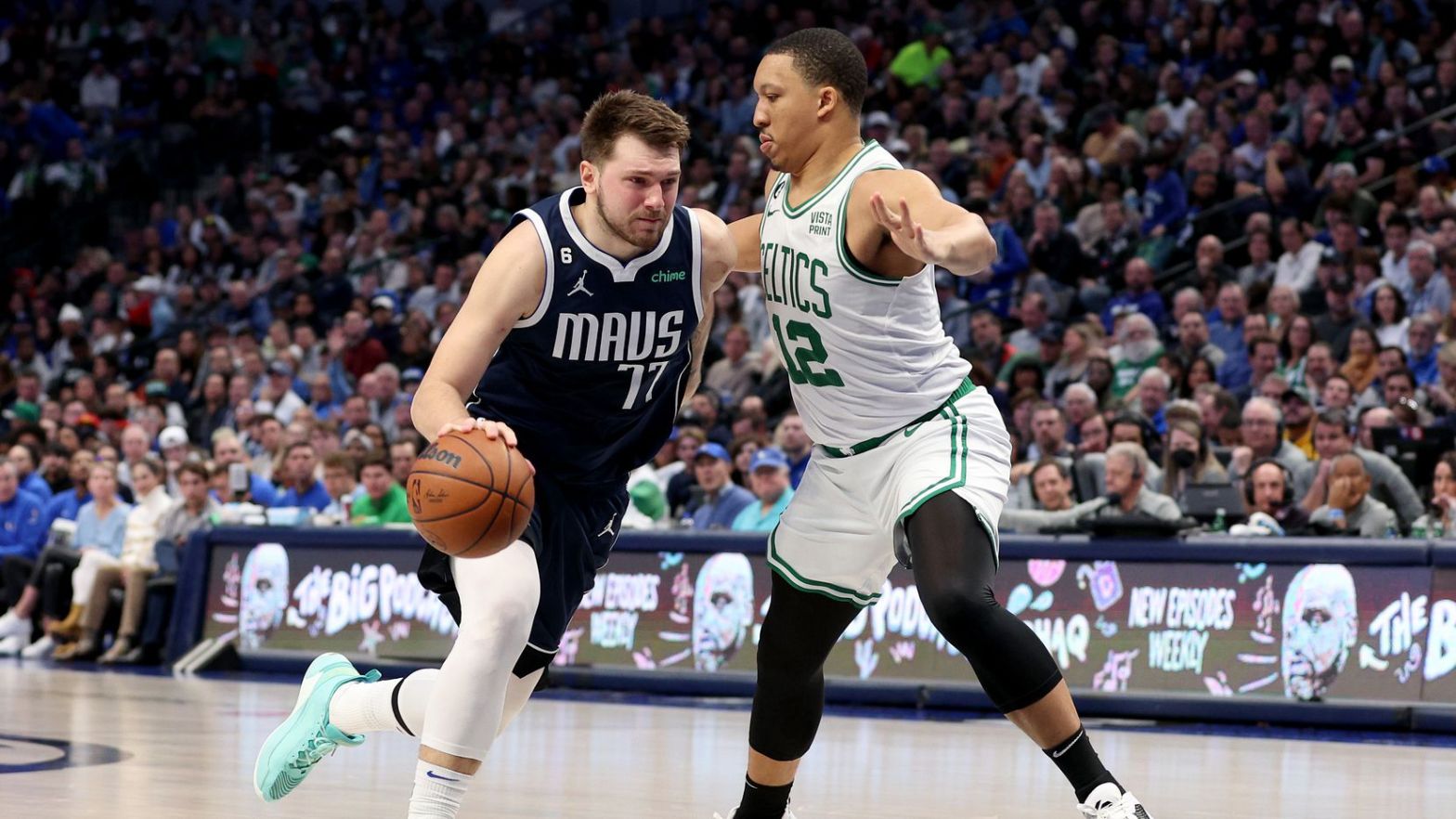
When looking at Dallas’ roster now, it’s easy to see a roster that is young, versatile, exuberant, and athletic. More work is needed to be done, but the multi-dimensionality of individual players on the roster has increased tenfold, emphasized further by Wednesday night’s sign-and-trade to net Grant Williams. Williams’ versatility was perfectly displayed in the postseason, where he guarded Joel Embiid in one series to Jimmy Butler in the next. Reggie Bullock was a crucial piece of the Mavericks’ team that made the Western Conference Finals in 2021-22, but he was stretched way too thin in his role this past season. More than anything, Bullock was significantly less complex of a player; on offense, he was a standstill shooter who was hesitant to attack a hard closeout. On defense, he was good, but far too overmatched to be guarding the opposing team’s alpha. The simple Bullock for Williams swap alone is a huge boon for Dallas’ roster.
The new look Mavs go well beyond Williams, however. Other new Mavericks include Dereck Lively II, the #12 overall pick, Olivier-Maxence Prosper, the #24 overall pick, Seth Curry, Dante Exum, and Richaun Holmes. Outgoing are Bullock, Davis Bertans, and Justin Holiday, with it being more likely than not that JaVale McGee (either via trade or the stretch provision), Christian Wood, and Frank Ntilikina will be joining suit. All the intel seems to indicate Tim Hardaway Jr. would be traded as well. As currently stands, Dallas’ roster is below:
Guards (8): Luka Doncic, Kyrie Irving, Tim Hardaway Jr., Jaden Hardy, Seth Curry, Dante Exum, McKinley Wright IV (TW), Mike Miles Jr. (TW)
Wings (3): Josh Green, Olivier-Maxence Prosper, A.J. Lawson (TW)
Forwards (2): Grant Williams, Maxi Kleber
Bigs (4): Richaun Holmes, Dereck Lively II, Dwight Powell, JaVale McGee
The increased versatility is readily apparent on the wing and at the forward position the most; Josh Green’s game is reminiscent of Bruce Brown and Josh Hart, in the sense that he thrives as a cutter, secondary playmaker, rebounder, and defender while impacting the game without needing a high volume of shot attempts. We’ve yet to see a lot of Olivier-Maxence Prosper, but he can hit standstill threes, guard multiple positions, and outwork opponents on the glass. OMAX, as he’s more commonly referred to, will certainly offer a more intriguing skillset of on-ball creation than Reggie Bullock or Justin Holiday. And lastly, there’s Maxi Kleber, arguably Dallas’ most versatile player prior to the acquisition of Williams. Kleber can switch on the perimeter, guard bigger players inside (Zion Williamson), and function as the small-ball five due to his ability to hit threes. With all due respect to Bullock and Holiday, you’d be hard pressed to find NBA teams that win championships with their wing players operating as a 3-and-D threat in the purest form. As much as I love Dorian Finney-Smith, his skillset was in a similar range; given Dallas’ shallow layers of on-ball creation on the roster, they don’t have the luxury of deploying multiple standstill shooters for 25+ minutes per game. Now, they don’t even have a singular standstill offensive player on the roster, outside of Maxi Kleber, Tim Hardaway Jr., and their centers.
When you’re gifted with a player of Luka Doncic’s caliber, the goal should never be to win one championship as quickly as possible, but rather, to win as many titles as possible. Historically speaking, superstars don’t win championships exceptionally early in their career, in large part because it takes additional time to develop into a top-5 player in the league. There is no “rookie contract” advantage in the NBA like the one that exists for quarterbacks in the NFL. Sure, having a player on a rookie deal in the NBA does unlock a lot of flexibility, but you still need that top-5 guy with MVP credentials to win a championship. With all due respect, you don’t win the NBA Finals with Nick Foles.
With how good Luka Doncic was as early as his second season, it did toughen the job of Dallas’ old front office to properly build a sustainable, long-term contender alongside him. The Mavericks shouldn’t be faulted for trying, however; the Kristaps Porzingis deal was universally heralded at the time and should still be thought of as a good move. Dallas lost a first-round pick in that deal (and one that’s yet to be redeemed), Dennis Smith Jr. (their top-10 pick from the year prior), and another pick in the draft night deal to acquire Doncic. Essentially, the Mavericks’ only young piece around Doncic was Jalen Brunson, and we all know how that has worked out for Dallas.
In the Nico Harrison era, the Mavericks are not exhausting all their team-building avenues for one title as quickly as possible. As evidenced by this offseason, they’ve emphasized constructing a sustainable roster. With the acquisition of Williams final, the Mavericks now have six players under 25 on the roster, all with varying levels of intrigue from generationally great (Doncic), to glue guys on a title team (Green, Williams), to potential Sixth Man of the Year contender (Jaden Hardy), to two potential defensive stalwarts (OMAX, Lively). That is an exciting build for the future, and the rest of the roster isn’t old either. JaVale McGee (35), Seth Curry (32), Dwight Powell (32 on July 20), Kyrie Irving (31), Maxi Kleber (31) and Tim Hardaway Jr. (31) are the only players older than 30 on the roster, and it feels significantly more likely than not that both McGee and Hardaway Jr. will be wearing a different uniform next season. If the Portland Trail Blazers opt not to match the offer sheet the Mavericks presented to Matisse Thybulle, Dallas would add another wing to their roster who’s in his mid 20s. If Dallas successfully offloads Hardaway Jr. and McGee, I’d imagine it’ll likely be for a player in his 20s.
This is now a roster in Dallas that is younger, more versatile, and more athletic that they ended last year with. Expectations exist that not only can a lot of the sub-25-year-olds can contribute immediately, but that they’ll develop long-term around Luka Doncic. And the most crucial part? How controllable all the players and contracts are, which is why building through the draft is so critical. Josh Green is extension eligible and will almost certainly be retained next summer, if not extended sooner. Jaden Hardy isn’t going anywhere. Lively, Prosper, and Williams are all signed for the following four years. Doncic is under contract for another three. This is a group that will certainly grow together and, in an extremely optimistic lens, features six players who complement each other nicely and all possess NBA-starter upside at minimum. That shouldn’t be overlooked, even if the Mavericks’ roster still falls short of being title worthy.
Theoretically, the Dallas Mavericks have two (or three) moves remaining. The first is utilizing their mid-level exception (MLE), which they are planning on offering Trail Blazers’ wing, Matisse Thybulle. Shams Charania of The Athletic has reported the deal is for 3 years, $33 million. Thybulle is an extremely limited offensive player; he’s not a good three-point shooter and in an offense that is still way too stagnant, it’ll be critical for him to knock down shots. While I’d love for the Mavericks to install more motion, off-ball screening, and cutting to their offense while utilizing Doncic at the top of the key in more of a facilitator role to circumvent their limited on-ball creation outside of their two stars, I’m skeptical it happens (more on that topic later this summer). However, Thybulle is an elite defender; he ranked 18th in DLEBRON amongst all players and 2nd amongst perimeter players. Viewing Thybulle solely as an off-ball playmaker isn’t accurate; he’s one of the five best individual perimeter defenders in the NBA. For a team that was abysmal at point-of-attack perimeter defense a year ago, landing Thybulle would be a huge addition. Not to mention, but Thybulle’s ability to generate steals should, in theory, lead to a ton of easy transition opportunities.
If the Trail Blazers do match the Thybulle contract, something I’m a bit worried about, where could Dallas pivot? One name I’d take a strong look at is Ayo Dosunmu; Dosunmu is far from the defender Thybulle is, but he ranked 15th among shooting guards in DLEBRON and 9th amongst players with at least 1,500 minutes played. Dosunmu is only 24 years old, is great at getting to the rim and finishing around the rim and did shoot 42% on corner threes during his rookie season. For the same contract that Dallas offered Thybulle, I’d be willing to take the same gamble for Dosunmu. If not Dosunmu, splitting the MLE (roughly $8-10M) between players like Jaylen Nowell, Hamidou Diallo, or Romeo Langford, although that isn’t the preferred route. Either Thybulle or Dosunmu would be a terrific usage of the MLE in not only acquiring a high impact perimeter defender, but also a player that fits the young core that Nico and team have beautifully built this summer.
The second move would be trading Tim Hardaway Jr. and JaVale McGee, although this may become three moves if they cannot find any takers for McGee. I don’t expect McGee to be on the roster regardless, as Dallas could opt to waive and stretch him in lieu of a trade. I’d imagine the Mavericks are shopping this package, likely along with the two newly acquired second-round picks via the Grant Williams S&T, for a starting center. The dream names include Jarrett Allen and Ivica Zubac, but realistically, I don’t see how that gets done. Jarrett Allen is an All-Star and Dallas’ package is underwhelming, features two contracts that aren’t appealing, and only includes second round draft assets. They’re not getting Allen for that package. Zubac is perhaps more attainable; reports have been that the Clippers are shopping him and if Los Angeles deals for James Harden, they’ll need more standstill shooters, especially if Norman Powell is offloaded. It’s a bit more realistic to see the angle for Zubac, but making the money work in that deal is tough, especially considering the Clippers would be taking on two contracts that hold onto the cap sheet next season.
One name that I haven’t seen connected to Dallas, but makes a lot more logical sense, is Jonas Valanciunas from the New Orleans Pelicans. The Pelicans have been rumored to be shopping Valanciunas along with point guard Kira Lewis Jr.; those two just so happen to nearly perfectly match the salaries of Hardaway Jr. and McGee. Valanciunas wouldn’t solve Dallas’ rim protection issues, but he’s an elite rebounder who can score and play inside. For an expiring contract, Valanciunas serves as an ideal stop gap for Dereck Lively, who I expect to be in a more prominent role come Year 2 rather than Year 1. Kira Lewis is a really interesting piece here as well; he fits the timeline (22 years old), has shown a solid ability to score at the rim and has flashed a bit defensively. The Pelicans were rumored to have interest in Hardaway Jr. when he was a free agent a few seasons ago; they did just draft Jordan Hawkins, who has a similar playstyle to Hardaway, so I question how much interest New Orleans would have. However, McGee theoretically better suits the Pelicans’ desire for a rim-protecting five and combined, him and THJ should have a greater net impact to the roster than Valanciunas and Lewis.
If not Valanciunas, the market does slim out in terms of realistic options. The Mavericks could toss a gaudy offer sheet to restricted free agent center Paul Reed, who is a per minute monster and has flashed a lot of promise. Dallas could then pivot to pursuing a wing with the Hardaway Jr. and McGee package, although Reed doesn’t help fill a need today. It feels like Dallas’ best bet at finding an immediate center upgrade is angling for that Valanciunas deal, even if he’s not the most ideal fit for the roster.
The Mavericks’ roster still shouldn’t be considered good enough to compete for a championship, but in terms of optimism, vision, and sustainability? They are exponentially better off today than they were 30 days ago. Dallas’ pivot this offseason to one that emphasized youth and versatility is already reaping rewards simply from an on paper evaluation. You won’t look at Dallas and see a title contender, but you will see them building towards something. Six players under the age of 24, two top-15 players in tow, and a few more moves still in store should generate excitement and optimism for the future. The incremental building is crucial, as Dallas will still need more top-end talent than the currently possess. Maybe Lively, Prosper, or Hardy exceeds their realistic ceilings and becomes that third option. Maybe Josh Green or Grant Williams breaks out into a 16+ PPG scorer. That may seem unlikely, but it seems like a significantly more likely path to success than Dallas’ previous strategy of striking for gold in the offseason and hurriedly plugging the inevitable holes after they failed. They’re still another 1-2 high-level players away from being in the same echelon as Denver, Milwaukee, and Boston, but they’re a heck of a lot closer than they were in April, and a heck of a lot more interesting and fun. For now, before the games start up again, that’s all you can ask for.
 The Chirp