When the Dallas Mavericks reached the Western Conference Finals last season, it felt like the beginning of what would be a (somewhat) regular occurrence for the Luka Doncic-led team in Texas. Last season’s Mavericks’ roster wasn’t perfect, but it illuminated a few principles that seemed easy to continue building upon. Dallas was most successful with multiple shot creators on the court, rather than relying on Doncic to create all the offense while surrounding him with three shooters and a lob threat. The dynamism Dallas was able to generate with Doncic sharing the court with Jalen Brunson and/or Spencer Dinwiddie led to an offensive system that was a nightmare to guard; defending Doncic 1v1 is a doomed decision, but double teaming him while two guards, who were well above average/borderline elite at creating for themselves as well, were on the court led to constant mismatches and plenty of open 3-PT shots. With a core duo of Brunson and Doncic, alongside a roster perfectly complemented with key rotation pieces such as Dorian Finney-Smith, Reggie Bullock, and Maxi Kleber, it felt like the Mavericks were only a few pieces away from being a title favorite: they needed an interior upgrade, they could’ve used an upgrade over Spencer Dinwiddie to be elevated to the next level, and they needed additional wing depth. It wasn’t a thin shopping list that could be acquired in one offseason, but it was a clear path with simple needs. They accomplished the hard part by getting the top-level talent. They just needed to continue building.
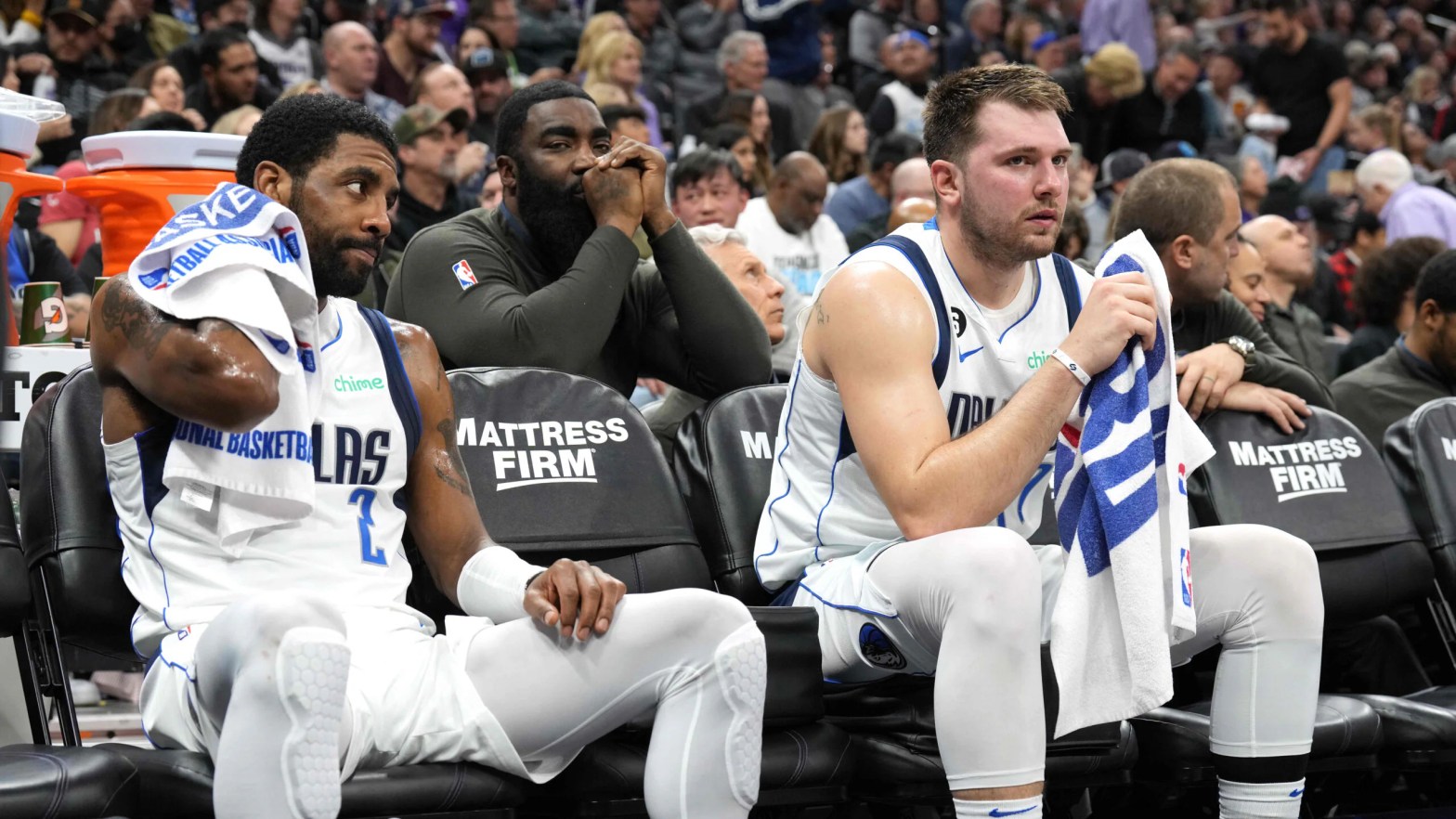
We all know what happened since. Jalen Brunson signed with the New York Knicks, a decision which has developed into a “he said, she said”, divorce-esque like breakup initiated by two power brokers (Mark Cuban and Rick Brunson). The Mavericks falsefully believed that trade acquisition Christian Wood and a healthy Tim Hardaway Jr. could replace Brunson’s production, a notion that conveniently left out Brunson’s off-court impact/locker room presence and playmaking, two areas where Dallas clearly struggled this season. JaVale McGee, who the Mavericks successfully rendered unplayable during their playoff victory over the Phoenix Suns last May, was signed with Dallas’ only viable financial resource to fill their need for a more physical interior presence. It took less than ten games for McGee to be relegated to the bench in favor of Dwight Powell, the player McGee was signed to replace. Finally, the Mavericks took a last-ditch swing which reeked of desperation to try and salvage an MVP-caliber season from Doncic, trading away Spencer Dinwiddie, Dorian Finney-Smith, and an unprotected 2029 first-round pick for Kyrie Irving, who is due to hit unrestricted free agency in ~3 months and is notorious for throwing his teams into a soap opera which always ends with him leaving a wreckage behind. It’s rather ironic to look back on Dallas’ first game of the season, a game in which they lost to the Phoenix Suns by two points because Damion Lee hit a contested, fadeaway jumper with seconds left. The way Dallas lost that game feels so resemblant of the entire season: a lack of interior defense, poor execution in clutch situations, terrible free throw shooting, and subpar roster cohesion and playmaking.
There are plenty more pitfalls to mention of Dallas’ season, but it’s best summarized in one word: humbling. This was an organization that oozed hubris after an inspiring playoff run a year ago. Their attitude after losing Jalen Brunson reeked of arrogance, as they espoused publicly, and clearly viewed him privately, as replaceable, rather than essential. It was a Dallas’ front office which, instead of building upon the formula they found to win with Luka Doncic, decided to revert to a different style of team building, one built eerily similarly to the roster which consistently failed in 2019 and 2020, when Kristaps Porzingis was the co-star to Doncic. The Mavericks clearly felt that, with Luka Doncic, they could withstand any roster loss and remain a title contender. The embarrassing nature of the season, combined with rather reflective commentary from Mark Cuban, Doncic, Jason Kidd, and others in recent days, makes it seem hopeful that perhaps the theme of humility (and accountability) has started to resonate within the organization. Whether their off-season actions back that up, however, is another story.
Once again, the Mavericks enter an off-season faced with significantly more questions than answers. The roster is sure to look substantially different next season, based on comments from Cuban, Kidd, and Doncic. It’s also unfathomable to think that, after how this season went, that the Mavericks would return the crux of this team. Regardless of the lurking cloud surrounding Doncic’s future with the Mavericks, one thing is for certain: a change in direction is needed in Dallas.
A Foundational Shift in Team Building Strategy is Needed
Since the inception of the new CBA in 2012, Mark Cuban’s team building philosophy has centered around one thing: the incessant pursuit of star players. It’s a philosophy and mindset that is necessary to win in the NBA. The problem with Dallas’ thinking? It’s that the Mavericks’ team strategy has seemingly centered around finding an “out of the box” superstar. Superstars win titles in the NBA, but they can be acquired and developed in a manner different than the pursuit Dallas has repeatedly failed in: trying to acquire an established star with a war chest full of accolades via free agency.
Dallas’ incessant pursuit of the established superstar via free agency, combined with the near-sightedness in failing to leverage the NBA Draft in a more effective manner to continuous, patient team building has led to ~10 years of roster shortcomings. It shouldn’t be lost that, Dallas’ most successful players over the past five seasons were both found within the same draft class in Luka Doncic and Jalen Brunson. In large part, it’s because NBA franchises don’t let talented players they’ve developed in house walk out the door. The Mavericks strategic vision of building around established superstars is merely a fantasy rooted in a false belief that superstar players readily change teams in free agency. It’s a rare occurrence and, when it does, it nearly always includes a player angling for a preferred destination such as Los Angeles.
Acquiring stars should be the end goal, but there isn’t only one way to do it. Acquiring Kyrie Irving ironically has finally allowed the Mavericks to accomplish their seemingly never-ending mission of finding an All-NBA caliber player to support their franchise stalwart. But, with Irving hitting unrestricted free agency in ~3 months and a >75% chance at a top-10 pick incoming, Dallas cannot afford to repeat their same failures.
It would be hilariously embarrassing, and painfully ironic, if Dallas’ pick slides out of the top-10 and is conveyed to the New York Knicks. If the odds do work in Dallas’ favor, however, they’ll be armed with an unexpected, yet valuable, roster construction tool. The only downside to having a player of Doncic’s caliber on the roster is the championship clock ticks louder and faster, but the Mavericks have to exercise patience. Trading a top-10 selection for an above average, but not All-Star caliber player would be a ticket guaranteeing mediocrity. However, continuing to build a sustainable young core that currently features Doncic (24), Josh Green (22), and Jaden Hardy (20) should be the long-term play. The mission in Dallas shouldn’t be to win a championship as quickly as possible, it should be to win as many championships as possible. That means a philosophical shift into valuing the draft as a way to best be able to successfully build a sustainable, cohesive unit that has staying power for the next 5-7+ years at the highest level. Cores built through the NBA Draft are the keys to winning over a sustained period of time. The Mavericks need to embrace that preposition rather than pursuing instant gratification with hoping to strike gold once.
Team Needs: More Multi-Dimensional Players
Dallas’ divergence from their successful formula a year ago was extremely frustrating to witness as a fan. Half court shot creation is by far the most valuable skillset in the NBA and Dallas had an abundance of it last season, which in large part helped them negate some of their flaws before facing the Golden State Warriors. The roster last season possessed a dynamic different from every other roster construct we’d seen the Mavericks attempt with Doncic, one which was built around multiple shot creators on the court alongside Doncic at once. For as good as Kristaps Porzingis is, he’s not a player who can generate efficient and effective offense on a consistent basis when given the ball and told “go”. The Mavericks reverted back to the previous, flawed style this season, where they diminished the shot creation help around Doncic to just Spencer Dinwiddie for the first 40-50 games. The acquisition of Kyrie Irving and emergence of Jaden Hardy alleviated some of Doncic’s burden, but it came too late. It was evident how gassed Doncic was after the All-Star break and, as a result, the Mavericks struggled immensely.
Independent of Irving’s future in Dallas, one thing is for certain: the Mavericks need more shot creators. I cautioned this when Dallas made the Irving deal, but that deal did nothing to substantially move the needle forward for the Mavericks this season. Irving essentially replaced Dinwiddie’s shot creation role, albeit at a significantly better level. But he did not solve the recurring issue, that Dallas only has two shot creators in the normal rotation. With Irving back and anticipated rotation minutes from Hardy, that gives Dallas three, albeit Hardy is still rather inexperienced and cannot be expected to carry that type of playmaking burden only as a sophomore. Dallas’ roster breakdown of players who could create for themselves is staggering: look at the stark differences in clusters of players whose shot profiles were broken down by dribbles and unassisted volume:
| Player | % of Shot Attempts (3+ Dribbles) | % of Field Goals Unassisted |
| Luka Doncic | 75.5% | 85% |
| Kyrie Irving | 54.2% | 66% |
| Tim Hardaway Jr. | 21.2% | 20% |
| Maxi Kleber | 0.0% | 8% |
| Dwight Powell | 2.6% | 21% |
| Christian Wood | 15.4% | 29% |
| Reggie Bullock | 1.1% | 5% |
| Josh Green | 22.2% | 23% |
| Jaden Hardy | 44.7% | 40% |
| Justin Holiday | 4.4% | 19% |
The constant debate in recent memory has been around whether Doncic’s heliocentric style of play is out of necessity, or if it limits the Mavericks’ overall ceiling. The numbers above and the eye test agree: in no world would Dallas’ offense become more efficient by taking the ball out of Doncic’s hands in favor of self-creation from Tim Hardaway Jr., Christian Wood, Reggie Bullock, or other key rotation fixtures. In the same boat, it’s unfair to ask those three, as examples, to play in roles that significantly stretch above their offensive skillsets and repertoire. The Mavericks will even witness a decline in efficiency shifting the ball from Doncic to Kyrie Irving or Jaden Hardy. The difference is the decline is significantly less steep and when you have multiple players who are: 1) comfortable creating for themselves and others off the dribble and, 2) can do it with decent volume and above average efficiency, you’re able to unlock a significantly higher ceiling due to the added offensive complexity and dynamism you’re introducing.
The Mavericks need to elevate their roster by focusing on adding multi-dimensional players to the roster, layering in key skillsets such as shot creation, connective passing, cutting, perimeter defense, and defensive versatility. It’s not a slim shopping list and illustrates the flaws in Dallas’ roster. Right now, the Mavericks roster is built to accommodate and accentuate Doncic’s heliocentric tendencies under the false pretense that Doncic heliocentrism is the way to win championships. It didn’t work for LeBron James, it didn’t work for James Harden, and it likely won’t work for Luka Doncic. The Mavericks have too many players whose games (with all due respect), are concentrated in one or two core skills: they have plenty of good standstill shooters, but many of those guys aren’t significant difference makers in other areas like perimeter defense, passing, or shot creation. The Mavericks have a few capable lob threats, but those players struggle in areas such as rebounding, perimeter defense, or as a perimeter spacer.
Throughout the summer, we’ll be diving deeper into specific players I’d target if I was sitting in Nico Harrison’s seat, but for now, the core tenants remain: a heavy focus on multi-dimensional players who can succeed with multiple skillsets, such as a 3-and-D player who can attack a closeout for dribble pullups and layups at the rim, or a rim-protecting big who can switch on the perimeter and roll hard to the rim offensively, or even a role player who can thrive in short roll situations, serve as a willing cutter, and can guard 2-3 positions defensively. Those archetypes are what successful teams are built off of. Dallas needs more dimensional depth within their rotation pieces.
A Culture Built on Accountability
In the final days of the Mavericks season, we heard a lot more honesty from the organization, particularly from Doncic. One thing that stood out to me? His emphasis on chemistry. Dallas’ energy down the stretch was pitiful, particularly against Charlotte. They competed extremely hard after the rock bottom game in North Carolina, but it wasn’t enough. I wouldn’t classify this team as “broken”; the team’s rush of celebration after Maxi Kleber’s buzzer beating three, for example, is a good illustrator of that. With that being said, Dallas’ locker room certainly lost plenty of charm and the culture that tied the team together a year ago. Jalen Brunson’s departure can be pinpointed here as a direct result of the declining chemistry and accountability, but it goes beyond Brunson as well. Boban Marjanovic departed this summer and Spencer Dinwiddie plus Dorian Finney-Smith were dealt for Irving. Aside from Dinwiddie, the Mavericks lost multiple long-tenured Mavericks who carried a lot of weight in the locker room. Jason Kidd has never been a self-serving example of accountability and himself has emphasized a player-driven culture. For as great as Doncic is, all accounts indicate he’s not an extremely vocal leader; he’s 24 and still maturing as well, so that’s not a knock. But, it’s an area the Mavericks have undervalued since Dirk Nowitzki’s retirement and truthfully, since J.J. Barea’s retirement. With Brunson and Finney-Smith both gone, the Mavericks clearly lacked a strong locker room voice.
The lack of accountability we saw from Dallas goes beyond just conjecture and reading between the lines. Doncic is, without a doubt, a top-7 player in the NBA. But, how often do we see his relentless complaining to officials serve as a distraction for his performance over a single, or multiple, possessions? How often do we see Doncic’s behavior permeate to other players on the team, namely instances of Christian Wood complaining about a non-call instead of getting back on defense? Doncic’s lack of defensive effort, where he often relies on a short defensive slide to provide a mild day on an inevitable attack to the rim, is unacceptable at times. Doncic certainly had those moments last season, but they weren’t as glaring.
The best teams in the NBA, and past NBA Champions, have all been built around a culture of accountability, one that starts at the top. Not only does it start at the top, but contending teams have veterans throughout the roster who embrace, and demonstrate, that culture as well. Look at Golden State with Steve Kerr, Steph Curry and Draymond Green, along with Andre Iguodala as a key veteran. What about Milwaukee in the year prior, with Giannis Antetokounmpo, Jrue Holiday, and PJ Tucker as a grizzled veteran whose game embodies the dirty work? You can even go back to the Toronto Raptors a few seasons ago, with Kyle Lowry as a staple alongside trade deadline acquisition Marc Gasol. These teams exude a strong culture and, in those cases, it’s spearheaded by tenured veterans with the team. It’s, in part, why I think the loss of Brunson in particular was so noticeable in this aspect of the Mavericks. His tenure in Dallas, and the respect he garnered amongst his teammates, allowed him to emerge as a leader. It’s a hard reputation to build up.
There is no doubt that roster upgrades are needed in Dallas, but the Mavericks have to be careful to not ignore the “people” part as well, by focusing on high character, culture-building type of players. Goran Dragic, a good friend of Luka Doncic, would be a great place to start. He’s an experienced veteran, he has Doncic’s respect, and could certainly help with mentorship regarding demeanor and leadership. Dallas reserved a roster spot this year for Theo Pinson for him to serve as “first team All Culture”. It’s not the worst idea in the world to have another spot or two reserved for a player who can contribute in the rotation, but can also add a significant impact in the locker room as well.
Outlook
Drastic changes are on the way for the Mavericks this summer. The bottoming out of the club this year leaves Mark Cuban and Nico Harrison with no choice but to reshape the roster in a dramatic fashion. In a way, that is an exciting preposition for Mavs’ fans, who for years have watched this roster, by and large, remain relatively constant for the past few seasons. Personally, I view Dallas’ roster breakdown as fairly obvious: Luka Doncic, Josh Green, and Jaden Hardy are untouchables for me. It may seem weird to classify Green and Hardy, Dallas’ two best trade assets outside of picks, as untouchable, but Dallas needs to build up a younger core to win over a sustainable period of time. Both showed tremendous growth that I don’t find it unrealistic to think Green will eventually become one of the better 3-and-D+ wings in the league and Hardy could blossom into a Jordan Clarkson type of player. Those are reasonable ceilings for each who, if accomplished, would be a huge boost to Dallas’ roster.
Dallas is likely going to be forced to bring back Davis Bertans because of his contract and I’d imagine that’s the case for JaVale McGee also, although his salary is far easier to move. Kyrie Irving is a major wild card for me; there’s no denying his talent and I maintain his fit with Doncic is nearly perfect. That being said, how can you trust putting a significant investment into him, given his history? This was my exact fear when Dallas traded for Irving in February: they are now inevitably tying Doncic’s future and happiness with the franchise to the most volatile player in the NBA, who has left a mess at every NBA team he’s been a part of. The Mavericks have boxed themselves in enough that, if Irving wants to re-sign with Dallas, they basically have to oblige. Personally, I’d be interested in seeing what sign-and-trade possibilities exist; Chris Paul and PHX’s remaining picks as swaps, for example, would be a deal I’d have substantial interest in.
Some of Dallas’ rotational pieces fill a similar viewpoint for me: they’re not untouchable, but some should be prioritized. Maxi Kleber had a rough season, but he also tore his hamstring and missed much of the year. His versatility in allowing Dallas to thrive in five out lineups remains extremely valuable and he’s on a great contract. He should be prioritized, but not labeled as off limits. Players like Tim Hardaway Jr., Christian Wood, Dwight Powell, and Reggie Bullock I feel slightly different on. I’d be fine with any of the four coming back, but they need to be slotted into diminished roles. Hardaway Jr. is a great volume shooter, but he’s an example of a player who Dallas should aim to upgrade on; they need a player with more layers to his game as their 3rd/4th scoring option rather than Hardaway’s game. Wood is nearly a lock to depart if Jason Kidd remains the coach, which it appears he will. I’d bet Dwight Powell returns and truthfully, he does have a role on this team: he’s among the best screeners and rollers in the league, he’s improved dramatically as an outlet for Doncic when trapped, and he players with a lot of energy. The Mavericks can do a lot worse than Powell as a fringe rotation piece and, if they somehow trade McGee, there’s a more logical roster fit. Lastly, Bullock is a really interesting case study. He’s a good 3-PT shooter and is a smart off-ball defender. His contract isn’t exorbitant either. But, similar to Hardaway, Dallas needs to find a more multi-dimensional wing. Bullock is strictly a standstill 3-PT shooter and average/above average wing defender who can’t defend longer wings or effectively switch multiple positions. If Bullock is relegated into the role that Justin Holiday filled, that would be significantly more preferable.
Every season since the Mavericks drafted Luka Doncic, I’ve declared the following off-season as consequential. It’s a small price to pay to have a player with the talent of Doncic on the roster. The Mavericks have a lot of work to do, but it’s not doomsday yet. We know where the flaws exist. Other teams throughout the league can provide a blueprint and tricks of how to improve. It’s up to Dallas’ front office to use this humbling experience to adopt their methodology and properly build a title contender in Dallas; Luka, and the fans, deserve it.
 The Chirp