
There is no such thing as dull anticipation for the start of a new NFL season. I’d argue this upcoming season offers the most intrigue we’ve seen in a while before the dawn of the first kickoff. We have a loaded top of the league, filled to the brim with star quarterbacks, many of whom are just getting their careers started in the AFC. In the NFC, we have plenty of grizzled veterans going after another ring: the ageless wonder Tom Brady, reigning champion Matthew Stafford, and back-to-back MVP Aaron Rodgers will all be in heated competition. The league is still, to an extent, stuck in old ways of thinking and managing a game, as teams revert to “traditionalist” methods such as frequently punting on 4th downs and running the ball at a high clip. Yet, we’ve also seen plenty of glimpses of innovative minds creating the beginnings of a revolution of sorts in terms of how teams approach game management, including win probability models, aggressive play calling, and an increased emphasis on explosive plays.
In a lot of ways, it feels like we’re nearing a new era of NFL football, one that is almost symbolic of the age disparity amongst the top quarterbacks in the league. It’s a fascinating phenomenon to watch unfold and this year feels like we’ll see plenty of teams leaning more into their analytical thinking while some resistance may only grow stronger. There is plenty of anticipation entering the 2022-23 NFL Season.
One thing that’s always fascinated me about the NFL season is how dependent results are on variance, to a greater extent than other leagues due to the shorter nature of an NFL season. With only 17 games, it’s easy for variance to steal, or give, a game to a team, something which could easily determine a playoff berth, job security, or even in the most extreme circumstances, a Super Bowl. Variance makes football the hardest sport to predict and in a results-oriented business, it can have massive ramifications.
While it’s impossible to predict any sport, one thing we can do is glean insights from prior seasons, to be able to pick apart unique metrics to get a better sense of the NFL landscape and what we anticipate will happen this upcoming season. It’s an imperfect science for sure, but a method we’ll adopt today to try and provide some predictability to what has become the most unpredictable sport.
Introduction to Team Profiles
There is no singular metric to examine and use it as a catch-all, foolproof way to draw conclusions around an NFL team. It takes a collection of metrics, but in order to draw the most insightful nuggets, it usually takes uncovering a variety of layers rather than skimming the surface with results-oriented statistics or basic counting statistics which reward volume. In that sense, we’ve adopted a holistic approach of building “team profiles”, which utilizes multiple metrics that analyze causes that contribute to winning to help evaluate teams. Wins, to an extent, are rather irrelevant to us. Results are what teams are ultimately measured on, but in terms of prediction, true performance, and expectations, a lot of the underlying metrics can provide greater insight than a 12-5 record flashing on the standings.
Today, we’ll take a look across five key analyses to help compile some thoughts on what we expect to happen in the 2022-23 NFL Season. Some will be proprietary metrics we’ve calculated at The Chirp; others will come from publicly sourced data from Football Outsiders and other sites to try and attempt to analyze a team’s true level of performance a year ago and therefore, what to expect this upcoming season.
Analysis #1: Overall Adjusted Performance (OAP)
The first analysis is a proprietary Chirp metric, one we deem as Overall Adjusted Performance (OAP). Through OAP, we attempt to measure how good a team truly is, beyond what the naked eye sees on the scoreboard. In a lot of aspects, results can be deceiving; it may seem counterintuitive, but from a simple standpoint, how often do people say, “they gave that game away” or “that was a game they really should not have lost”. Yes, wins and losses are the ultimate determinant, but they rarely tell the full story. OAP dives in deeper and is a composite score across three underlying metrics:
- Percentage of time a team is within one possession (either winning, trailing, or tied)
- Percentage of time a team is leading by two or more possessions
- Percentage of time a team is leading the game for
The reason why this composite scoring across the listed metrics is utilized is to try and adjust for the variable nature of results. The majority of NFL games are decided by one possession; therefore, it’s reasonable to believe if a team is within one possession, either leading, trailing, or tied, they’re “competitively” in the game. A team can fall behind by one possession on a fluke play or an untimely turnover. However, the odds of variance plays occurring that lead to a two-possession deficit or lead are exceedingly rare, which is why we factor in the time a team leads by two or more possessions. Lastly, game time leading is an important stat and, even if it can be swayed by a singular play, it’s a terrific indicator of who should win a game. After all, if a team is leading for 95% of the game, they are extremely likely to win the game.
Below is a depiction of the OAP rankings for last season, with playoff teams highlighted in blue:

Our OAP analysis does indicate some key findings, namely that 10 of the top 14 teams in OAP made the postseason. The four who missed were the Indianapolis Colts (#2), Los Angeles Chargers (#11), Minnesota Vikings (#12), and Seattle Seahawks (#14). On the flip side, the four teams that fell outside of the top 14 in OAP, yet made the postseason were the Cincinnati Bengals (#16), Philadelphia Eagles (#17), Las Vegas Raiders (#21), and Pittsburgh Steelers (#28). An immediate observation made is that it is quite stunning how the Cincinnati Bengals were, by our OAP evaluation, an average team in the regular season, yet represented the AFC in the Super Bowl.
What the specific “playoff exception” teams do prove, however, is the variance of the NFL season. The last day of the regular season nearly always decides, at minimum, a playoff spot. Last season, both the Indianapolis Colts and Los Angeles Chargers were eliminated on the final day, with the Chargers eliminated on the final play. On the flip side, the Raiders and Steelers, the two greatest outliers within our sample, both made the postseason on the final play. Many people believed that both the Colts and Chargers were the best AFC teams fighting for the final spots. Yet, both missed out because the Colts lost to the Jaguars, who were the worst team in the NFL, and the Chargers lost the wildest game of the year to the Las Vegas Raiders.
From the NFC standpoint, the Minnesota Vikings were in nearly every game a year ago; they played a league-high 13 one possession games and there were a few obvious games they should’ve won. They lost Week 2 to Arizona by one point, despite leading by two possessions for nearly 10% of the game, and they lost Week 9 to Baltimore in OT despite leading by two possessions for 27% of the game. If those games swing in Minnesota’s favor, as one would expect, the Vikings would be in the postseason. The Seattle Seahawks were a surprising team to see listed within the top 14, in large part because their play calling is consistently uninspiring, Russell Wilson suffered a broken finger, and their roster wasn’t particularly impressive. Yet, Seattle was 3-5 in one possession games and, in games Geno Smith started plus Wilson’s first three starts after returning (which he reportedly did too soon), the Seahawks were 1-5. In the eleven other games, they were 6-5. Seattle isn’t a candidate for legitimate positive regression due to them blowing up the roster and entering a rebuild, but they likely would’ve been a serious playoff threat had they run it back.
Analysis #2: Win Profiles – Examining Game Time Leading & One Possession Win Reliance
Win profiles are another tool we utilize to determine the quality of a team’s wins. We measure two variables here: game time leading (the percentage of time a team is leading for in a game, on average) and one possession win reliance (the percentage of a team’s total victories that were decided by 8 points or less). Ideally, a team would want to maximize its game time leading and lower its one possession win reliance, which would indicate a team that frequently leads and wins games by a sizeable margin.
Below is our Win Profile Matrix; the bottom right quadrant is desirable, as it depicts teams who have above average game time leading and below average one possession win reliance (which means a fewer percentage of their wins are of the one possession variety). The top left quadrant is the least desirable, as it depicts teams who are below in game time leading and above average in one possession win reliance. These teams, in theory, often win close games but they don’t usually lead for a substantial portion of the game.
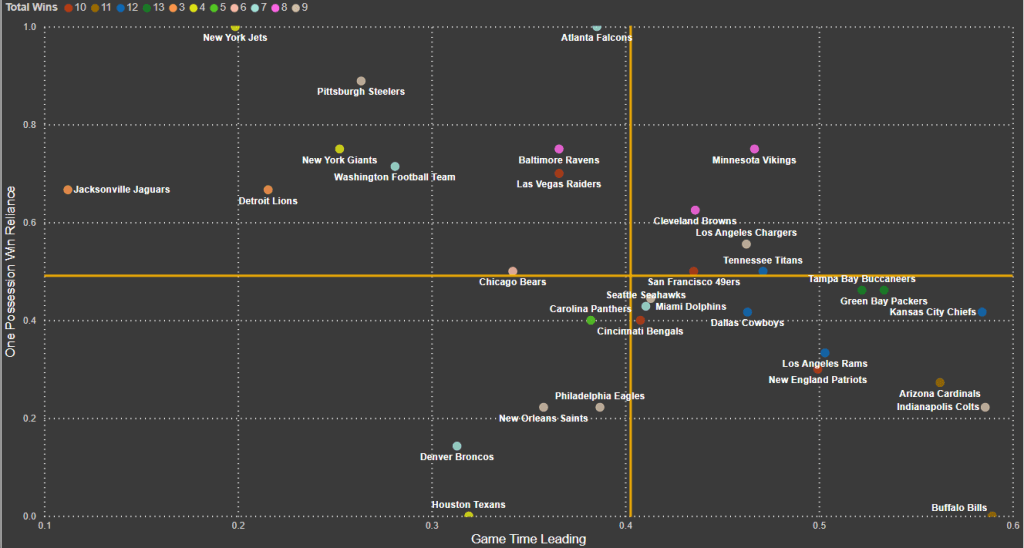
There are a few key takeaways to be had from our Win Profile Matrix. One is how the Indianapolis Colts pop here again; they were 2nd in our OAP metric and are within the most desirable quadrant here. The Colts ranked 2nd in the NFL in game time leading and only two of their nine victories came by eight points or less. Indianapolis was remarkably 2-5 in games decided by one possession, but 7-3 in games decided by two possessions; in other words, when they won, they often won big, but when they lost, they often lost small. Indianapolis and Pittsburgh both finished 9-8, but the quality of those 9-8 records is vastly different as depicted here.
The Pittsburgh Steelers are in the basement quadrant here, as they were overly reliant on one possession victories while ranking below average in game time leading. The raw numbers are particularly staggering: Pittsburgh was 8-1-1 in games decided by eight points or less, compared to 1-6 in games decided by 9 points or more. In other words, when Pittsburgh lost, they lost big, but when they won, they won small, in games that can easily swing the other way off a few bounces. The Las Vegas Raiders, another OAP outlier from above, are also in the basement quadrant, sporting a 10-7 record that I’d argue is incredibly misleading. While Las Vegas’ splits aren’t as stark as Pittsburgh’s; the Raiders were 7-2 in one possession games and 3-5 in two possession games, that split is not ideal. In fact, as we see from the clusters, the Raiders and Steelers’ win profiles bear closer resemblance to the New York Jets, New York Giants, and Washington Commanders than they do to playoff teams like the Dallas Cowboys, Los Angeles Rams, and Tennessee Titans.
A few other quick notes here, particularly in our bottom left quadrant. These are teams who see rather surprising results: they are below average in game time leading and below average in one possession win reliance. By rule, these teams subsequently have the majority of their wins come by 9+ points, which feels a bit counterintuitive considering they don’t lead games at a high clip. Naturally, there are plenty of rich insights to gather here after doing some deep dives. I’ll briefly touch on three teams who should be competing for postseason spots this year: Denver, Philadelphia, and New Orleans:
- The Denver Broncos were 1-5 in one possession games a year ago, but 6-5 in two possession games. It’s a bit paradoxical to see such a record; when Denver won, they often won big, but their game time leading numbers are rather underwhelming, ranking below average. Well, one explanation is that Denver beat up on some really bad teams: four of Denver’s two possession victories came against the worst teams in football; the New York Giants, the New York Jets, the Jacksonville Jaguars, and the Detroit Lions. The Broncos were great at bullying the bad teams (which is what good teams do), but also had a fair share of lopsided results to good teams.
- The Philadelphia Eagles conspicuously have a very similar profile to the Denver Broncos. Philadelphia’s victories were comprised slightly more of one possession victories than Denver’s were, plus they had a higher game time leading score. However, Philadelphia also showed unusual splits and a similar backstory. The Eagles were 2-4 in one possession games but 7-4 in two possession games. Winning seven games by 9+ points is an impressive feat, but consider the level of competition: Atlanta, Detroit, Denver, New Orleans, both New York teams, and Washington. The Eagles were 1-7 against teams above .500 last season with their only win coming over New Orleans. On average, Philadelphia lost games by two possessions to above .500 teams. Like Denver, the Eagles were great at bullying the proverbial bottom teams, but weren’t great against everyone else.
- Lastly, the New Orleans Saints show similar splits, but a vastly different story. The Saints’ win profile is most similar to Philadelphia’s; they each had two wins by one possession and seven by two possessions. However, the difference is that New Orleans did beat up on good teams; four of New Orleans’ two possession wins came over Green Bay, New England, and Tampa Bay (x2). The Saints were more inconsistent than Denver and Philadelphia, as over 50% of their losses were by two possessions or more, but they also showed a higher ceiling than either team in the mix here. Consider also this: the Indianapolis Colts boasted a 7-2 record in two possession games as well and also totaled nine wins for the season but are graded with a significantly higher win profile than either Philadelphia or New Orleans. Why? Because they were 2nd in game time leading, indicating that a lot more of those one possession games arguably should’ve swung in their favor. It’s not a luxury that either the Eagles or Saints can contend to with their record.
Analysis #3: Loss Profiles – Examining Game Time Leading and One Possession Loss Reliance
Our third analysis is quite similar to the one above, except we are focusing on losses, rather than wins. Loss profiles give us the ability to determine the quality of a team’s losses, just like win profiles give us the ability to determine the quality of a team’s wins and whether or not a team, in theory, should’ve performed better record-wise. Here, the point is fairly similar: ideally, teams would want to maximize their game time leading and maximize their one possession loss reliance. In other words, teams want to be leading the game for a higher percentage of the time and, in the event they lose, they want the losses to be close, within one possession where games can “swing” on something as a random as a high variance play (such as a loose fumble).
Below is our Loss Profile Matrix. The top right quadrant is the spot teams want to be: it indicates teams with a high game time leading and a high one possession loss reliance. This is where a higher percentage of teams’ losses (more than league average) are of the one possession variety. Inversely, the bottom left quadrant is undesirable: it depicts teams with low game time leading and low one possession reliance, or teams that often trail for a higher percentage of the game and whose losses are comprised of ones by two or more possessions at a higher than average clip.

Like our Win Profile Matrix, some highlights stand out within our Loss Profile Matrix. One immediate one is the Tampa Bay Buccaneers, who did not lose a single one possession game a year ago. This is quite a lucky feat and considering Tampa Bay’s high game time leading, perhaps it may not seem all that unlikely. It is, however, and it’s a phenomenon that likely will not repeat this upcoming season. If you look purely based on game time leading, a lot of teams around Tampa Bay’s score see roughly 40-80% of their losses come by one possession: that’s more expected within Tampa Bay’s range. This matrix does have some semblance of a linear relationship, where teams that led for a higher percentage of the game, more likely than not, would lose by one possession (when they were to lose a game).
Based on what we know, it shouldn’t be too surprising to see the Pittsburgh Steelers and Las Vegas Raiders once again looped in with some of the bottom-10 teams in the NFL. The quality of their losses were rather poor and their peripherals weren’t impressive enough to compile a positive team profile. The fact that two playoff teams can closely resemble teams that picked in the top 10 provides some insight into how football games, and therefore results, can swing on small, uncontrollable moments.
Two other quick things to point out within our Loss Profile Matrix. First, the Minnesota Vikings are an interesting case; they’re in the ideal quadrant (top right), in large part because they played the most one possession games in the league last season. They were 6-7 in those games, which is right around league average. However, their game time leading mark is exceedingly high, which is why they’re clustered around playoff teams like San Francisco and Green Bay. Minnesota’s win profile didn’t pop off the page, which gives us a general idea that, a year ago, the Vikings were consistently competitive in the heavy majority of their games. That is, they were often within a possession, more often than not with the lead, but didn’t necessarily hold on to win some of those games. As mentioned at the beginning of our piece, swaying one or two of those would’ve made them a playoff team.
The Baltimore Ravens are the toughest team to analyze, as their roster was decimated by injuries last season. In essence, the analysis of Baltimore’s club is more resemblant of a hefty mix of Baltimore’s starters and reserves, something other teams didn’t experience to the lopsided extent that Baltimore did. However, despite all the injuries, the Ravens played 12 one possession games a year ago, second most in the NFL. While Baltimore’s win profile wasn’t good (high one possession reliance, low game time leading), their loss profile is solid for an 8-9 team; they didn’t lead games for a high clip (as to be expected, given their roster), but they were extremely competitive in the majority of their games and losses. Baltimore was 6-6 in one possession games last season. With Lamar Jackson, they actually got fairly lucky to win some of those games, but the luck faced a steep reversion to the mean without him, as the Ravens lost multiple agonizingly close games to end the year. Baltimore is one of the rare teams to have a high component of both their losses and wins be within 8 points.
Analysis #4: Dominance
Finding the cream of the crop in the NFL takes a compilation of all of these identified metrics (and more), but one peak into how we can attempt to simplify dominance comes with our Dominance Matrix, which depicts two possession games. The top left quadrant here is ideal: teams in this quadrant saw a higher than average percentage of their victories come by nine points or more, and a lower than average percentage of their losses come by nine points or more. Inversely, the bottom right quadrant is the least desirable, as these teams saw a disproportionate amount of their losses come by two or more possessions, while seeing a miniscule (relative to the league) amount of their victories come by two or more possessions. One other quadrant to highlight here is the top right, where we identify some volatile clubs. These clubs witnessed both high two possession win and loss reliance, highlighting some inconsistency in terms of competitiveness. In other words, these teams either won big or lost big; more often than not teams in this quadrant were well above average from a record standpoint, but it does indicate some high volatility. Meanwhile, the bottom left shows the consistently competitive clubs who did not often swing outside of the one possession boundary.
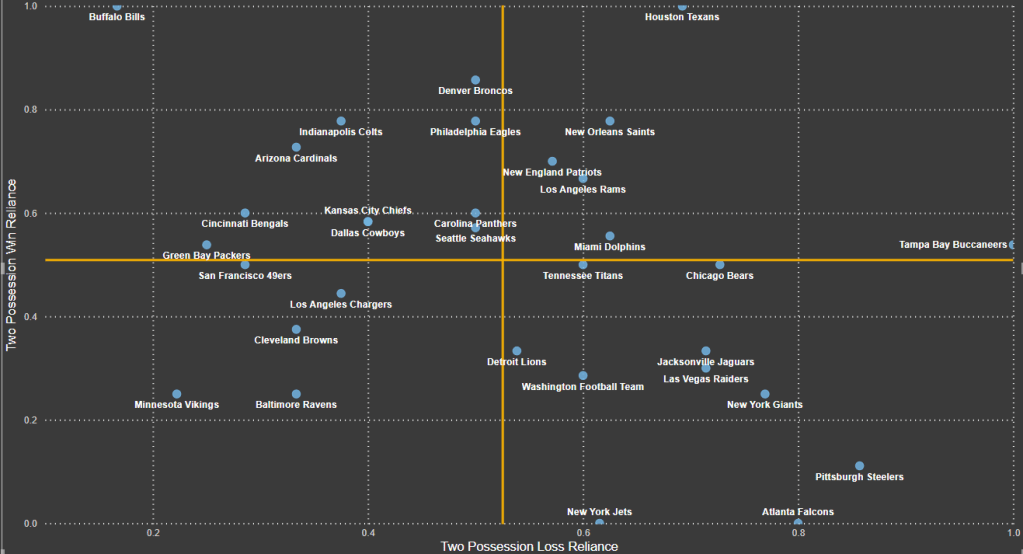
Like clockwork, both the Raiders and Steelers are looped in the undesirable quadrant with bad teams.
For all the talk about Brandon Staley’s aggressiveness actually serving as “recklessness”, the Chargers are depicted as consistently competitive here. So too are the Ravens, who have another ultra-aggressive coach in John Harbaugh. I thought it was a unique point to bring up, as one could argue that Staley and Harbaugh’s ultra-aggressiveness really doesn’t make it less likely that their team can stay within a game. In fact, it could make it more likely.
The Carolina Panthers are an interesting bunch: compared to the league, they won by two possessions or more at a higher clip and lost by two possessions or more at a lower clip. Seeing them in the dominant quadrant is certainly a surprise, but as mentioned, analyzing these metrics in a nutshell can be highly misleading. The Panthers started out the year hot but plummeted down the stretch. They finished 2-12 to end the year. In games Sam Darnold started last year, Carolina was 4-8, but five of those were two possession games, where they went 2-3.
I’m not sure people recognize just how good the Buffalo Bills were last season. One common thread through our metrics so far is that, in our opinion, Buffalo was easily the best team in the NFL. It’s a shame a coin toss (once again, an uncontrollable situation) took away their shot at a Super Bowl run. All of Buffalo’s 11 wins last season came by nine points or more. In true dominant fashion, Buffalo was a remarkable 11-1 in two possession games a year ago. They ranked 1st in OAP and consistently lead the pack in our composite profiles. There’s a reason they are the favorites to win the Super Bowl this season.
Analysis #5: One Possession Performance
This analysis will be briefer than the ones above, in large part because it is the inverse of Analysis #4. Our One Possession Matrix just flips what we see above to depict one possession reliance. There aren’t really any additional insights to touch on here, but it’s just another way to view some of the key topics we’ve touched on.

Team Profiles to Predict the 2022-23 NFL Season
So far, we’ve looked at five individual analyses to help pull back the layers behind the surface-level records we see from all the NFL clubs. The final tool to use is our win model, which we use retroactively to predict, based on some key statistics, what a team’s record should have been. Take a look at our top six over and underachievers:
| Team | Model Projected Wins | Actual Wins Above Projected |
| Green Bay Packers | 10.41 | +2.59 |
| Las Vegas Raiders | 7.88 | +2.12 |
| Tennessee Titans | 10.60 | +1.40 |
| Los Angeles Rams | 10.89 | +1.11 |
| Miami Dolphins | 8.03 | +0.97 |
| Pittsburgh Steelers | 8.11 | +0.89 |
| New England Patriots | 12.15 | -2.15 |
| Seattle Seahawks | 8.89 | -1.89 |
| Indianapolis Colts | 10.67 | -1.67 |
| Detroit Lions | 4.48 | -1.48 |
| New York Giants | 5.29 | -1.29 |
| Carolina Panthers | 5.92 | -0.92 |
One key thing to highlight is that, when taking individually, each analysis provides only a portion of the picture. The important thing is to find the patterns throughout. For example, every analysis we’ve shown has highlighted how the Las Vegas Raiders and Pittsburgh Steelers were extremely lucky to be in the postseason a year ago. In a results-oriented business, it’s hard to convince people that they should care that Vegas and Pittsburgh got lucky and, in reality, were nowhere near as good as their record indicated a year ago. However, in our analyses to try and provide some insight into what we could expect this season, those type of nuggets are gold.
When following the thread of patterns through our analysis, there are a few major takeaways we have that culminate into our overall projections for the upcoming season. Here are some of our thoughts by conference:
AFC
The Buffalo Bills are primed to sit atop the conference this year and in my opinion, are clearly the best team in the NFL. Their dominance was beyond impressive a year ago and they should only get better, as Josh Allen seems to just be hitting the tip of the iceberg regarding his potential. It is substantially harder to win a Super Bowl once a quarterback soaks up a heavy majority of the cap space and this is Buffalo’s last season with Allen only taking up a relatively small hit. The Bills upgraded this off-season as well, signing Von Miller to a massive contract, adding Rodger Saffold to their offensive line, and bringing in a promising crop of rookies. The Bills are rightfully favored to win the Super Bowl.
Trying to decipher how good the Baltimore Ravens will be this year, based off last year’s composite profile, feels impossible. When Lamar Jackson started, the Ravens were 7-4, but even that team was really thin. Baltimore was down its top three running backs, star left tackle, two defensive line starters, and multiple corners for the majority of last season at any given time. It’s a testament to John Harbaugh that this team was so close to making the playoffs. Based off Baltimore’s profile, they were merely an average to slightly below average team last season, but that was almost Baltimore’s “B+” squad rolling out there. Two years ago, the Ravens were #1 in OAP and this year’s roster should resemble the 2020 roster to a much closer degree. I’m all in on the Ravens this season: if you want a darkhorse team to win the Super Bowl, this is it.
The Kansas City Chiefs had a nightmarish start to the season, but they finished up right around where they’ve been ever since Patrick Mahomes became the starter: near the top of the league. Kansas City was 4th in OAP last season, yet it feels like everyone is forgetting about them because of trading Tyreek Hill to Miami. The Chiefs were consistently clustered amongst the top teams within their profile and still have plenty of offensive speed, plus a great offensive line. As teams place more of an emphasis defensively on limiting explosive plays, the Chiefs’ offense will have to adapt, something that could see a new version of Andy Reid’s system emerge this season. I feel extremely confident that, when it’s all said and done, the Chiefs will once again be a serious threat in the AFC this season. Patrick Mahomes is that good, Travis Kelce is that good, the offensive line is that good, plus a revamped secondary combined with an improving defense should make this a different, yet still very talented, Chiefs’ team.
The unluckiest team in the NFL last season was the Indianapolis Colts, who based on their profile, easily should’ve been a playoff team. Indianapolis came closer to resembling Buffalo, Arizona, and Kansas City (teams who made the postseason with 10+ wins) than they did Philadelphia, Cleveland, and Minnesota (teams with 8-9 wins that were borderline postseason teams). Our model had the Colts winning the AFC South last season, which is fairly remarkable since the Titans won the division by three games. Matt Ryan isn’t the player he once was, but he is an upgrade over Carson Wentz. There are some question marks at wide receiver, but the Colts should be anchored by their defense. Even with Matt Eberflus becoming the Bears’ head coach, there is a ton of talent on that side of the ball and Gus Bradley is one of the best coordinators in the game. This should be amongst the weakest divisions in the NFL as well, placing Indianapolis in prime position to have a monster year.
If there’s one team in the AFC West that can topple Kansas City for the division, it’s the Los Angeles Chargers in my opinion. I am all in on Brandon Staley and Justin Herbert; Staley’s analytically driven style is extremely fun to root for and get behind. It also doesn’t hurt that he has one of the best quarterbacks in the game, a player who I think can win MVP this season. Los Angeles’ team profile indicates they likely should’ve been a playoff team last year, something our model also agrees with. This off-season, they took advantage of Herbert’s miniscule cap hit, trading for Khalil Mack and signing J.C. Jackson. Los Angeles’ biggest flaw last season, their run defense, has been fortified as well through a variety of free agent signings. Staley’s approach to game management gives Los Angeles a statistical edge each weekend, but their on-field talent is among the game’s best. They play in the toughest division, but they will be fearsome.
The Cincinnati Bengals were pretty clearly not the second-best team in the NFL last season. Yet, they are coming off a Super Bowl appearance with major aspirations this season. Joe Burrow is one of the best young quarterbacks in the league and his swagger is unmatchable; him and Ja’Marr Chase are one of the best QB/WR duos in the game. Cincinnati will likely experience some regression this season; they were an OAP outlier (barely) and their team profile wasn’t overly impressive. But our model indicated they were a playoff team and outside of OAP, other profile metrics concurred strongly. Cincinnati funneled a lot of resources towards fixing their horrible offensive line and their only notable loss was tight end CJ Uzomah, who they replaced with Hayden Hurst in a move I’d consider lateral, at worst. I don’t think the Bengals are a serious threat to win the Super Bowl, but they’re not a non-playoff team either. They’re a good, competitive team who should make the postseason again in a loaded conference.
We touched on them a bit earlier, but the Denver Broncos are a team poised to make a jump this season. Their team profile was solid; they won by two or more possessions at a higher clip than the league and lost by one possession around league average. Their OAP ranking wasn’t great (22nd), but the acquisition of Russell Wilson should pay major dividends. Denver’s roster is in pretty good shape, and I think you could argue they had one of the worst quarterback situations in the league last season. Nathaniel Hackett will likely be a better game manager than Vic Fangio and, historically, coaches from the Kyle Shanahan tree have been successful. The Broncos’ defense has a ton of talent and while regression should be natural now that Fangio is gone, I don’t anticipate Denver’s defense dipping too much. This is still an above average defense combined with what should be a much-improved offense. The advanced metrics put the Broncos in a positive light as well, making them a prime playoff candidate.
AFC Projected Playoff Picture
- Buffalo Bills
- Baltimore Ravens
- Kansas City Chiefs
- Indianapolis Colts
- Los Angeles Chargers
- Cincinnati Bengals
- Denver Broncos
NFC
The NFC is wide open this season and, in my opinion, I’d argue there are 3-4 AFC teams that are better than the top NFC team. On paper, the Tampa Bay Buccaneers appear to be the best NFC club and they were easily our model’s top team a year ago. Tampa Bay’s team profile was impressive as well, although perhaps not as impressive as one would expect: the Bucs ranked 5th in OAP and while they didn’t dominate as frequently as you’d like from a top team and were in our “volatile” region, the NFC just isn’t strong enough to knock Tampa down a meaningful peg. Tom Brady’s unretirement is sending off some weird vibes around this team, but a few things remain true. The Buccaneers’ defense should remain near the top of the league, they significantly improved their wide receiver depth this past spring (albeit they did lose Rob Gronkowski), and Tom Brady is still Tom Brady, until play proves otherwise. It’s fair to question this team’s ceiling and their offensive line is a question mark, but right now, it feels a bit reckless to bet against Tom Brady having another Brady-esque season.
Aaron Rodgers won back-to-back MVPs, yet the Green Bay Packers didn’t make the Super Bowl in either season. It speaks to how hard it is to get on the biggest stage. Green Bay was the biggest overachiever according to our model last season and while 13 wins probably was a bit high given their overall team profile, the Packers were far from a bad team a year ago. Green Bay was 6th in OAP and 5th in game time leading; they weren’t as dominant as you’d expect from a 13-win team, but they weren’t squeaking by their opponents either. Trading Davante Adams is a huge loss for an offense that has consistently overlooked the wide receiver position, but this is Aaron Rodgers we’re talking about. He’ll make it work, although expecting Green Bay’s passing attack to be less potent is an accurate expectation. Defensively is where I think the Packers will make their money this season; their defense is young and loaded with talent. Jaire Alexander is one of the more underrated corners in the game and Green Bay has a lot in the front seven like Rashan Gary, Kenny Clark, De’Vondre Campbell, and first-round pick Quay Walker. The Packers are due for some regression, but it won’t be severe enough to knock them out of the postseason.
The San Francisco 49ers didn’t post a particularly impressive profile a year ago, but they did exhibit one that was fairly resemblant of their actual performance. This feels like a team ready to take off this year, however. San Francisco got significantly stronger as the year progressed and arguably should’ve beaten the Los Angeles Rams in the NFC Championship Game. Now, San Francisco made the playoffs on the final weekend, and they weren’t a top-10 team last season. But the potential is tantalizing this season. Trey Lance’s mobility gives him a far larger margin for error than Jimmy Garoppolo had. Lance, Deebo Samuel, and George Kittle gives San Francisco a deadly array of offensive playmakers, plus they have a strong offensive line and a blossoming defense. DeMeco Ryans did a terrific job building up the Niners’ defense a year ago and Charvarius Ward should be a huge addition who addresses their biggest defensive weakness. San Francisco is likely still around the 10th best team in the league, but in a weaker NFC, that might be good enough to get them the division.
The NFC East has traditionally been the weakest division in the NFL over recent memory. I don’t anticipate that changing this year, but perhaps the Dallas Cowboys have something to say about it. Dallas was really good last season, ranking 7th in OAP and rating extremely highly in all of our advanced metrics. In fact, the Cowboys graded out similarly to Kansas City in a lot of our profiling. The problem is, this summer, I think Dallas took a sizeable step backwards. Tyron Smith’s injury is an unfortunate loss and one that has historically spelt doom for Dallas’ offense. The offensive line is a question mark, they’re not as deep at wide receiver as they’ve historically been, and they’re a team ridden with penalties. I don’t think Dallas will be bad, but I do think it’s unrealistic to expect a team that performed at expectations a year ago to reach similar heights with a clearly inferior roster. It may seem crazy to think Dallas’ best unit might be their defense, but part of me leans that way currently considering the offensive injuries. Dallas’ defense was great at forcing turnovers a year ago, but they’re not great enough to anchor a contending team.
The Los Angeles Rams are the reigning Super Bowl champions and return the crux of the championship squad: Head Coach Sean McVay, Matthew Stafford, Cooper Kupp, Aaron Donald, and Jalen Ramsey. By our profiles, the Rams weren’t close to being the top team in football a year ago, ranking 8th in OAP and 7th in game time leading while being labeled as a “volatile” team. While the Rams weren’t the top team, they were very good. Our model did have them as the 4th luckiest team and, considering their volatility and the nature of a “post Super Bowl hangover”, I think it’s reasonable to anticipate a slightly disappointing regular season. That should not be mistaken with the Rams being an overrated team, however. Bobby Wagner should be a huge addition for this team, which has struggled at linebacker for a while now. Allen Robinson is also a more than suitable replacement for Odell Beckham Jr., who could also still return to the Rams when healthy. I don’t think the Rams repeat as Super Bowl Champions, but this is still a clear top tier team in the NFC.
One of the unluckiest teams in the NFL last season was the Minnesota Vikings, who I’d argue are primed for a bounce back season. Kevin O’Connell replaces Mike Zimmer as head coach and O’Connell is yet another coach from the McVay/Shanahan tree. If history is any indication, he’s likely to be successful. Our model had Minnesota as a playoff team last season and the OAP metric agreed; their overall profile depicted that of a slightly above average team and in a depressed NFC, that should be good enough to make the postseason. The Vikings were a “consistent competitor” a year ago; they rarely blew teams out and rarely got blown out. The offensive firepower is plentiful on this roster, and they’ve made some key defensive personnel additions with Za’Darius Smith, Harrison Phillips, and Jordan Hicks this off-season. Talent-wise, Minnesota has improved enough that, combined with their anticipated positive regression, should be in the thick of the playoff race.
We spent some time indicating how the Philadelphia Eagles’ dominance profile was highly misleading because of their disproportionately strong performance against bottom-tier NFL teams. While I am still skeptical around Philadelphia, there is no doubt their roster has substantially improved and put them in a significantly better position to compete against the top teams. Howie Roseman has had an extremely strong off-season that has seen the Eagles acquire A.J. Brown, Haason Reddick, James Bradberry, Jordan Davis, and C.J. Gardner-Johnson. I’m a believer in Jalen Hurts because, like Trey Lance and others, his mobility gives him wiggle room on how good of a passer he needs to be. The Eagles have generated Super Bowl buzz and while I think that’s extremely premature for a team that hasn’t beaten a high-quality NFL team playing its starting quarterback in two seasons, the playoffs seem like a highly achievable outlook.
NFC Projected Playoff Picture
- Tampa Bay Buccaneers
- Green Bay Packers
- San Francisco 49ers
- Dallas Cowboys
- Los Angeles Rams
- Minnesota Vikings
- Philadelphia Eagles
Final Predictions + Futures to Bet
Based on our comprehensive analyses that have built our composite team profiles, we’ve been able to draw some predictions we’re fairly confident in for the NFL season. There are some teams that consistently pop within a pattern in our profiles, indicating that last season, they either likely weren’t as good as their record indicated, or were likely better than their record indicated. Viewing these metrics in a nutshell is folly, as no singular measure can adequately predict the true performance of a team. However, when combined, these can be a valuable tool to draw meaningful projections that can be used for betting purposes and/or bragging rights. Here are some longer-term plays we believe in, that culminate in my projected Super Bowl between the Baltimore Ravens and San Francisco 49ers:
Bills/Colts Division Winner Parlay (+145): This is my favorite future to bet this off-season. These teams were #1 and #2 in OAP last year and their full team profiles were the most impressive in the league. New England and Miami are two solid teams in the AFC East, but they’re well behind Buffalo when looking at a holistic picture. Barring a drastic injury, the Bills will win the East. The Colts seem to be in a race with the Titans for the AFC South, but the Titans are a team I’d label with a warning, meaning they could combust this season. They were one of the biggest overachievers in our win model and had a fairly poor overall profile, especially for a team that had the #1 seed in the AFC. But the vibe around the Titans screams as if they’re entering a retooling phase, which makes sense since the current core hasn’t made the Super Bowl and seems unlikely to do so, especially when paying Ryan Tannehill a substantial sum of money. Tennessee drafted Malik Willis this year, they traded A.J. Brown and replaced him with Treylon Burks (younger, cheaper option who could be the next A.J. Brown) and didn’t aggressively upgrade other roster holes. I wouldn’t be surprised if Tennessee floundered to a 7-10 or 8-9 mark this year, making Indianapolis, a team due for positive regression with an improved roster, an extremely strong bet to win the division. This parlay gets you some exposure to a Buffalo division win at plus odds. As a bonus, I also like Buffalo over 11.5 wins and Indianapolis over 9.5 wins individually as well. I think the Bills will have the best record in the NFL this season.
Las Vegas Raiders Under 8.5 Wins: This bet shouldn’t be a surprise to those of you who have followed along with our points. The Raiders were one of the most misleading teams this past season and even the acquisition of Davante Adams will not make me believe the Raiders can replicate last year’s campaign. Our model had the Raiders at 7.88 wins last season and their division got significantly tougher. Yes, Adams is a huge acquisition, and the Raiders deserve credit for navigating extreme adversity last season. But I’ll gladly bet on regression and for a Raiders team, in a loaded conference, to finish below .500 for the season.
Los Angeles Chargers Over 10 Wins: On the flip side, I’m extremely bullish on the Los Angeles Chargers. They’re due for positive regression, have a potential MVP candidate, an aggressive coach, and significantly fortified their defense this off-season. A 10-7 record is extremely feasible and if L.A. won Week 18 last year, they would’ve achieved it with an inferior roster a year ago.
Tennessee Titans Under 9.5 Wins: Not to echo too much of what I said above, but I think this is a solid regression bet that makes sense given some environmental factors that our metrics do not account for. The tides seem to be turning towards a retool/rebuild in Tennessee. Harold Landry’s season ending injury nudged me over the edge to fully take the plunge on this bet.
Baltimore Ravens to Win the Super Bowl: I spent much of this article gushing over the Buffalo Bills to win the Super Bowl, yet I’m betting on the Ravens. One theme I did harp on should ring true here: variance. Variance in football exists and while we can attempt to predict things and utilize our metrics to paint an illustrative picture of what we think should have happened a year ago, there’s a reason why the NFL season results rarely mirror our own predictions of what should have happened. The Bills are better than the Ravens, but Baltimore was dominant two years ago and should closely resemble that group. At +2000 odds, compared to Buffalo’s +600, I’ll certainly take the Ravens. If you do want some Buffalo exposure, you can get them to win the AFC at +350, which is a good bet in my opinion.
New York Giants Under 7.5 Wins: There was nothing overly impressive surrounding the New York Giants’ team profile a year ago, so consider me surprised their win total line is at 7.5. The Giants had a strong draft, but Brian Daboll and Joe Schoen inherited one of the worst rosters in the NFL with a major question mark at quarterback. Daniel Jones is 12-25 for his career and while I’m a Daboll believer, asking Jones to reach 66.7% of his total career win total in a single season feels exceedingly lofty, especially considering the Giants weren’t a great team a year ago. Even with the Giants being one of our model’s biggest underachievers, they were still only predicted at 5.29 wins.
Washington Commanders Under 8.5 Wins: The final bet of our article, I’m once again going back to the well of taking the under in Washington’s win total. This is not a good roster and the recent reports indicated Chase Young has reaggravated an injury. Washington was lucky a season ago to win seven games and their profile resembles that of a bottom-10 team. Finishing below .500 is a bet I’m extremely confident in.
Two Minute Drill for the Road
- We didn’t touch on the Arizona Cardinals much and this was a team that popped in our analysis. Arizona was 3rd in OAP (best in the NFC) and had a terrific overall team profile that one could contest was the best in the conference. Yet, I didn’t predict Arizona to make the postseason. DeAndre Hopkins is suspended for the first six games and the Cardinals were 3-4 without him a year ago. Arizona was terrific pre-bye last year, going 10-2, before finishing 1-4 and going out with a whimper in the postseason. I’m not sure which team is the “true” version of the Arizona Cardinals and ultimately, I think Minnesota is a safer team based on their profile rather than Arizona, who dominated the first portion of the season with a whole roster. I’m not a believer in Kliff Kingsbury and while personal bias may play a role in me neglecting to select Arizona as a postseason team, I think there’s enough objective logic here to back it up.
- I’m not sure a team has a wide range of outcomes than the New Orleans Saints do this season. Their profile was a mess last season: #24 in OAP, our model had them 10th in the NFC, and they were firmly in the “volatile” quadrant. The Saints did that with a backup quarterback for much of the year, but Jameis Winston is the definition of volatile and without Sean Payton, I’m not sure how the Saints will adapt their system. New Orleans has a much deeper offense on paper than in past years, but they lost Terron Armstead in free agency. Their defense is top heavy but saw Marcus Williams and C.J. Gardner-Johnson both leave this off-season. I could see the Saints surprising and going 11-6 with a playoff berth and pushing for the division crown and I also could see them going 6-11 and aiming for a rebuild.
- We’ve made our thoughts on quarterbacks on rookie-scale contracts abundantly clear over the years at The Chirp (last year’s post can be found here), but one interesting nugget comes around win trajectory. Amongst our sample of QBs who received a second contract since the CBA changes in 2011, they saw a massive increase in winning percentage in Year 2 before peaking in Year 3. The 49ers, Bears, Texans, Patriots, Jets, and Jaguars all have quarterbacks entering Year 2; I’m not bullish on Chicago or Houston, but this is a betting edge to examine and a trend to watch. This trend proved true last year as Joe Burrow, Justin Herbert, and Tua Tagovailoa all led teams to an above .500 record.
- Lastly, we saw defenses adopt a two high safety look at a higher clip last season in their attempts to limit explosive offensive plays, which are one of the greatest predictors of whether or not a team will score on a drive. It’ll be interesting to see how offenses adapt this season: do they run the ball more frequently and “take the bait” against a light box? Do they hit with quick passes and rely on creative blocking schemes? Are RPOs utilized at a higher clip to get linebackers to bite and open up the intermediate game? The NFL is a copycat league and also one driven by adjustments. I’m keeping my eye on watching how NFL teams will aim to get their explosive offensive juice back this season.
 The Chirp