

The first wave of the 2022 NBA Off-Season is unofficially complete, as many teams have begun preparing to compete for the championship next season. We’ve seen a few clubs make the necessary upgrades on the peripherals to take, at minimum, a modest step forwards next season, but a lot feels up in the air due to the future of Kevin Durant. Durant, who on his worst day is still a top-5 player in the NBA, has requested a trade out of Brooklyn, a request that, while likely to be fulfilled, has yet to come to fruition. I anticipate this second wave of moves is destined to come after the Durant and Kyrie Irving dominoes fall, dominoes which will send seismic shockwaves throughout the NBA.
In the meantime, with the moratorium period over and moves officially finalized, we can draw some insights on the calm before the Durant/Irving storm. Here are ten thoughts we’ve had over the initial wave:
1. The Brooklyn Nets Are in a Bad Spot, But It Could be Worse
When Kevin Durant officially asked out of Brooklyn, it felt like the brewing storm had finally arrived in New York. A tumultuous season (to say the least) seemed destined to end this way, with a generational talent under contract for four more seasons asking to get traded. It never seemed like the Nets were playing with fire when they formed perhaps the most lethal offensive trio in league history with Durant, James Harden, and Kyrie Irving, but the drama was too much. Harden was dealt in February after asking out and Durant and Irving are next in line.
The spot Brooklyn is in isn’t enviable; they’re breaking up a team that was certain to be a title contender in large part, because of inner forces disrupting chemistry and making the product significantly more challenging than it needed to be. However, it could be worse. For starters, Irving opting in has guaranteed the Nets will get something for him via trade, with all intel pointing towards the Los Angeles Lakers. Secondly, Durant will likely command the most significant trade package in league history, especially after the Utah Jazz netted five picks, plus a few role players, for Rudy Gobert and his $40M AAV contract. The Nets do owe Houston unprotected first round picks in 2024 and 2026, plus unprotected pick swaps in 2023, 2025, and 2027. Ironically, this puts the Nets in an eerily similar position to where they were after the infamous Kevin Garnett/Paul Pierce trade, except the Nets now have the opportunity to recoup some major assets. Brooklyn already recouped some assets by trading James Harden for Ben Simmons, Seth Curry, Philadelphia’s 2023 first round pick (which was traded for Royce O’Neale) and their 2027 first round pick. This will certainly be a hot take but moving both Durant and Irving could end up leaving Brooklyn with a brighter future than having them both in tow and dealing with the endless controversies. The Durant/Irving/Harden strategy has undoubtedly been a failure since the Nets didn’t even make the Conference Finals and sacrificed their drafts to do so, but this is their opportunity to transform that experiment into one of the most promising futures in the league.
Kyrie Irving, even on an expiring contract, is likely to land the Nets something substantial solely because of the pressure on the Los Angeles Lakers. This is the deal which, based on reporting from Chris Haynes, Marc Stein, Adrian Wojnarowski, and Shams Charania, which logically makes the most sense:
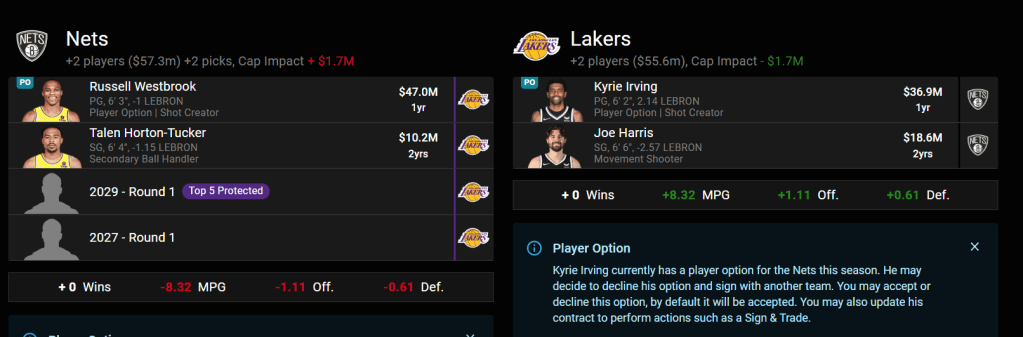
Here, the Nets recoup two future firsts which should be of fairly strong value. Russell Westbrook is solely to make the salaries match, but in theory, he should be a far more effective player when allowed to dominate on-ball, rather than his clunky off-ball fit in Los Angeles. A Westbrook/Ben Simmons duo should be… interesting, but I think Westbrook has some good basketball left and very likely will be a positive for the Nets next season. Talen Horton-Tucker is the annually overrated player solely because he plays for the Lakers, but he’s young (22 in November) and has shown some shot creation chops in his career. Horton-Tucker would be a fairly nice piece for Brooklyn’s core going forwards. I’m not sure any other team would throw their hat into the Kyrie Irving sweepstakes, making this realistically the best package Brooklyn can get. For a guy on an expiring contract who’s destroyed every locker room he’s been a part of, two first round picks and an intriguing young player isn’t a bad return. Moving off Joe Harris’ contract in this deal is a good way to loop in a hefty deal for a player the Lakers could really use.
The real player of intrigue here is Kevin Durant and while lots of packages have been circulating, there is a baseline Brooklyn should look to. The Los Angeles Clippers deal for Paul George a few seasons back is, to date, perhaps the most absurd swap of picks/players and it’s what the Nets need to model their Durant deal after. Ideally, Sean Marks and the front office should use the Paul George framework as a starting point. Let’s take a look at what the Clippers dealt for George:
- Three unprotected first round picks via LAC
- Two first round picks from MIA, via LAC (one unprotected, one protected)
- Two pick swaps
- Danilo Gallinari
- Shai Gilgeous-Alexander
To summarize, the Thunder here got five first-round picks, two pick swaps, a starting-caliber player, and a young building block with All-Star potential. Just a few days ago, the Utah Jazz got four first round picks (really five, since they got 2022 first rounder Walker Kessler as well), a pick swap, and three rotation players for Rudy Gobert.
Canvassing the league, here are a few ideas that may suffice:
Boston Celtics: Jaylen Brown, Marcus Smart, two unprotected first round picks, two pick swaps
Miami Heat: Kyle Lowry, Duncan Robinson, Tyler Herro, Max Strus, three unprotected first round picks, three pick swaps (for Durant and Day’Ron Sharpe)
New Orleans Pelicans: Brandon Ingram, Larry Nance Jr., Kira Lewis, Herb Jones, five first round picks (two from NOP, one from MIL via NOP, two from LAL via NOP)
New York Knicks: Evan Fournier, Derrick Rose, R.J. Barrett, six first round picks (four from NYK, one from NYK via DET, one from NYK via WAS), two second round picks
Philadelphia 76ers: Tobias Harris, Tyrese Maxey, Paul Reed, two unprotected first round picks, two pick swaps
Phoenix Suns: Deandre Ayton (via S&T), Mikal Bridges, Cam Payne, four unprotected first round picks, two pick swaps
Portland Trail Blazers: Anfernee Simons, Josh Hart, Keon Johnson, three unprotected first round picks, three pick swaps
Toronto Raptors: OG Anunoby, Gary Trent Jr., Khem Birch, four first round picks (three unprotected), two pick swaps
Realistically, based off the reporting of teams who’ve connected with Brooklyn about Durant, I think those are the packages Brooklyn can look at. Personally, the New Orleans Pelicans’ package is the most intriguing to me, but if Durant applies pressure to get to a specific spot (namely Phoenix), the Nets may settle for a bit less. Regardless, it’ll be stunning if the Nets get a haul for less than the comparable Paul George deal.
When putting it all together, it’s 100% conceivable that, by trading Irving and Durant, the Nets could end up with 7+ first round picks, multiple rotation-caliber (at worst) players, along with 1-2 young players with All-Star upside, and some second-round picks as well. The Nets could also look to trade some pieces on the peripherals, like Seth Curry, to get even more assets back. I’m not sure their future is really as bleak as people are acting. Many teams who have had to move on from superstars (New Orleans with Anthony Davis and Jrue Holiday, Houston with James Harden, Oklahoma City with Paul George) all have extremely bright futures. The Nets should be no different.
2. What is Going on in Minnesota?
The greatest thing of the first few days of NBA free agency was Brian Windhorst going on First Take, telling the equivalent to a murder mystery of “what is going on in Utah”, only for the Jazz to swing a blockbuster involving Rudy Gobert a few hours later. The legacy trade for Windhorst has been the biggest move of the off-season so far, in Minnesota acquiring 3x DPOY Rudy Gobert from the Utah Jazz for what is the equivalent of five first round picks and three rotation players. It was the definition of a blockbuster deal and one, from Minnesota’s standpoint, that I can’t seem to figure out.
On the one hand, there’s no denying Gobert’s defensive excellence. The Timberwolves were surprisingly adept defensively last season (13th in defensive rating) and that should only improve with Gobert at the rim. Minnesota struggled to defend the rim and rebound last season, areas where Gobert will be a massive upgrade as the best rim protector and rebounder in the NBA. Simply put, Gobert will raise Minnesota’s regular season ceiling by a substantial degree, one where they’re likely out of the play-in tournament. But, in my opinion, this move leaves them far away from title contention.
When a team trades away nearly a decade’s worth of draft control, it’s the definition of a win-now, “all chips in the center” move. Yet, with all due respect to Rudy Gobert, this move doesn’t make the Wolves even close to a legitimate contender in my opinion. Gobert has been exposed the past two postseasons in particular and while people rightfully point out Utah’s poor perimeter defense as a culprit, it also speaks to Gobert’s individual flaws and the direction the league is trending. Gobert’s salary ($40M+ AAV) makes it exceedingly difficult to properly field the necessary shot creation around him, especially considering Gobert’s non-existent “do it yourself” kit offensively. Gobert is historically great defensively, but his lack of offensive ability, namely his inability to punish smalls down low, allows teams to get away by playing small, which subsequently poses a challenge for Gobert on the defensive end to worry about a corner shooter/perimeter player.
There are lots of things I disagree with regarding Minnesota’s move here, but their willingness to guy all-in on a Towns/Gobert frontcourt is certainly the most confusing aspect. In theory, perhaps it works well offensively, and Gobert is good enough defensively to cover up for the likely issues that will occur with Towns guarding perimeter players at a higher clip. But Minnesota is now investing over $400M in two centers, during an era where the league is moving away from big men into a “functional size” era; essentially, finding players who have a versatile toolkit of skills within the 6’4 – 6’10 (or above) range. It feels almost too obvious that, as soon as Minnesota plays a team that spaces them five out, their defense will struggle and Towns/Gobert will be unable to make the smaller opponent pay, simply because they aren’t dominant enough. Posting up Towns on smaller players will cause a spacing nightmare with Gobert on the court and as the roster currently sits, there isn’t enough shooting to combat that. I personally would’ve aimed to build this roster around Anthony Edwards and would’ve even considered trading Towns, but instead, the Wolves went a full 180 in the other direction. It’s an interesting experiment, but one that I don’t anticipate paying dividends when it matters most.
3. Don’t Sleep on the Philadelphia 76ers
One of the clear winners of the opening wave of free agency has to be the Philadelphia 76ers, who have quickly replenished the roster around James Harden and Joel Embiid into a group that resembles a clear title contender. A difficulty of making an in-season trade for a player of Harden’s magnitude is it exacerbates the challenge of quickly fielding a roster capable of championship contention, in large part due to the A) unexpected nature of acquiring a superstar, and B) because key depth is likely part of the return package. Harden’s age necessitates urgency, but it was always a bit unfair to imagine the 76ers being champions last season. Now, it’s title-or-bust for Philadelphia and that’ll likely be the mindset for the foreseeable future.
The 76ers are all-in and so far, Daryl Morey’s moves reflect that. My long-standing prediction that Philadelphia will never win a title with Embiid and Simmons on the same roster has proven correct, but it’s been impressive how much Morey has reshaped this group, especially just a few years after the disastrous Al Horford/Josh Richardson pairing. P.J. Tucker is a perfect fit in Philadelphia; his toughness will quickly make him a fan favorite and Joel Embiid personally vouched for him right after Philly’s series loss to Miami. Tucker’s defensive stoutness on the perimeter will be essential for the 76ers, as will his rebounding and corner 3-PT shooting. Tucker has shown little decline the past few seasons and if his defense holds up, he’ll be an extremely impactful signing.
While the Tucker signing was perfect, the acquisition of De’Anthony Melton may be the most underrated move of the summer. Melton is an ideal 3-and-D guard complement who should thrive off-ball alongside both Tyrese Maxey and Harden. Melton is a career 36.1% 3-PT shooter, right around league average, but he’s a phenomenal defender who’s an underrated secondary playmaker. A backcourt trio of Maxey, Harden, and Melton gives Philadelphia a tremendous rotation for the postseason. They desperately need some more depth behind those three; someone like a Rajon Rondo or Avery Bradley could make sense, but for the playoffs, they’re largely set.
A lot has been made about James Harden’s supposed decline and while he’s certainly lost a step, he’s still one of the premier half-court shot creators in the NBA. Between Harden and Embiid, Philadelphia possesses two of the best in the half-court, a necessity to win in the postseason. The Harden/Embiid duo was the best P&R combination in the league after the trade and their offensive firepower is further augmented by blossoming star Tyrese Maxey and the perennially underrated Tobias Harris, who’s one of the best 4th options in the NBA. Philadelphia’s projected starting five of Tyrese Maxey, James Harden, Tobias Harris, P.J. Tucker, and Joel Embiid may very well be the best in the NBA. Factor in a bench unit that features De’Anthony Melton, Georges Niang, and Danuel House Jr., and you’re looking at a very, very scary playoff rotation.
The 76ers still have more moves to make and Daryl Morey isn’t one who sits by idly. Matisse Thybulle has been one of the most discussed players in trade circles and I’d be surprised if he wasn’t dealt. Philadelphia should be considering a roster consolidation trade, where they ship out a few end-of-bench guys, plus a future draft asset, for a rotation-caliber player. Both the Dallas Mavericks (Christian Wood) and Boston Celtics (Malcolm Brogdon) have made near identical moves, swapping out end-of-bench contracts and a late first-round pick for a player who, at minimum, will contribute 24+ minutes per game. Eric Gordon of the Houston Rockets is one possibility for Philadelphia, and I’d also throw players like Bojan Bogdanovic, Jordan Clarkson, Kelly Oubre Jr., and Jakob Poeltl as other options. Bogdanovic is probably the dream scenario; the 76ers can basically throw Matisse Thybulle, Furkan Korkmaz, Georges Niang, and Isaiah Joe at Utah for Bogdanovic, a move that would thin Philadelphia’s depth, but provide them with a phenomenal wing addition. The 76ers also need some frontcourt insurance behind Joel Embiid, but that should be easier to address via free agency, whether it’s someone like Tristan Thompson, Thomas Bryant, or even someone like LaMarcus Aldridge. If Montrezl Harrell’s legal situation clears, he’d be a potential under-the-radar option.
Overall, throwing a future on the 76ers to win the NBA Finals is a bet I’m extremely inclined to take. They have all the necessary pieces to win on the roster and I still believe they’re set up well for one additional trade to put them over the top. Getting them at +1400 odds, or 8th best in the NBA, is incredible value.
4. The Eastern Conference Is Legit
The Western Conference has long ruled the NBA, but the tide may be changing in the league. While both conferences possess their fair share of legitimate title contenders, the depth of the Eastern Conference is something we haven’t seen in years.
The top tier of the Eastern Conference is, at least to me, fairly well set. The Boston Celtics were arguably the best team in basketball from January on before falling to the greatness of the Golden State Warriors in the NBA Finals. There should be little regression from them this upcoming season, as they’re running back their core while adding in both Malcolm Brogdon and Danilo Gallinari. The Milwaukee Bucks are right there with Boston; their entire core is back as well, along with Joe Ingles. Lastly, the aforementioned Philadelphia 76ers need to be in that realm as well.
But the second tier of the East really shows off the riches with exceptional depth. Last season’s #1 seed Miami Heat have taken a step back, as the only roster change they’ve experienced is losing PJ Tucker. But, this is Pat Riley after all, and it’s silly to think Riley will sit and do nothing while Jimmy Butler is in his prime and aging. The Heat have been mentioned as a Kevin Durant destination, although that seems unlikely due to the CBA nuance that prevents the Brooklyn Nets from acquiring Bam Adebayo as long as Ben Simmons is on the roster. But, Miami has other trade options, namely Donovan Mitchell and John Collins. The Toronto Raptors run their core roster back as well, plus they’ve added another wing in Otto Porter Jr. to bolster a strong rotation. Toronto needs more guard depth, but they’ve prioritized an abundance of wings, length, and versatility, primarily amongst their big men being able to handle the ball. The Raptors, with Nick Nurse and a budding roster, will be an underrated threat.
Yet, the East gets even deeper, even if the five teams listed were all the top-5 seeds from a year ago. The Chicago Bulls, if they stay healthy, should be right in the mix as well. I’d argue the Bulls are even a darkhorse Conference Finals contender; they have a ton of shot creation, two terrific perimeter defenders in Lonzo Ball and Alex Caruso, and an improved bench. The Atlanta Hawks added Dejounte Murray to form one of the best backcourts in the NBA, plus they’ve significantly fortified their perimeter defense to form a more cohesive roster around Trae Young. And don’t sleep on the Cleveland Cavaliers, who have a promising young core that should be fully healthy this season, namely one that’ll include an 82-slate of games from Collin Sexton (assuming he’s brought back), Ricky Rubio, and draftee Ochai Agbaji. The Brooklyn Nets seem to be blowing it up, but if Durant and Irving can be convinced to return, they’d arguably be the favorite to win the East. The Washington Wizards should be a threat to push for a play-in spot with some of their off-season moves as well.
From top to bottom, I think it’s beyond reasonable to say the Eastern Conference is stronger than the West. No longer will a below .500 record be enough to make the postseason. It should be a really competitive regular season and a postseason that has the potential to be amongst the best we’ve ever seen.
5. What is the Portland Trail Blazers Long-Term Strategy?
The Portland Trail Blazers have been one of the more confusing teams for me to decipher this summer, primarily because of what appears to be an inconsistent strategy. By keeping Damian Lillard, Portland is unquestionably signaling that they aim to compete at the highest level, yet their roster moves indicate otherwise.
Bringing back Anfernee Simons was a no brainer, as he’s extremely talented and, outside of Lillard, is Portland’s best asset. Acquiring Jerami Grant from Detroit had a lower cost than anticipated, but Grant is likely the 4th or 5th best player on a true title contender. In Portland, he’ll likely be asked to serve as the #2 or #3 option, something he can capably do, but at what rate? Grant’s emergence in Detroit has been impressive, but it’s also likely made him a touch overrated. Grant’s efficiency plummeted the past two seasons, in large part because he was forced to create for himself at a significantly higher clip. Grant proved he could do it, but he didn’t do it all that well, furthering my belief that Grant isn’t the secondary shot creator Portland needs. Simons has shown enough promise to be that guy, but if C.J. McCollum never won a title alongside Lillard (or even won a Conference Finals game), do we really believe Simons will do so in the next 2-3 years, which’ll likely be the end of Lillard’s peak years? I think Portland has some solid pieces on the roster, but the group they’ve assembled is far from a contender, which is the goal they’ve committed themselves to so long as Damian Lillard is still on the roster.
The construction we’ve seen from the Blazers ultimately has me questioning what their strategy truly is. The McCollum/Lillard pairing had clearly run its course and dumping Norman Powell and Robert Covington last year allowed Portland to slide under the luxury tax. But those moves are also the antithesis of competitive roster building, especially when it feels like the Blazers swapped that core for a new one that eerily resembles some of the similar flaws; an undersized, defensively challenged backcourt, lack of wing shot creation (unless Shaedon Sharpe is a plug and play 15+ PPG guy, which is asking a whole lot), and limited frontcourt versatility. Portland has hovered around the 7-10 seeds ever since their Conference Finals appearance and based on their current roster, I don’t think that’ll change this year.
It’s easy for me, without any responsibility to the fans or ownership, to sit here and say the Blazers should trade Damian Lillard, but I likely would’ve advocated for that this summer. Instead, it feels like Portland is trying to straddle two lines: a youth movement along with competitiveness in Lillard’s window, two tracks which both lack the necessary, top-end talent to succeed. Anfernee Simons and Shaedon Sharpe are nice young pieces, but they alone cannot usher in a new era of Portland basketball single-handedly. Portland needs more if they’re aiming to build for the future, but they also need significantly more if they’re aiming to compete currently. It’s an odd direction the Blazers are moving in and one where I’m struggling to see their bigger picture at the end of this.
6. The Family Business in New York
The New York Knicks finally got their point guard, agreeing to terms with Jalen Brunson on a 4-year, $104 million deal. I’m on the record expressing how big of a Brunson fan I am (here were my thoughts on Brunson’s departure from Dallas) and he should quickly become a favorite for the Knicks fans.
It’s officially a family business in New York with the coming together of both Brunsons and Roses, yet the lengths to which New York went to get their guy was quite extensive. It is worthy to note the Knicks acquired three first round picks in a flurry of draft day trades that helped to clear cap space for Brunson, but the overall price to generate the money needed to sign him was extremely steep. The Knicks traded six second round picks, two first round picks (their #11 pick and the rights to Jalen Duren at #13), two rotation fixtures in Alec Burks and Nerlens Noel (and an additional $6M in cash), plus a salary dump of Kemba Walker to free up the cap space for Brunson. Frankly, it’s a remarkable maneuver to sign a player who likely will never be an All Star and who’s career PPG average is at 11.9. Obviously, that is a bit of a straw man knockdown of just how good of a player Brunson is, but is he a franchise-altering piece? Likely not, making the extent to which New York went to acquire him a bit puzzling.
Obviously, the family connections here likely helped push along the Brunson to New York train, but I have to wonder how impactful the addition of Brunson will be on the basketball court. New York has an interesting amalgamation of left-handed players who, at their best, are freight trains headed to the basket. That includes Brunson, but also R.J. Barrett and Julius Randle. It’s three players who have some redundancy in style; Brunson will likely need to adapt into more of a catch-and-shoot player with the Knicks, something he excelled at in Dallas. However, he’ll have to do it without the benefit of having arguably the best floor general in the game, Luka Doncic. The fit in New York likely won’t enable the playoff-version of Brunson we saw, where he was able to work on perimeter players with ample space and a variety of crafty isolation moves. It’s tough to envision a Knicks’ offense that’ll feature Julius Randle, R.J. Barrett, Mitchell Robinson and Tom Thibodeau’s principles as providing a similar environment that would allow the Knicks to maximize Brunson’s skillset.
Ultimately, the acquisition of Jalen Brunson does make the Knicks better, but if their expectations are for Brunson to perform in a similar fashion as he did in the 2022 postseason, their hopes will likely fall short. Brunson is more than capable of being an 18+ PPG player on a nightly basis, but with that current Knicks roster and perceived lack of spacing? Even for a player as crafty around the rim as Brunson is, he likely will experience some dips in efficiency and overall effectiveness, in large part due to the weaknesses on New York’s roster. I’d anticipate the Knicks would like to fully remake what is a mediocre group overall, which would allow Brunson to blossom into the player he’s capable of becoming. But, that’ll require a substantial transformation; the Knicks have the assets to do so, but until we start to see the wheels in motion, the Brunson signing in a nutshell feels like one that won’t move the needle a ton for the Knicks.
7. Keep an Eye Out for the Denver Nuggets
It feels a bit contradictory to say “keep an eye out” for a team that boasts a back-to-back MVP winner, but in the case of the Denver Nuggets, that feels like the appropriate terminology. The Nuggets were Conference Finals’ participants back in the 2020 Bubble, but since then, they’ve been knocked down by the injury bug. Jamal Murray and Michael Porter Jr. have each missed substantial time over the past two seasons, but both are seemingly going to be 100% entering next season, making the Denver Nuggets a legitimate threat again to make some noise out West.
After the Golden State Warriors and Los Angeles Clippers, the Western Conference feels fairly wide open. Those two aforementioned teams aren’t invincible at the top either, meaning that a team like Denver easily should have, at minimum, Conference Finals aspirations. Even with a healthy Murray and Porter Jr., Denver’s roster likely wasn’t good enough this past season to seriously push some of the elite teams in the Western Conference. However, with some of their off-season moves, it feels like the stars are beginning to coalesce into one of the best rosters that Denver’s front office has been able to build around their franchise cornerstone Nikola Jokic. Denver’s ceiling will depend on the health of Murray and Porter Jr., two players who, when healthy, are both extremely capable half-court shot creators. But, assuming their health, this is a team I’d keep a keen eye out for.
A few years back, prior to max signings for Murray and Porter Jr. which tightened Denver’s purse strings a bit, Tim Connelly (now Head of Basketball Operations with Minnesota) had a deep and talented roster. Go back to the 2019-20 season and their roster was quite impressive: Jamal Murray, Gary Harris, Will Barton, Paul Millsap, Nikola Jokic, Jerami Grant, Malik Beasley, Mason Plumlee, Michael Porter Jr., Torrey Craig, Jarred Vanderbilt, Monte Morris, and PJ Dozier are the ones who stand out. Obviously, some of those players a few years ago had yet to blossom into their current-day selves (namely, Jerami Grant, Michael Porter Jr., and Jarred Vanderbilt, but even Nikola Jokic to an extent), but that roster was filled to the brim with young depth combined with a well-balanced starting five. When Denver made a trade deadline deal that, in some instances amounted to a resignation that they wouldn’t be able to afford Malik Beasley, they lost both Beasley and Vanderbilt in the trade, moves that begun to loosen Denver’s best asset, their young depth. Gary Harris was eventually traded in the Aaron Gordon deal (a win for the Nuggets), while Jerami Grant, Mason Plumlee, and Torrey Craig both departed in free agency. Meanwhile, these key rotation players were replaced with the likes of Facundo Campazzo, JaMychal Green, Isaiah Hartenstein, JaVale McGee, Austin Rivers, and Bryn Forbes. That’s a major downgrade in talent and, combined with the injuries to their front-of-the-line guys, it’s quite impressive that Denver has been able to hang tough in the West. It really, more than anything, highlights Nikola Jokic’s greatness.
This summer, however, it feels like new front office executive Calvin Booth and the Nuggets have really gotten back to bolstering the comprehensive roster around Jokic, rather than consolidating assets for cheaper replacements on important bench slots. Denver swapped Monte Morris and Will Barton for Ish Smith and Kentavious Caldwell-Pope, a deal that makes Denver worse on paper, but likely helps them a bit overall. KCP is an ideal fit alongside Jokic and should be a comparable player to what Gary Harris was, albeit a much better 3-PT shooter. He also provides more stability in the starting five over Will Barton, who has only played 60+ games once since the 2018-19 season (meanwhile, KCP has eclipsed that mark every season for his career). Smith is a capable point guard who is a downgrade from Morris, but the move will free up promising sophomore Bones Hyland to have a breakout year. Hyland’s bench scoring and ample shot creation ability makes him one of the more intriguing players for next season, in my opinion. Denver also added Christian Braun via the draft, who’s a league-ready rookie and should immediately contribute due to his cutting ability.
The darkhorse move Denver made was signing Bruce Brown Jr., a deal that is one of the best values of free agency. Brown made himself an invaluable member of the Brooklyn Nets due to his versatility; for all the well-deserved recognition Gary Payton III got for his performance with the Golden State Warriors, Brown is a batter version of GP3 (in my opinion) and was had for a fraction of the price. Brown is a tremendous perimeter defender who thrives offensively in short rolls and cuts, two skills that should play beautifully with Jokic. Brown’s overall versatility will allow Mike Malone to get increasingly creative in his lineup optionality; he could feasibly run Brown as a small ball big alongside Aaron Gordon, could pair him in lineups with Jamal Murray and Bones Hyland, or run him as a fill-in starter in case of an injury.
The Nuggets still have more work to do, although their financial situation likely limits what they can feasibly accomplish. Denver is still a far way off from the impressive depth they rostered two seasons ago, but they slowly pushed in a positive direction this summer with the aforementioned moves. Denver’s likely 8-9-man postseason rotation will be quite imposing: Jamal Murray, Kentavious Caldwell-Pope, Bones Hyland, Bruce Brown Jr., Michael Porter Jr., Aaron Gordon, Jeff Green, and Nikola Jokic is pretty good, even if the tail-end depth falls off a bit. The Nuggets have put themselves in position to be in position, a move in which Calvin Booth and company deserve a lot of credit for.
8. Which Western Conference Teams Will Get Squeezed from the Playoffs?
The Western Conference isn’t the same beast as it once was, but the conference is still quite fierce and features 11 teams who hold aspirations likely well-beyond simply making the playoffs. Three of these teams will certainly get squeezed out and if a surprise upstart team jumps their timeline (perhaps the Sacramento Kings), it could knock out another club.
To start, there seems to be five teams that feel safe to pencil in: Golden State, Los Angeles (Clippers), Denver, Phoenix, and Memphis. Even if the Suns lose Deandre Ayton and don’t get Kevin Durant, this was a 65-win club who performed well without Ayton. They’ll certainly get something of value in return for him as well, considering his restricted status. It feels like a lot of people are sleeping on the Suns due to their embarrassing Game 7 loss to the Mavericks, but this was a team that was the best in the NBA for the heavy majority of the season. They aren’t going anywhere. As for Memphis, even without Jaren Jackson Jr. for the beginning of the season, they’ll likely be fine. Ja Morant playing at an All-NBA level, along with their style of play made for the regular season, puts them in a position to once again get homecourt advantage.
The next tier is where things get really interesting. I think the Minnesota Timberwolves are another team we could almost pencil in and if the Los Angeles Lakers trade for Kyrie Irving, that’s seven teams that feel like near locks to make the postseason. Who amongst the New Orleans Pelicans, Dallas Mavericks, Portland Trail Blazers, and Utah Jazz (assuming they keep Donovan Mitchell) would be the last team in? I think it’d come down to New Orleans or Dallas; the Pelicans have the better roster on paper, but have you seen Luka Doncic? Dallas’ roster this season is arguably better than it was two years ago when they finished 5th in the West and lost to the Clippers in seven games. Even with the loss of Jalen Brunson, I have a very hard time leaving the Mavericks out of the playoffs altogether. But, the same is true for New Orleans: a healthy Zion Williamson totally transforms the Pelicans’ outlook, plus they have C.J. McCollum and Brandon Ingram in tow too, along with an array of rising sophomores who performed exceptionally well last season. The fact that one of those teams will likely miss the postseason (assuming the Lakers get Kyrie Irving) is astounding.
If I’m a general manager of a young team filled with assets, I’m keeping my eye on this Western Conference race all year. Some talented teams are destined to miss the postseason, which could force drastic personnel changes. It feels like this second tier of the West could be ripe for picking next summer: would Portland finally move on from Damian Lillard if they miss the postseason? Surely Donovan Mitchell would request out of Utah, if he isn’t traded already? How married would the Los Angeles Lakers be to Anthony Davis if LeBron James were to leave in free agency? There’s a lot to unpack in the Western Conference and due to the nature of the postseason field, there will be massive ramifications.
9. What is Next in Utah?
The Utah Jazz assuredly aren’t done after offloading Rudy Gobert to Minnesota, but what isn’t apparent is what move comes next for the Jazz. Brian Windhorst’s campfire story on First Take rightfully pointed out that, when Danny Ainge hired Brad Stevens in Boston, he went on to trade both Kevin Garnett and Paul Pierce. There are some similarities here, but some recent reporting has indicated it’s not expected for Donovan Mitchell to request a trade. Perhaps Mitchell gives new head coach Will Hardy a chance, but the Jazz’s roster is down two starters from a year ago (including their two best defenders), and a 3-and-D wing in Danuel House. Some of the return pieces Utah got for Gobert should help them remain competitive; Patrick Beverley is an above average perimeter defender who’ll help instill some toughness in Utah, Jarred Vanderbilt is one of the best defensive forwards in the NBA, and Malik Beasley is instant offense, primarily with his 3-PT shooting.
Looking at Utah’s current construction, it feels as if they’re in a transition window. Their old core clearly hit its ceiling and they cashed in extremely well with the Rudy Gobert deal. But there are still some notable holdovers including Bojan Bogdanovic, Jordan Clarkson, and Mike Conley. The Jazz have already traded two starters this summer, who just so happen to be the team’s best defensive players and have not improved their roster in a net positive fashion. They still lack the core pieces crucial for contending for a championship, yet their roster and Donovan Mitchell’s presence indicates that contention is their ultimate goal. It’s somewhat of a similar position as we highlighted with the Portland Trail Blazers, except Portland did begin to cash in some of those picks into players they perceive as “win now” guys alongside Lillard.
If I were Danny Ainge and company, I’d probably lean towards blowing it up in full fashion in Utah. Their current roster likely competes for the play-in as constructed and perhaps can even surprise as a pesky 7 or 8-seed with a new system and the defensive intensity that Patrick Beverley will provide. The allure of what Donovan Mitchell can fetch in a trade, combined with a historic 2023 class that could net the Jazz Victor Wembanyama, has to be a consideration as well. The Miami Heat, for example, could feasibly offer Tyler Herro, Max Strus/Gabe Vincent, Duncan Robinson, and multiple picks for Mitchell, a deal that makes sense for both parties, especially with the Heat sliding back a tier in the Eastern Conference this summer. Mitchell’s hometown New York Knicks could offer a treasure trove of picks and players like Evan Fournier, Cam Reddish, and Miles McBride. Or, in the crazy four-team trade possibility with Durant headed to Phoenix, the Jazz could offload Mitchell to Brooklyn and end up on the receiving end of a historic haul of picks and potentially someone like Cameron Johnson. Bojan Bogdanovic, even on an expiring deal, would almost certainly land the Jazz a first-round pick, as would Jordan Clarkson. The market for Mike Conley may be a bit cool, but it isn’t hard to envision a scenario where a strong first half makes him the most sought after trade deadline candidate.
In Utah’s point-of-view, it’s easy to see why they’re still attached to Mitchell. He’s a 25-year-old star who is playing in a market that is notoriously difficult to recruit players of his caliber to. That isn’t a player you just trade away, but at this point, I’m not sure the Jazz are in position to win a championship within the foreseeable future. I’d argue this is the perfect time to deal Mitchell considering the league landscape. Whatever the Jazz decide on Mitchell, it seems extremely unlikely their off-season is done. Expect more moves coming out of Salt Lake.
10. Wave #1 Winners and Losers
Winner (Philadelphia 76ers): For all the reasons listed above, the Philadelphia 76ers are the biggest winner so far this off-season in my opinion. They’ve appropriately upgraded their roster to legitimate title status and the news of James Harden’s intense commitment to his summer workouts have to be music to the franchise’s ears. I think Philadelphia is seriously in the same tier as Boston and Milwaukee. They still have some holes, namely some additional frontcourt depth and they could use one more legitimate rotation piece, something which I believe will come in a “roster consolidation” deal. Philadelphia has taken a necessary step on paper so far this off-season to contend, making them a clear winner.
Loser (Brooklyn Nets): It’s an obvious one and a bit of a cop out, but when a top-5 player in the world asks out, you have to be a loser here. Kyrie Irving feels like a lock to be traded out of Brooklyn and while the Nets likely will honor Kevin Durant’s request as well, what would be interesting is if the Nets are able to salvage the relationship and run it back next season. Brooklyn’s roster is much improved and although Ben Simmons hasn’t played in over a year, he’s a perfect complement to both Durant and Irving. The Nets have gone from a title contender to likely mediocre team because of Durant’s trade request, but until it’s been completed, the Nets are able to rightfully retain hope of a championship season.
Winner (Boston Celtics): The Boston Celtics were two wins away from the NBA Finals and while Eastern Conference counterparts Milwaukee and Philadelphia went out and improved this summer, so did Boston, arguably in a bigger way. Malcolm Brogdon is a huge addition who gives the Celtics more perimeter shooting, shot creation, and positional versatility. It’s clear the Celtics are all-in on functional size; Derrick White at 6’4 will likely be their shortest rotation player next year and they don’t have any immobile big men. Brogdon should also help lessen the playmaking load on Jayson Tatum and Jaylen Brown who both struggled with turnovers to an extreme degree at various points in the postseason. Also, did we even mention the addition of Danilo Gallinari? Although he’s past his prime, Gallinari is a fantastic marksman who’s a reliable double-digit scoring contributor. The Celtics are current title favorites on Vegas’ sportsbooks and it’s easy to see why. They need some frontcourt insurance behind Robert Williams and Al Horford, but this roster has arguably the best projected postseason rotation, combined with a ton of experience.
Loser (Miami Heat): Although the Miami Heat’s only noticeable loss to their roster was P.J. Tucker, it feels like the Heat have had a disastrous off-season, namely because the rest of the conference has improved so much. We’ve touched on the improvements of Milwaukee, Boston, and Philadelphia, but younger teams like Cleveland, Toronto, and Atlanta should continue to improve along with a healthy Bulls’ roster. The “Heat Culture” is too strong to count this team out, but Miami is looking much closer to a 5 or 6-seed rather than a team one win away from the NBA Finals. Never count out Pat Riley, but he needs to make a splash as Jimmy Butler isn’t getting any younger and Kyle Lowry looked surprisingly suspect for much of the postseason. Their roster is far from being a title contender; a trade for Donovan Mitchell or Kevin Durant changes that instantly, but that might be the necessary move to rightfully catapult the Heat back into the conversation.
Winner (Detroit Pistons): A team we haven’t yet touched on, the Detroit Pistons have had an extremely impressive summer. The return for Jerami Grant felt a bit light initially, but the Pistons ended up converting that pick into Jalen Duren, who is an explosive, rim-running center. I personally don’t value centers to a high degree but investing in Duren is a smart move alongside Cade Cunningham and rookie Jaden Ivey; also, it’s a significantly better addition, in my opinion, than a max contract for Deandre Ayton would’ve been. Ivey was also Detroit’s best-case scenario on draft night; his explosiveness and ability to attack the rim should pair beautifully with Cunningham’s game. I wouldn’t be surprised if Cade flirted with an All-Star bid this season as well. It seems like people have forgotten a bit of just how good he is because of the fantastic rookie seasons we saw from Evan Mobley, Scottie Barnes, Franz Wagner, Jalen Green, and Josh Giddey (plus Cade’s injuries). I also liked how the Pistons have embraced this more methodical rebuild, as they continue to accumulate picks for salary dumps. Nerlens Noel and Alec Burks are both NBA-caliber rotation players who deserve 16+ minutes a night as well, making them far from actual “salary dumps”; they’re both likely to contribute on and off the court in a noticeable way. I wouldn’t be surprised if the Pistons surprised some people this year and pushed close to 30 wins. Their roster is brimming with talented, young players and they have a lot of untapped upside.
Loser (Dallas Mavericks): Truthfully, I’m not sure the Dallas Mavericks are a legitimate “loser” this summer; I’m including them here because they lost Jalen Brunson without a clear replacement in tow, but the Mavericks haven’t had a disastrous off-season by any means. I wonder how different the fans’ perception of their summer would be had they traded for Christian Wood after Jalen Brunson’s decision, rather than before, but regardless, the addition of Wood should give Luka Doncic one of the best pick-and-pop partners in the NBA. Wood’s ability to create off the dribble (32% of his makes were unassisted a year ago) and his tremendous 3-PT shooting talent makes him a prominent threat for Dallas, just in a different (and likely less impactful) fashion than Brunson was. Dallas’ “loser” label primarily comes due to the rest of the Western Conference’s improvements, leaving the Mavericks likely hovering around the play-in seeding. They have enough flexibility to feasibly improve their roster next summer in an impactful way, but they’re an obvious contender to take a step back next season. Not many teams can say that this summer (who haven’t swapped contention for a mound of assets), making the Mavericks fall in the loser bin.
 The Chirp