

While not ideal, the Dallas Mavericks have been here before: down 2-0 to a far superior opponent, headed back home to fight for their season. The Mavericks have battled uphill all season long and if there’s one thing noticeably apparent about this year’s club, it’s that they never quit. This is easily Dallas’ toughest test yet, just 48 hours off from blowing a 19-point lead to a team whose core has been to five NBA Finals, winning three championships and clearly has the hunger for more.
No matter what happens on Sunday evening (and the subsequent games thereafter), this season has been a rousing success for Dallas. There will be plenty of time to commend the work that Jason Kidd and his staff have done all season after the campaign officially ends, but for the Mavericks to even be in position to fight back from a 2-0 hole to the Warriors for an NBA Finals berth is quite the privilege. And for a team that has fought all season long, the Mavericks won’t be satisfied with a “successful” season, especially not after getting so close.
The Mavericks are on the ropes headed into Game 3, but there should be some optimism on Dallas’ end as well. Dallas will punch back and delivering the knockout blow that eluded them in Game 2 will be crucial. Here are a few things to watch for in Game 3 and beyond:
Dallas’ Defense Will Be Fine
After Game 2, one would’ve been excused if they thought the 2019-20 or 2020-21 Dallas Mavericks were on the court. Dallas’ defensive performance, particularly in the 4th quarter, was one of their worst of the season. Their ability to contain Golden State’s ball-handlers at the point of attack was non-existent, as the Warriors consistently had a conga line going to the basket. Jordan Poole, in particular, was a thorn in Dallas’ side, as the Mavericks had nobody capable of staying in front of the slithery guard. Yet, even with the seemingly wide-open look after wide-open look, the peripheral numbers show things are not quite as desperate as they seem.
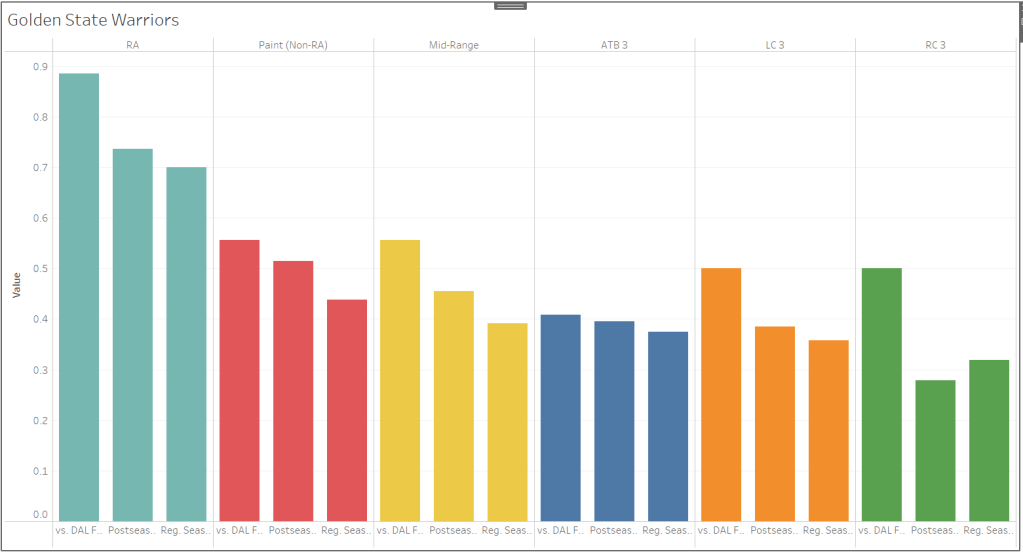
While the Warriors got great looks in Game 2, they are on quite the hot streak to begin this series. Check out our graph below that illustrates Golden State’s shooting splits from the major areas on the court across the regular season, postseason, and this series against Dallas:
For further detail (vs. Dallas/postseason/regular season):
- Restricted Area: (88.5/73.6/70.0)
- Paint (Non-RA): (55.6/51.4/43.8)
- Mid-Range: (55.6/45.5/39.1)
- Above the Break Three: (40.8/39.5/37.4)
- Left Corner Three: (50.0/38.5/35.8)
- Right Corner Three: (50.0/27.9/31.9)
Golden State has seen shooting jumps in the postseason overall, but their leaps and bounds above their averages through two games against Dallas. Despite the increased percentages, the Warriors’ raw shot profile has not increased alongside. Check out some numbers below:
| Restricted Area | Paint (Non-RA) | Mid-Range | Above Break 3 | Left Corner 3 | Right Corner 3 | |
| Regular Season Freq. | 26.80% | 16.31% | 11.64% | 34.94% | 5.78% | 4.53% |
| Postseason Freq. | 19.32% | 26.48% | 11.99% | 33.72% | 4.65% | 3.85% |
| vs. DAL Postseason Freq. | 15.85% | 32.93% | 16.46% | 29.88% | 2.44% | 2.44% |
Golden State has been forced into significantly more paint and mid-range jumpers than their usual shot profile prefers, while the Mavericks have limited their at-rim attempts and 3-PT shot. The jump in paint attempts is particularly concerning, but it’s primarily been seen on shots further from the rim:

But, the percentages have seen a massive jump, particularly right at the rim:
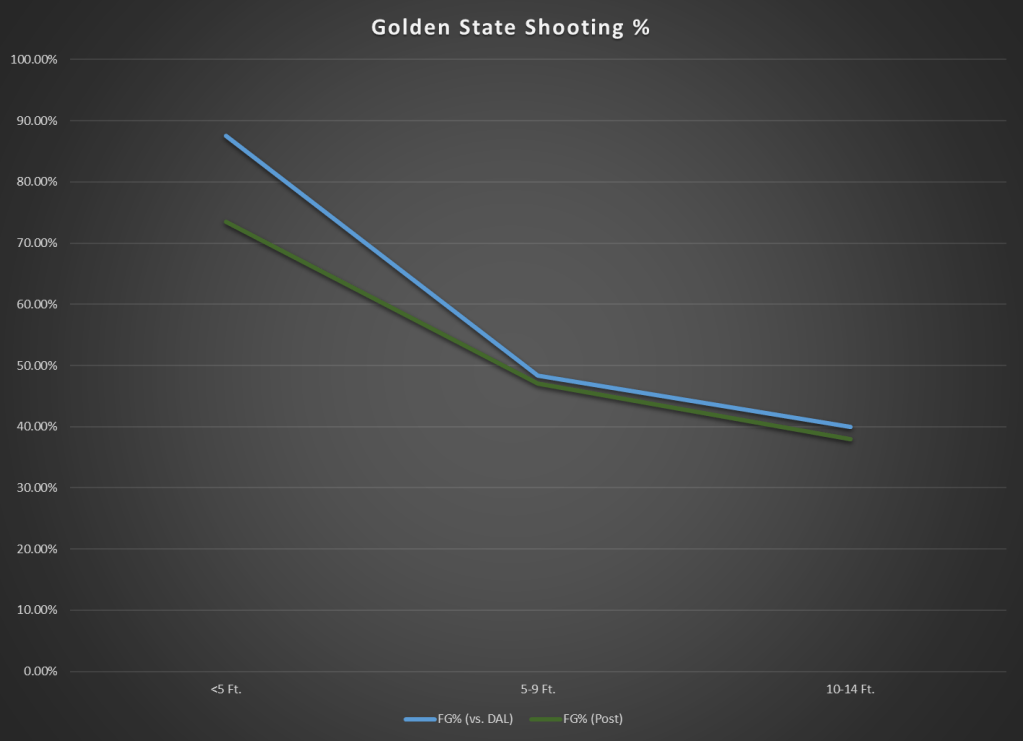
A lot of this can be chalked up to Dallas’ relative lack of rim protection, especially compared to Golden State’s most recent opponent, the Memphis Grizzlies. However, there is a portion of this that is explained by shooting variance. The Warriors will likely cool off from all areas of the court, but particularly around the rim. Considering how little resistance Dallas offered on Golden State’s penetration last game, I expect it to be a major point of emphasis for the Mavericks in Game 3.
In addition to Golden State’s pure shot profile not seeing a subsequent increase (from an analytical perspective), their percentage of “wide-open” and “open” shots, as classified by NBA.com, has also not improved:
| Wide Open (2-PT) | Wide Open (3-PT) | Wide Open (Total) | Open (2-PT) | Open (3-PT) | Open (Total) | |
| Regular Season Freq. | 3.70% | 21.10% | 24.80% | 12.80% | 18.30% | 31.20% |
| Postseason Freq. | 4.50% | 18.00% | 22.50% | 13.80% | 17.00% | 30.80% |
| vs. DAL Postseason Freq. | 3.00% | 13.40% | 16.50% | 13.40% | 15.20% | 28.70% |
Just 45.2% of Golden State’s shot attempts have been classified as either “wide open” or “open” by NBA.com, a far cry from the Warriors’ regular season mark that was north of 56.0% (and, their first two rounds against Denver and Memphis, which was at 54.7%). The Mavericks have been particularly elite at running Golden State off the 3-PT line, but it’s come at the expense of their interior defense, where the Warriors have feasted all series. It’s part of the challenge defending a team that possesses Stephen Curry, Klay Thompson, Jordan Poole, and Andrew Wiggins, along with a system that feasts off back cuts, off-ball movement, and dribble handoffs. Dallas has to find the “right balance” of running the Warriors off the 3-PT line while simultaneously minimizing looks within 9 feet, a nearly impossible task. Right now, I think their balance is a bit skewed towards limiting threes; with anticipated shooting variance and hyper-focused containment at the point of attack, I strongly believe Dallas will have some strong defensive games at their disposal.
The Mavericks’ Offense Is Due
When Dallas exploded for 15 first half threes on Friday, it felt like the avalanche of positive regression was coming. Yet, after the scorching hot start, Dallas plummeted to earth in the second half, shooting just 6/18 from deep, with some Luka step backs in comeback time salvaging what was a pitiful half from beyond the arc. But, unlike the Warriors, Dallas’ shot selection has arguably improved, even though their percentages have largely dipped, especially from the corners:
| Wide Open (2-PT) | Wide Open (3-PT) | Wide Open (Total) | Open (2-PT) | Open (3-PT) | Open (Total) | |
| Regular Season Freq. | 3.60% | 23.20% | 26.70% | 14.40% | 17.00% | 31.40% |
| Postseason Freq. | 2.50% | 26.10% | 28.60% | 13.40% | 19.80% | 33.20% |
| vs. GSW Postseason Freq. | 4.30% | 31.70% | 36.00% | 9.10% | 20.70% | 29.90% |
36.0% of Dallas’ shots this series have been classified as “wide open”, a ridiculous amount through two games. Nearly 66% of Dallas’ shot attempts have been wide open or open, a mark well above their regular season averages. Yet, in particular, their 3-PT marks have plummeted, as the Mavericks are hitting just 36.5% of their wide-open threes and 32.4% of their open threes, both below average marks. For contrast, the Mavericks connected on 37.2% of their open threes and 41.9% of their wide-open threes against Utah and Phoenix. Take a look below at Dallas’ full view across areas:

The Mavericks have been terrific around the rim, but they’re not getting there very frequently (just 9 attempts inside the restricted area according to NBA.com), in large part due to Golden State’s scheme at walling off driving lanes for Luka Doncic. Dallas’ shooting dips, particularly on corner threes, is what’s hurt them the most, as the Warriors’ gameplan at walling off the paint breeds open looks from the corner. Maxi Kleber, Reggie Bullock, and Dorian Finney-Smith are a combined 3/12 on corner threes, the majority of which have been terrific looks. For reference, those three were a combined 41.3% from the corners in the regular season. They’re bound to break out given all the great looks they’re getting.
Dallas’ shot profile indicates they’re generating terrific shots, and by and large, the eye test backs that up. However, there are areas of improvement. When Dallas’ offense struggles, it’s largely because they waste shot clock time trying to generate a switch that Golden State does not concede. Or, in this series in particular, they get Kevon Looney on a switch, and he’s been terrific defensively. The Mavericks had a ton of success with a Bullock/Doncic pick-and-pop last game (1.80 PPP), as Golden State has adopted a hard hedge approach with Steph Curry. Dallas, namely Luka, has to either attack the hedge quickly and with force, or allow that pick-and-pop to take place.
Rapid-Fire Adjustments to Consider for Dallas
Embrace Super Small Lineups: Kevon Looney’s effectiveness in this series has been a major difference maker, as he’s arguably been the Warriors’ MVP through two games. Unlike the previous centers Dallas has encountered, Looney has been terrific at guarding on switches, moving his feet well on the perimeter and blocking off easy attacks to the basket. The Mavericks have attacked Looney far too often, but he’s also done damage offensively, often camping out down low for easy buckets off dribble penetration or operating as an effective passer out of the post. It’s gotten to the point where Dallas has to play Looney off the court because of how effective he’s been, not because he’s an easy matchup to attack.
One adjustment is for Dallas to embrace ultra-small ball in spurts, rather than rolling out Maxi Kleber against Looney so often. If Kleber were to knock down corner threes, this story could change, but right now, Kleber has really struggled this series. In Game 2, Kleber was in numerous impossible situations defensively, where he was in 2-on-1 scenarios. I’d argue Dallas needs to throw some different looks at the Warriors, namely switching more on the perimeter, which is where I think Josh Green can play a role. Green was extremely effective during the regular season comeback against the Warriors and his style can play an impact here. He’s an opportunistic defender who’s also improved as someone who can initiate dribble handoffs offensively. In particular, that was one wrinkle Jason Kidd deployed in Round 1, where Green initiated offense to force Rudy Gobert to move on the perimeter a bit. Kleber can do DHO action as well, but Green’s athleticism and passing ability poses a unique challenge. I’m not advocating for Josh Green to be unleashed for 20+ minutes, but I think he has a role to play in this series as a way to combat Kevon Looney.
Attack Jordan Poole: To me, the most obvious adjustment the Mavericks can make is mercilessly attacking Jordan Poole every chance they can get. There’s no question Poole is a gifted offensive player (he was the difference-maker in Game 2), but he’s a really poor defender. Poole’s DFG% is 48.8% in the postseason, which isn’t a good mark at all. Yet, it seems like the Mavericks have let the Warriors get off the hook far too often by letting them hard hedge and recover. There are a few adjustments Dallas can make, although they already made an effective one with Reggie Bullock screening:
- Dallas should be more assertive attacking the hard hedge, rather than hoping the screener will drag Andrew Wiggins away on a switch. The Mavericks did this at an extremely effective rate early in Game 1. The Warriors have not allowed Stephen Curry or Jordan Poole to stay switched onto Luka Doncic and the supporting Mavericks, primarily Spencer Dinwiddie, have not effectively targeted mismatches.
- One easy way to prey on Poole is to allow Dinwiddie to initiate the offense more when on the court. It’s a risky proposition, considering Dinwiddie has been extremely inconsistent this postseason, but when he’s at his best, he’s downhill going to the rim. Poole has little chance at stopping Dinwiddie and the Warriors have been less “switch agnostic” against Mavs other than Doncic. Taking the ball out of Luka’s hands isn’t ideal, but Dallas desperately needs Dinwiddie to get going and the Warriors have shown they’re willing to concede switches in other matchups.
The Mavericks made a living against Utah and Phoenix attacking their weak links defensively, but they have yet to figure out Golden State’s defensive tweak. It took the Mavs some time to figure out Phoenix as well, but once they did, they feasted nearly every possession. It’ll happen against Golden State as well, but right now, the Mavericks are far too often playing into the Warriors’ hands.
Trust the Defensive Gameplan: We highlighted Dallas’ defense early on, but right now, Dallas’ process is in a decent place. They need to be significantly better at walling off dribble penetration but conceding that has allowed the Mavericks to better defend the 3-PT line. I think Dallas could possibly ease some of their perimeter aggressiveness (namely against Klay Thompson, who blew by Maxi Kleber twice after Kleber pressed against him), but overall, their gameplan has been solid. They’ve forced the Warriors into more difficult shots than they’re used to and have limited their attempts from beyond the arc. There will be some praying involved that the Warriors would experience some offensive regression, but by and large, their defensive process has been good.
I think the adjustments here are more tone-setting. Dallas will likely come out physical and hyper-focused defensively, especially after Jason Kidd’s postgame comments. Reggie Bullock will likely pick up full court again, but the Mavericks need to be crisper in the half-court and mix in some wrinkles. Blitzing the Warriors is ineffective, largely because Draymond Green and Kevon Looney are so effective in short-roll situations. Switching onto the perimeter is something I think the Mavericks should embrace more often this series, even if it leads to disadvantageous crossmatches (like Maxi on Steph Curry).
Game 3 Outlook
Overall, there are some silver linings to Dallas’ start. The Warriors have shot extremely well, the Mavericks have shot relatively poorly, and Dallas’ defense has yet to play close to their ability. It’s only two games and Dallas has been here before, even if it’s not an envious position to be in. Since Luka Doncic’s return, the Mavericks have not lost a home game in the postseason (4-0), and their only loss was Game 1 against Utah which they lost in the final 45 seconds. Dallas has been great at making the proper adjustments and defending home court. Game 2 was certainly disappointing, but that feeling of disappointment is actually a privilege, because it means your team is good enough to have something tangible to be disappointed about. There are no downsides for the Mavericks regardless of this series result, and it’s a series I think they still have a chance to be competitive in. It’s been a fun season so far, but the Mavericks aren’t ready for it to end: if they can deliver that knockout blow tonight, the dynamic of the series can shift.
 The Chirp