
A simple truth is staring the Dallas Mavericks in the face as we officially enter the NBA Off-Season: they cannot significantly upgrade the roster this summer without more cap space being created. Maybe truth is too strong of a word, but it is my profound belief that if Dallas fails to generate more cap space, any roster improvements will either be marginal, or result in other holes opening up. Why is this the case? As their cap sheet currently stands, Dallas has two possible routes:
- Retain THJ, add free agents for the MLE and BAE (marginal upgrades)
- Add a $20M AAV free agent, but lose THJ and full MLE
In my opinion, neither route is particularly appealing. Option 1 is marginal upgrades and likely means Dallas failed to add meaningful shot creation around Luka Doncic, which will result in stagnation. Option 2 could very well be a lateral move that doesn’t make Dallas any better, either. More space widens the options and creates scenarios where Dallas can meaningfully upgrade the roster, instead of doing lateral shifts that might work.
With the NBA Draft slated for Thursday, July 29th and free agency starting not far after on August 2nd, time is of the essence for Dallas. On Sunday, Jake Fischer of Bleacher Report, Shams Charania of The Athletic, and Adrian Wojnarowski and Zach Lowe of ESPN dropped a handful of nuggets surrounding league intel. As the draft approaches, trade talks will pick up steam and there will be a greater sense of urgency among multiple teams to get moves done that helps aid in their free agency blueprint. Dallas, despite having no draft picks, should be active over the coming days. It’ll be interesting to see how freshman President of Basketball Operations/General Manager Nico Harrison performs, but from his cool confidence and long track record of success, I have plenty of faith in his decision making. The rest of Dallas? That is a bit more questionable, but the coming days should be telling on what direction many teams in the league will take over the next few months and what direction Dallas will go in free agency.
In case you missed it, I outlined the need for more cap space for the Dallas Mavericks in my Off-Season Primer, which has two parts. Part 1 is focused primarily on a general overview of Dallas’ position entering the summer and personal team-building principles I believe in, while Part 2 includes specific free agent/trade targets to fulfill each need I highlight. In this specific post, I’ll incorporate in some ideas/players I have already suggested while getting creative with some extra ways at creating cap space for the Dallas Mavericks.
Quick Refresher: Dallas’ Current Cap Situation
Below, we have Dallas’ current salary cap sheet:
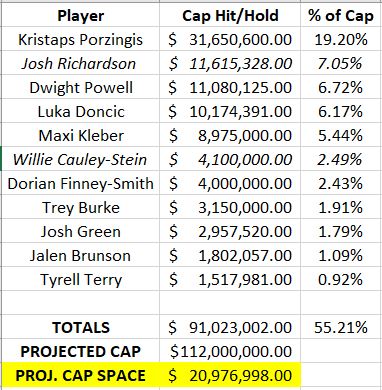
Now, there are two wild cards: Josh Richardson, who has a player option, and Willie Cauley-Stein, who has a team option. While it seemed ridiculous to think Richardson would opt in during the preseason, all reports indicate he’s leaning that way after a disappointing year. Richardson really struggled in Dallas; he was a frequent ball stopper, his on-ball defense was extremely disappointing, and his 3-PT shooting regressed. Now, it should be noted that Richardson was one of several Mavericks to catch COVID-19 early in the season and before that, his defense in particular was quite impressive. I still remember him hounding Jamal Murray in the 4th quarter of that epic Mavericks’ overtime win in Denver (ironically, Richardson’s last game before catching COVID-19). Richardson’s struggles last year and particularly, his inability to earn significant playoff minutes, makes it extremely unlikely he’ll return, in my opinion. However, the optimistic viewpoint is with a full off-season and a further recovery from COVID-19, perhaps Richardson can be the type of player Dallas hoped for when they traded Seth Curry for him. I’d probably pin Richardson’s chances of being on Dallas’ roster opening night around 20% (but, I will make the case for Dallas keeping him throughout this article). The major obstacle here is Richardson’s option deadline is August 1st, which is after the draft. That does complicate potential deals Dallas can make during Thursday’s draft to clear cap space by offloading Richardson.
As for Cauley-Stein, there have been no rumors surrounding Dallas’ thinking regarding his club option. I have made clear my belief that Dallas would be better off declining Cauley-Stein’s option. The idea of having a rim running, shot blocking big is very appealing, but I think Dallas can and should do better than Cauley-Stein. For a 7’0 big, Cauley-Stein is a poor finisher around the rim when not dunking and his shot blocking is just ok. Declining Cauley-Stein’s option frees up $4 million in cap and that’s good enough for me.
The Dallas Mavericks also have cap holds. The big one to note is Tim Hardaway Jr.’s, which is worth roughly $28 million. Because of how large Hardaway Jr.’s cap hold is, it essentially makes his Bird Rights not as valuable. I have outlined my stance on THJ in my Off-Season Primer, but to reiterate, I find it very hard to envision a scenario where Dallas significantly improves while retaining THJ. As unfortunate as that is, Dallas’ cap situation makes that fairly clear.
How Can Dallas Free More Space?
Things may seem dim regarding Dallas’ cap space due to Richardson opting in, but there are a ton of creative ways for the Mavericks to generate extra space. NBA teams have been effectively manipulating and skirting the cap for years. Below, I’ve listed and explained a few ways Dallas could generate new space:
Salary Dumps: This is the method everybody immediately thinks of, but it’s also the hardest to pull off. Smart clubs who are rebuilding should always be eager to absorb a team’s “bad” contract if a sweetener comes attached, but those clubs are limited. Examining the league landscape, it seems like only Oklahoma City has shown any interest in filling that role. Maybe Orlando and Houston jump into that mix, but neither have the cap space to do so. I often see Mavericks’ fans on Twitter saying “dump” salaries like Dwight Powell ($11M) and Josh Richardson ($11.6M), but I don’t see any realistic scenario where Dallas can just handoff either contract without attaching some form of sweetener that they lack. Maybe you can interest Oklahoma City in Josh Richardson and Tyrell Terry for a protected second round pick, but I’d think Oklahoma City would reserve their cap space for absorbing contracts that come with better sweeteners attached, like they did in their Al Horford trade. Personally, I also think that would be an awful idea for Dallas that follows along the lines of their repeated failures of “Plan Powder”.
Lower Cap Trades: For lack of a better term, another avenue, albeit an underrated one, is to conduct a trade with another team that slightly frees up more cap space. This is an area that I think could be interesting for Dallas this summer, but it is tricky since this likely requires the team Dallas is trading with to have cap space. However, deals like this can free up a few million which is better than keeping a full contract on the books.
And, below is the sign-and-trade, which is essentially the primary method teams utilize to acquire a free agent without cap space. This is a strategy that does not create new cap space, but rather, allows you to reallocate:
Sign-and-Trade: The sign-and-trade has become increasingly popular around the NBA as teams become less inclined to lose an asset for nothing in free agency. With a player empowerment era, no longer are players confining their potential destinations solely to teams with cap space; rather, they are canvassing the entire league and identifying their preferred team, and then that team is on a mission to create the space necessary to acquire the player. This has happened more frequently over the past few years, namely with D’Angelo Russell and Golden State, Jimmy Butler and Miami, Kemba Walker and Boston, and more. It would not surprise me a bit if Dallas intends to go the sign-and-trade route this summer to land a max player, considering the cleanest avenues to them creating max cap space and retaining Tim Hardaway Jr. are basically impossible, given our current reports. While I would personally let THJ walk to land the max player, it seems like Dallas is intent on threading the needle of keeping Hardaway Jr. while landing that guy. It’s an interesting strategy, but usually when you get that audacious in free agency and have a long track record of failed strategies, it feels like a familiar pattern is once again rearing its ugly head.
Our three primary methods of cap space generation have been outlined and truthfully, there are possibilities for Dallas to free up, in my opinion, a ton of space. However, I consider this unlikely for a few reasons. Despite a new regime being introduced this summer, Mark Cuban remains the ultimate decision-maker and because of that, I doubt Dallas’ philosophies really change at all. One particular aspect the Mavericks have been stubborn and perhaps even ignorant about is their internal talent evaluation; it often feels like Dallas believes their best solutions are in-house, even if it’s not the case. The Mavericks have some nice players and deserve credit for the development of guys like Dorian Finney-Smith, Maxi Kleber, and Dwight Powell. However, their fondness of certain players has crippled them in recent years as I believe it has prevented them from seeking upgrades.
I mention this point because one clear way for Dallas to create space is by trading Maxi Kleber. Kleber is a player who likely won’t require the attachment of a sweetener and could net Dallas a solid asset, such as a late first-round draft pick. Check out this quote from Jonathan Givony of Draft Express and ESPN in his latest mock draft:
“Many expect them (the Knicks) to either look to package Nos. 19 and 21 and move up to the late lottery or mid-first, or trade one or both picks for more ready-made contributors”
-Jonathan Givony, latest NBA Mock Draft on ESPN
Maxi Kleber is a versatile, 3-and-D big who has shot above league average from deep the past two seasons, including knocking down 41.0% of his threes this past year. He’s likely worth a late first-round pick and the Knicks can absorb his contract without sending any salary back. Yes, New York is likely angling for a max player in free agency too, but Kleber’s $8 million salary is a minor dent in their cap space and gives them much-needed frontcourt depth and spacing. Would New York send Dallas’ own pick (#21) back for Kleber? I think it’s a possibility, although for the reasons outlined above, I doubt the Mavericks would bite.
Dallas’ fondness of their homegrown guys hamstrings their ability to create cap space in examples like this. I’m a huge Maxi Kleber fan, but the blunt reality is Kleber is not elevating the Mavericks into a title contender. He’s a valuable role player who, when healthy, is a terrific defender, but he’s struggled in his two postseason appearances and moving his salary is an easy way to inch closer to max space. If Dallas were to trade Kleber for the 21st pick (hypothetical) and decline Cauley-Stein’s option, they’d have roughly $33 million of space independent of what Josh Richardson does, plus they’d add another young player to the rotation.
While I think the idea for exploring a Maxi trade for a first round selection is interesting, I do want to make this clear: Dallas should not be pursuing this Maxi trade with the intent on it being for the cap space. I think a top-21 pick is terrific value for him; I do not think getting a second rounder for him is a smart deal. This is the difference Dallas needs to understand; trading players for picks is smart and the extra cap space is the added bonus. That is the correct line of thinking, not “trading players for cap space is smart, and the picks are an added bonus”.
One move I’d strongly be in support of is trading Trey Burke for a second round pick. Burke was a standout player in the Orlando Bubble, but failed to consistently crack the rotation this past season. The Brooklyn Nets can use some additional backcourt depth and have a multitude of second round picks, but a trade is unlikely since they cannot absorb Burke’s $3 million salary. The Charlotte Hornets are an interesting option; they’re likely looking for some additional backcourt depth and probably want a cheap replacement for Devonte’ Graham, who is a restricted free agent this summer. Burke for the 56th pick works for both sides and it’s an example of some trade that could make sense. Dallas could aim to dump Burke and a second round pick to Oklahoma City, but I think Dallas can find some asset in return for Burke, even if it is the 56th pick.
However, there are other, much more appealing options available for Dallas to essentially generate space without actually creating space. One specific avenue for cap maneuvering involves reallocation. Reallocation is essentially shifting your current cap obligations from certain players/skillsets to others; in essence, it’s a fancy word for making trades that don’t clear cap space. The Mavericks have been obsessed with having physical cap space over the past several years that a lot of time, it hurts their ability to facilitate moves. By having lots of physical cap space, you essentially operate as a salary dump team, which is reserved for clubs in rebuilds. Dallas is not rebuilding and while maximizing the physical cap space entering free agency is the obvious route, it may not be the most realistic nor the most appealing method. Having loads of cap space in free agency is only good if you find people to take it, something Dallas has struggled with. Now, before I fully dive into this concept, here’s a quick refresher of the five needs I’ve outlined for Dallas this summer:
- Secondary Shot Creator
- Complement to Secondary Shot Creator
- More Shooting
- Rim Running, Shot Blocking Big
- Veteran Presence
Instead of freeing up $30-40M of cap space and trying to check off all five needs (and more that will arise from dumping players), what if the Mavericks can reallocate their space to address more pressing needs, while creating some minor ones along the way?
Allow me to explain with an example: Dwight Powell. I mentioned earlier how unlikely I think it is to believe Dallas can wipe their hands clean of $11M by simply dumping Powell, but what if Dallas can find a way to reallocate Powell’s $11M salary into a player that fills their current needs better? Here’s one potential trade that illustrates this:
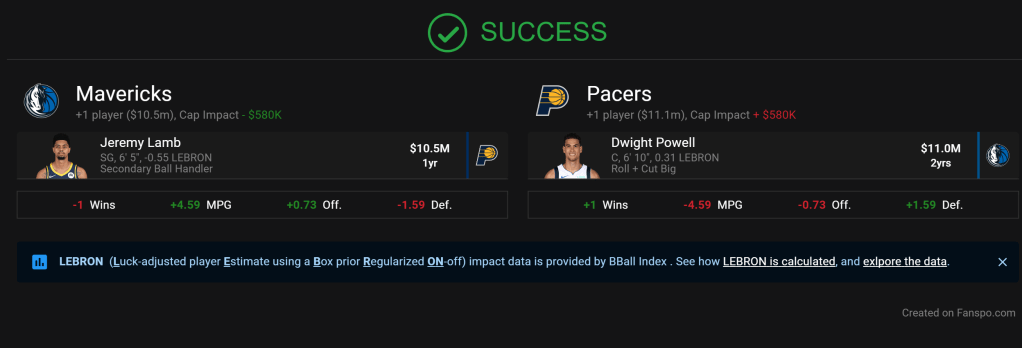
By acquiring Jeremy Lamb, Dallas can tentatively check off the box for a need of a complementary player to a secondary shot creator, but it further opens up the need for a rim running big and opens up an additional need: meaningful frontcourt depth. However, which need is more pressing? In my opinion, it’s surely that complementary player to the secondary shot creator, so by reallocating cap space (aka trading), Dallas fulfills a need that is more important to improving their roster. Jeremy Lamb, while recovering from injury, was fairly effective with Indiana last season and I outlined him as a potential fit in my Primer. Rick Carlisle reunites with Dwight Powell and Indiana’s frontcourt is razor thin behind Domantas Sabonis and Myles Turner. Indiana has a glut of wings and seem unlikely to keep all of T.J. Warren, T.J. McConnell (UFA), Doug McDermott (UFA), and Jeremy Lamb. This deal makes sense for both sides, fills a more important need for Dallas, and does not require cap space to make it happen.
Reallocating cap space is not only reserved for minor moves like this. It can also be done by trading Kristaps Porzingis for C.J. McCollum, a deal I’ve heavily advocated for. The Mavericks don’t necessarily create new cap space by doing the trade, but they do address their primary need of adding a secondary shot creator, but open up a new need, albeit a smaller one, of adding a pick-and-pop threat for Luka. Shuffling cap space around via trade to replace major needs with minor needs is the preferred method for operating. It’s tough to do, but allow me to pose this question: for argument’s sake, let’s say Dallas trades Porzingis and Powell and gets C.J. McCollum and Jeremy Lamb in return. Wouldn’t having $21 million (at minimum) to spend on say, Richaun Holmes, seem a lot more enticing with McCollum and Lamb in tow, rather than their current situation? The Mavericks cannot be afraid to utilize the trade market to reallocate their needs; in an ideal world, Dallas’ biggest need entering free agency is finding the rim running, shot blocking big. If that truly is their biggest need, it is because they fulfilled addressing the secondary shot creator + complement needs by shuffling around their current cap space allocation via trade.
Other Cap Deals/Reallocation Deals
Below, I have a list of all the possible strategies Dallas can utilize to address their roster needs, ordered from most appealing to least appealing (in my opinion):
1. Cap Space Reallocation (aka Trades): This will be the toughest to pull off, but Dallas needs to reallocate their cap space from being heavily invested in frontcourt players to being heavily invested in shot creators or, to put it bluntly, guys who can consistently and effectively get themselves a bucket in the half court. Despite this strategy not generating any new cap space, it fills their biggest needs (and, I would argue the biggest needs any team has in their pursuit of a title). This strategy does create new needs that become glaring/pressing, but ideally, they should be more minor in a holistic point-of-view. Frontcourt players are generally less important to title teams if you have multiple half court shot creators.
Anticipated Result: Dallas fills shot creation/complementary needs, creates glaring need for frontcourt help, no new cap space created
2. Sign-and-Trade: This *feels* like Dallas’ strategy and the league is certainly cozying up to the idea of sign-and-trades. For Dallas, the sign-and-trade strategy is likely a strong indication they want to retain Tim Hardaway Jr. and operate as an over the cap team, giving them access to the full MLE and BAE. In theory, it’s a smart strategy and is a savvy way to carve out space for two more impactful players. However, the risk is Dallas allowing guys to go off the board as they wait for sign-and-trade prospects to make their decision. This strategy likely means Kristaps Porzingis would be the return package of a S&T for rumored targets, perhaps Kyle Lowry (Toronto).
Anticipated Result: Dallas fills shot creation need, keeps THJ, opens up full MLE and BAE
3. Minor Cap Trades: I rate this idea slightly higher than salary dumps because minor cap trades do give Dallas some return assets. I really hate salary dumps since there are more effective ways of creating space than simply letting guys go for nothing.
Anticipated Result: Dallas frees up a touch more space through lateral moves
4. Salary Dumps
Anticipated Result: Dallas frees up a ton of new space, but creates a ton of new holes in the process
Dallas’ best methods for creatively creating more flexibility this summer? Ironically, I think it’s the two strategies that actually don’t create any new cap space at all. Rather, it’s utilizing your current contracts as trade assets to address needs most necessary to fulfill in order to win a championship while creating pressing needs that are less important to championships. Below, here’s some more trade ideas of these concepts in action. As a note, many of the players I have Dallas trading for were outlined in Part 2 of the Off-Season Primer as guys I would like the Mavericks to target. These deals may seem unrealistic, but they are ideas of how Dallas can theoretically work the reallocation/S&T strategies to solve needs without creating new cap space.
Deals to Add Shot Creation
Trade #1: The Bradley Beal Domino Falls
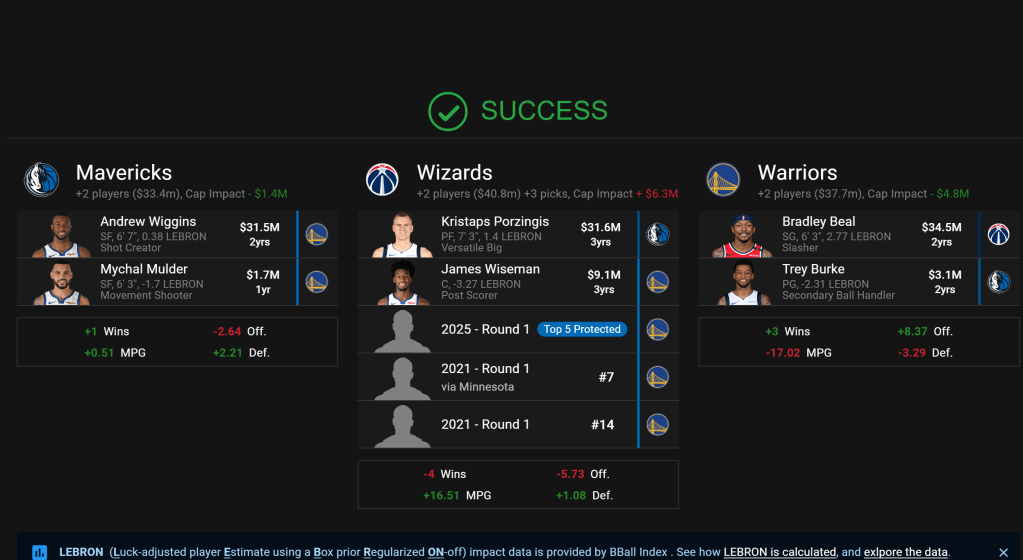
There was a ton of Bradley Beal buzz on Sunday, namely that his future with the Wizards is in question and he will decide before the NBA Draft. Adrian Wojnarowski said the Warriors would be after Beal (frankly, who wouldn’t?) and a package surrounding the 7th and 14th picks, plus James Wiseman, would be the crux of their deal. But, what if Washington didn’t want Andrew Wiggins? Enter Dallas, who could offload Porzingis to Washington, dump Burke to Golden State, and take on Wiggins and Mychal Mulder, a strong shooter. Yes, Dallas does aid Golden State by helping to facilitate a trade that lands them Bradley Beal, but this is an idea of how Dallas creates minimal cap space ($1.4 extra million), yet lands their secondary shot creator and adds more shooting, while creating a need in the frontcourt.
Andrew Wiggins was quietly a terrific playmaker and secondary shot creator for Golden State last year. I outlined all of his benefits in Part 2 of the Primer. Wiggins fills Dallas’ biggest need in inching closer to a title and the Mavericks didn’t need any extra cap space to get it done. Mychal Mulder is an underrated shooter (39.7% from deep this season), helping Dallas fill another need as well. By doing this trade, Dallas will have their $22 million of cap space ($26 if declining Cauley-Stein’s option), but no longer has to use it on a secondary shot creator, who will likely cost beyond that mark (and result in them losing THJ). The Mavericks could, in this scenario, come close to affording both Tim Hardaway Jr. and Richaun Holmes. If Dallas did dump Trey Burke, they could probably get it done. Does a Luka Doncic, Andrew Wiggins, Tim Hardaway Jr., Dorian Finney-Smith/Maxi Kleber, and Richaun Holmes starting five interest anyone?
Trade #2: Dallas Lands McCollum and More Guard Depth

The McCollum/Porzingis trade is, for me, a perfect starter to an incredible off-season. If Dallas really wanted to make an impactful upgrade, I think this is the best route. But, what if Dallas further went in on the cap reallocation in conjunction with this deal and created a scenario where they could spend all of their cap space on frontcourt players? It’s possible, believe it or not. Here’s another subsequent trade that could also play:
Now, in this hypothetical, Dallas has added their secondary shot creator (McCollum) and a decent complementary player to said shot creator (Lamb), and they didn’t need a dollar in cap space to make it happen! In conjunction, it’s highly unlikely Dallas would actually do this. But, Dallas clears out their two biggest needs this summer without a dollar of cap space being used, but they open up a massive need in their frontcourt.
This is, once again, where the benefits of reallocation come into play. Dallas is at $20.9M of cap space this summer as it stands; with these two deals, the Mavs add about $1.2M in extra space. For all intents and purposes, let’s round it to $22M of existing space after acquiring McCollum and Lamb. By declining Willie Cauley-Stein’s option, Dallas gets to $26M. If they deal Trey Burke for one of Charlotte’s late second rounders (which they should do anyways), they are at $29M.
$29M is a lot of cap space! And, they filled their two biggest needs without sacrificing Josh Richardson and/or Maxi Kleber to do it, plus haven’t yet spent a dime of their cap space. This is excellent manipulation. Sacramento can only offer Richaun Holmes a deal of 4 years, $50 million max as it currently stands. If Dallas got those trades done before free agency, is it inconceivable to think the Mavericks could swoop in right as free agency starts, offer Holmes a 4 year, $64 million deal (that Sacramento couldn’t compete with), and land him immediately? They’d still have another $13M to play with and could look to guys like Lauri Markkanen, Nerlens Noel, JaMychal Green, Jarred Vanderbilt, Paul Millsap, Otto Porter Jr., Danny Green, and others to spend it on. A starting five of C.J. McCollum, Luka Doncic, Dorian Finney-Smith, Maxi Kleber, and Richaun Holmes is super exciting. Imagine that group with a bench unit of Jalen Brunson, Josh Richardson, Jeremy Lamb, Jarred Vanderbilt ($8-10M), Jeff Teague ($3M), Josh Green, and Paul Millsap (Room Exception)? That’s the type of flexibility and elite roster construction reallocation/trades can unlock for Dallas. Personally, a depth chart that looks like this beyond excites me for next year:
| Luka Doncic | C.J. McCollum | Dorian Finney-Smith | Maxi Kleber | Richaun Holmes |
| Jalen Brunson | Jeremy Lamb | Josh Richardson | Paul Millsap | Jarred Vanderbilt |
| Jeff Teague | Tyrell Terry | Josh Green | Tyler Bey | Boban Marjanovic |
| Nate Hinton (Two-Way) | Extra Two-Way Player (56th pick) |
Sure, you may deem the individual Porzingis/McCollum and Lamb/Powell deals unrealistic, but I don’t think they are far fetched. Compile those all together and run away with a roster like this? Forgive me for thinking Dallas could make the Western Conference Finals.
Trade #3: Kristaps Porzingis/Kyle Lowry Sign-and-Trade
Personally, I view this scenario as more unrealistic than the one I listed above simply because I don’t envision Kyle Lowry choosing Dallas this summer. Lowry is a Philadelphia native and has been linked to the 76ers for a while, a team that just so happens to be in need of a point guard. Philadelphia can execute a sign-and-trade for Lowry, or Lowry can opt for the Los Angeles Lakers or Miami Heat. All three clubs have been connected as Lowry destinations far more frequently than Dallas, making me feel very weary of Dallas’ putting all their eggs into this basket.
For Dallas, the main benefit to doing a sign-and-trade this summer is to add a shot creator while keeping Tim Hardaway Jr., allowing them to operate as an over the cap team and have access to the full MLE (roughly $9-10M AAV over three years) and the BAE ($4M on a two year deal–what Boban got from Dallas). Dallas can do a sign-and-trade and not retain THJ (ex: S&T Porzingis for DeRozan), but this would maintain Dallas’ current cap position and they’ll operate as an under the cap team since their $21M in space won’t be used on THJ, removing their access to the full MLE and BAE. Truthfully, that idea is similar to the option I presented above, except McCollum is not a free agent.
For fun, let’s consider how Dallas can manipulate the sign-and-trade method to operate as an over-the-cap team and get access to the full MLE and BAE. Here’s what a potential Lowry/Porzingis S&T looks like:

With this S&T, Dallas would re-sign Tim Hardaway Jr. and have no cap space remaining, but they’ll operate as an over-the-cap team due to the S&T and utilizing THJ’s Bird Rights and cap hold. This gives the Mavericks the full MLE and BAE. By retaining THJ, however, we won’t have Dallas trade Powell for Jeremy Lamb here.
Let’s say the Mavericks use the MLE on Nerlens Noel and BAE on Wayne Ellington. Is the depth chart below better than the option I listed above?
| Kyle Lowry | Tim Hardaway Jr. | Luka Doncic | Dorian Finney-Smith | Nerlens Noel |
| Jalen Brunson | Wayne Ellington | Josh Richardson | Maxi Kleber | Dwight Powell |
| Trey Burke | Tyrell Terry | Josh Green | Tyler Bey | Boban Marjanovic |
| Nate Hinton (Two-Way) | Extra Two-Way Player |
Personally, I’d go with the former option that involves McCollum and Lamb.
So… What’s the Point?
While I listed just a few reallocation/S&T ideas above, there are a few primary points I am aiming to get across:
- If Dallas can address their shot creation/complementary piece via salary cap reallocation (trade), it opens up a ton of interesting possibilities via free agency. Now, you can prioritize Richaun Holmes, who is very attainable (due to SAC’s 4/50 constraint) and have extra money to bolster the frontcourt, like paying Nerlens Noel, throwing a large offer sheet at promising big Jarred Vanderbilt, or dividing it among 2-3 guys such as JaMychal Green, Otto Porter Jr., and Paul Millsap. Having your “cap space” priorities pivot from shot creation (which would allow 1 guy to take nearly all of the cap and cause major tradeoffs) to frontcourt (which would allow 2-3 guys to take the space) is a major win. Plus, this can all be accomplished without any true salary dumps.
- Dallas’ prioritization of Tim Hardaway Jr. really shrinks their avenues in how they can significantly upgrade the roster. I’m a THJ fan, but he’s not the secondary, half court creator Dallas needs to win a championship. By retaining THJ, due to Dallas’ cap situation, you’re almost asking either him or Kristaps Porzingis to be the secondary, half court shot creator. We saw against the Clippers that neither can do it consistently enough nor at a high enough level to fill that role. Why would next year be any different? If Dallas really wants to make that leap to championship contender (which they have to do with Luka in tow and PHX/ATL’s massive leaps), it likely means Hardaway Jr. has to leave, unfortunately. Unless, Dallas can execute the KP/Lowry sign-and-trade. But, that’s a lot of eggs to put into one very small, unlikely basket.
- Dumping contracts is easy to talk about, but dumping players with no value in return is silly. Yes, I did advocate for trading Trey Burke for the 56th pick, but more so, it’s the idea of dumping guys like Josh Richardson and Dwight Powell. Moves like that almost always involve a sweetener, open up more holes on the roster, and get you “flexibility”, which is only valuable if you can actually make a move. I’m totally fine with dumping a contract when necessary and personally, I don’t think trading a player for a draft pick is “dumping”. But, don’t expect Dallas to find a willing taker for Josh Richardson’s contract and, to be honest, I’m not sure I’d be on board with Dallas salary dumping Richardson at all. They can still get their primary shot creator without dumping his contract, if they go through reallocation or utilize a S&T with Porzingis and then retain Tim Hardaway Jr. through his Bird Rights.
Yes, Dallas’ cap situation seems bleak and from a simple scan, it feels like their options are severely limited. However, with some expert maneuvering, Dallas can address their biggest needs without needing any extra cap space. It may seem unrealistic to swap Kristaps Porzingis and Dwight Powell for C.J. McCollum and Jeremy Lamb, and to then have an extra $29M of cap space to throw at a bevy of frontcourt guys. However, it is possible and as mentioned, I don’t think those two trades are outlandish at all individually. This is a strategy the Mavericks have never deployed before, but truthfully, they’d be wise to address it this summer.
The NBA Off-Season is here… in other words, it’s the most wonderful time of the year. With the adoption of creative cap strategies and finding alternative routes to upgrade the roster aside from the repeated failure of “Plan Powder”, perhaps Dallas can make the NBA Finals the most wonderful time of the year for Mavericks’ fans, as well.
 The Chirp