
The Dallas Mavericks off-season is in full swing, with the introduction of Nico Harrison and Jason Kidd as part of the new leadership staff on Thursday. A new era is here in Dallas and while I’ve argued things have not really changed, there should be substantial roster changes this summer. The current iteration of Dallas’ roster is simply not good enough to win the title and with the progression of Luka Doncic, Dallas should be in win-now mode for the next several seasons. Luckily, Dallas doesn’t yet have the pressure to win a championship, but in a way, that in of itself is a problem. The Mavericks have to build a roster to garner the championship expectations that Luka Doncic deserves. Right now, they are far away.
For a refresher on a general overview of Dallas’ team needs and my thoughts on specific players, you can check out Part 1 of the Off-Season Primer here. Today’s post will solely be dedicated to specific targets Dallas should be identifying, with plenty of data utilized as evidence for these choices. Before I officially dive in, here’s a few prevailing thoughts I have:
- In Part 1 of the Primer, I discussed Kristaps Porzingis’ future with the team. I stand by my commentary regarding Porzingis’ game; he’s not going to develop into that secondary shot creator in the half court to make Dallas a championship team, but he can be an effective third option. However, I have become more and more convinced that Porzingis is the key to acquiring that secondary scorer for Dallas. Jake Fischer of Bleacher Report reported that “NBA Insiders expect a flurry of sign-and-trades” this off-season and Porzingis’ potential to be incorporated in certain deals could subsequently land Dallas their shot creator while either adding to their cap space or maintaining it. Teams are becoming more savvy in their maneuvering in the sense that losing an asset for nothing is poor management. Sign-and-trades are becoming increasingly popular, making a Porzingis S&T a realistic possibility.
- Marc Stein on the Greenroom on Thursday mentioned it seems likely Josh Richardson will opt in. That is not great news from Dallas’ standpoint, as their cap space will likely slot in around $21 million (roughly). Dallas could decline Willie Cauley-Stein’s option and salary dump Trey Burke to clear another $7.2 million. Regardless, the Mavericks need more cap space this summer. Their avenues currently exist like this:
- Option 1: Re-sign Tim Hardaway Jr. to a 4/80 deal, have about $11-14 million left in cap space (assuming Richardson opts in)
- Option 2: Clear another $12ish million in cap, sign a max free agent
- Option 3: Sign a few lower tier free agents for $6-8M annually instead
The options above are not terribly appealing. There are massive tradeoffs with every option that harm Dallas. Ultimately, if the Mavericks can clear cap space and execute effective trades, they can quickly transform their roster into one capable of winning the NBA Finals. Throughout this article, I’ll list plenty of maneuvers Dallas can run to build an improved roster.
Off-Season Targets Addressed Need-by-Need
Need #1: Secondary Shot Creator
Tier 1 Targets
The importance of adding more half court shot creation to this team cannot be understated. However, how can we determine whether a player is elite at creating for himself in the half court?
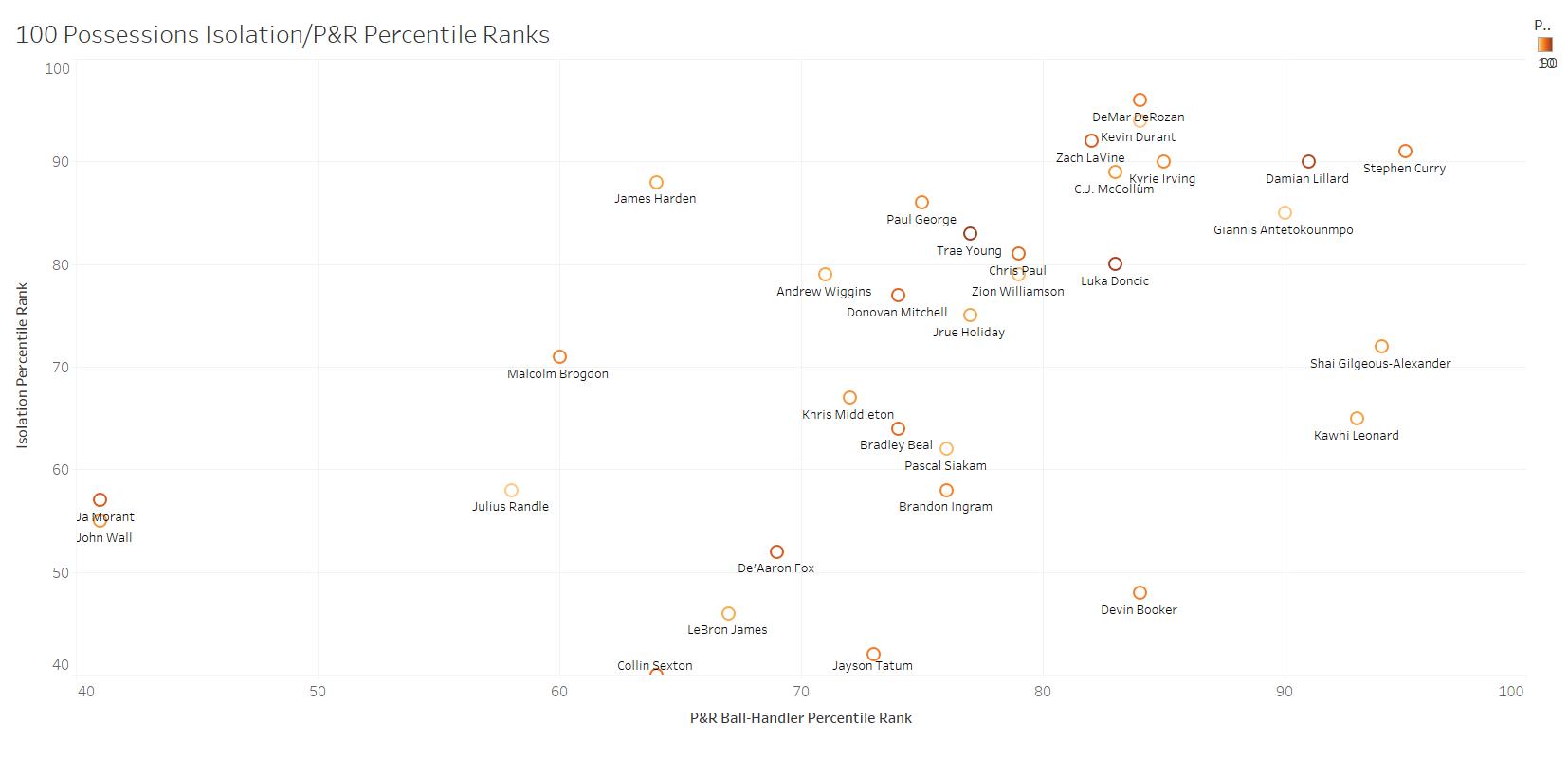
Luckily, the NBA collects play tracking data, courtesy of Second Spectrum, that provides some insights into how players perform in certain play settings. In looking at a secondary shot creator, there are two specific play types we are interested in here: isolation and pick-and-roll, specifically P&R “ball handler” as termed by Second Spectrum, or where the player in question was the ball handler in the P&R set. We are going to identify players that A) run a substantial amount of these sets to draw somewhat conclusive judgments, and B) excel in these sets based on their “percentile rank”, which comes from their PPP (points per possession) and a few other factors. Below, we have a graphical representation that highlights the following:
- Players have at least 100 possessions in both P&R ball handler and isolation
- Players rank at least in the 50th percentile or better in each set
These are the types of players Dallas should be targeting: players who not only are capable of running a lot of sets as the primary ball handler/shot creator, but players who are above average doing so. Take a look at the grouping here:
Let’s now further refine that set, focusing on just players who rank in the 75th percentile in both play types. This, in theory, should give us the “elite” players in these groupings:

In our visualization above, these are the the players Dallas should be targeting as the secondary shot creator alongside Luka Doncic. 3 of the 14 players above are in the NBA Finals (Jrue Holiday, Giannis Antetokounmpo, Chris Paul), and two more were in the Conference Finals (Trae Young, Paul George). I don’t believe that is a coincidence; having these elite half court shot creators makes your team more likely to advance in the postseason, especially with a higher frequency of isolation plays being run.
Target #1: C.J. McCollum (Under Contract-30 years old entering 2021-22 season)
2020-21 Stats (Per 36): 24.5 PPG, 5.0 APG, 4.2 RPG, 45.8% FG, 40.2% 3-PT, 81.2% FT
Listing C.J. McCollum as my recommended #1 target for the Dallas Mavericks this summer may come as a surprise, but based on the numbers, it should not. Simply put, C.J. McCollum is one of the best shot creators in the entire NBA and would be an ideal offensive complement to Luka Doncic. The graph above illustrates how McCollum was just 1 of 14 players with 100+ possessions in P&R and isolation to rank in the top 25% in terms of effectiveness in both. These numbers hold water over time as well; while not as elite, McCollum was in the 56th percentile in isolation and 71st percentile in P&R during the 2019-20 season. Both of those marks are still well above average, even if they are a decline from his terrific 2020-21 campaign.
One specific aspect of C.J. McCollum’s game I love is his spot up ability. McCollum shot 47.6% on catch and shoot threes this past season, 46.0% during the 2019-20 season, and 39.4% the year prior, all numbers well above league average (for reference, the league average catch and shoot percentage this season was 37.8%. McCollum was nearly 10% points above average). McCollum was also just one of fourteen players to rank in the top 25% in terms of isolation, P&R, and spot up scoring, further illustrating the deep array of offensive talent he possesses. Below is a tabular view of McCollum’s effectiveness by the amount of dribbles he takes:
| Dribbles | eFG% |
| 0 Dribbles | 66.8% eFG |
| 1 Dribble | 53.1% eFG |
| 2 Dribbles | 59.2% eFG |
| 3-6 Dribbles | 49.8% eFG |
| 7+ Dribbles | 51.2% eFG |
McCollum is still an effective scorer off the dribble, illustrating his strength in isolation. 56.7% of McCollum’s total field goal attempts had more than three dribbles overall. Portland was the heaviest team in terms of isolation frequency, but McCollum’s effectiveness in those settings bodes well for a potential fit in Dallas, where the Mavericks lack consistent isolation players aside from Luka Doncic.
Now, there are some concerns regarding C.J. McCollum. To me, the biggest has nothing to do with his specific game, but rather, the failed postseason runs he’s been a part of. I strongly believe McCollum is an ideal offensive fit alongside Luka, but if McCollum and Damian Lillard could never win a Conference Finals game, doesn’t it feel as if Dallas is also pursuing a strategy that has proven to fail? It is a concern I have, but the NBA is socially complex; not every team is the same, as schemes adjust, locker room dynamics are different, and players respond to settings in different manners. Another concern comes with McCollum’s defense, which is poor. McCollum ranked 80th among 130 qualified shooting guards in BBall-Index’s DLEBRON metric. However, McCollum ranked higher than comparable options, including DeMar DeRozan, Zach LaVine, and Bradley Beal. Lastly, McCollum’s assist numbers are underwhelming considering his usage, but I do believe that is a byproduct of Portland’s isolation-heavy scheme. The Blazers had the fewest passes per game in the NBA last season; I actually think McCollum possess playmaking upside considering his low turnover rate (7th lowest in the NBA) and effectiveness out of isolation.
The major hurdle to acquiring McCollum is that he’s under contract, with his 3 year, $100 million extension kicking in next season. Ironically, that contract matches Kristaps Porzingis’ perfectly for a trade. Would Portland consider a McCollum for Porzingis deal straight up? I certainly believe so; the McCollum/Lillard pairing has run its course and giving Dame a pick-and-pop big might be an avenue the Blazers opt for. A Porzingis + Josh Richardson for McCollum + Jusuf Nurkic also works. The big benefit to a KP for McCollum deal is that it keeps all of Dallas’ cap space still intact. The Mavericks could land McCollum as their secondary playmaker and pursue a Porzingis replacement, such as Richaun Holmes, for their cap space.
Target #2: DeMar DeRozan (UFA-32 years old entering 2021-22 season)
2020-21 Stats (Per 36): 23.0 PPG, 7.4 APG, 4.5 RPG, 49.5% FG, 25.7% 3-PT, 88.0% FT
I have gone back-and-forth over whether to list McCollum or DeMar DeRozan as my top target for the Mavericks this summer, but ultimately, I opted for DeRozan at #2. I truly don’t believe Dallas can go wrong with either guy, but I give McCollum a slight edge due to his better defense, more favorable advanced metrics, and elite shooting. Still, DeRozan would be a phenomenal addition for the Mavericks.
Among players with 100+ isolation possessions this past season, DeRozan was the best in terms of PPP. Not only was DeRozan elite in isolation, but as our graph above shows, he was also elite in P&R settings. This was not a one year fluke either; DeRozan was in the top 10% in both play types during the 2019-20 season as well. DeRozan is consistently one of the most effective “do it yourself” type of half court players in the NBA. He does have a slightly throwback style due to his mid-range game, but the analytics indicate a mid-range for DeRozan is actually a better shot for him than a three pointer, given his percentages. Some quick expected value math passes the check:
- DeRozan expected points per mid-range shot: 0.94 points (47.1% FG x 2 points)
- DeRozan expected points per 3-PT shot: 0.77 points (25.7% FG x 3 points)
DeRozan’s style is one that I actually view as advantageous for Dallas. No, he’s not a spot up guy which makes his perceived fit with Luka a bit clunky, but DeRozan’s slashing and post up ability could allow the Mavericks to invert the floor more often and deploy Luka in an occasional catch and shoot role. A DeRozan/Doncic duo makes it very tough to blitz Luka on screens due to the added playmaking and shot creation on the floor. DeRozan’s slashing ability comes into hand here: roughly 61% of his shots came within 14 feet of the rim and he had the 8th most free throw attempts in the league last season. Considering the pressure that DeRozan and Doncic put on the rim, it will be nightmarish for opposing defenses to try and combat that duo, even if the 3-PT shooting complement may be subpar. DeRozan is also a productive scorer in clutch time, ranking 3rd in total clutch points scored while boasting a similar usage rate to Nikola Jokic and Steph Curry.
When comparing DeRozan and McCollum, I’d argue DeRozan is the better individual scorer, but perhaps McCollum is the cleaner fit (and a great individual scorer in his own right). However, DeRozan is a much better facilitator, one specific area he’s drastically improved upon in San Antonio. DeRozan had the 10th best assist/turnover ratio amongst players with 20+ games played and 15+ MPG. The versatility he provides due to his size could allow the Mavericks to surround him with even more shooting, since he can function as a small ball four, an area where the Spurs successfully deployed him a season ago.
Adding either DeRozan or McCollum would be a home run for the Mavericks. The cap maneuvering necessary to bring in DeRozan will be a bit tricky. If Josh Richardson opts out, the problem is solved, as the Mavericks can easily fit DeRozan’s $33 million projection in their space, assuming Cauley-Stein’s option is also declined. However, if Richardson opts in (as expected), how does Dallas create the space for DeRozan? One area is the sign-and-trade proposal suggested earlier, where the Mavericks S&T Porzingis for DeRozan. Now, I deem this slightly unrealistic since the Spurs/Mavericks rarely, if ever trade, but there is some merit here. Remember, when Porzingis was traded to the Mavericks, it was reported the Spurs were on his list of preferred destinations and San Antonio does need frontcourt help. A potential sign-and-trade here does make sense, but Dallas’ most realistic pursuit is salary dumping Josh Richardson.
Target #3: Mike Conley (UFA-34 years old entering 2021-22 season)
2020-21 Stats (Per 36): 19.9 PPG, 7.3 APG, 4.3 RPG, 44.4% FG, 41.2% 3-PT, 85.2% FT
Mike Conley is not the half court offensive playmaker that McCollum and DeRozan are, but his combination of leadership, shooting, defense, and advanced playmaking still leads him to secure a spot as a “Tier 1” target. As a playmaker, Conley’s numbers over the past two seasons indicate lots of volatility: he was in the 85th percentile in P&R, but just the 38th percentile in isolation. However, during the 2019-20 season, he was in the 89th percentile in isolation, but just the 50th percentile in P&R. These rankings are heavily dependent on shooting and with year-to-year variance, this does make some sense. Conley is a knock down from the individual shot creator that Dallas could get by acquiring McCollum/DeRozan, but he is an elite defender. Conley ranked 6th in DLEBRON from BBall-Index amongst point guards. Conley would be Dallas’ best option at trying to thread the needle by adding a half court playmaker who subsequently is a positive on the defensive end of the court. The question then becomes: how much individual offensive creation are you fine with sacrificing for better defense?
While Conley was above average with his playmaking, his real strength came from his shooting last season. Conley was just 1 of 10 players to shoot over 40.0% from deep on both catch and shoot and pull up threes (amongst players with a minimum of 50 attempts on each). Many NBA players saw a spike in 3-PT% this season and Conley was no exception, although he did connect on 42.0% of his catch and shoot threes during the 2019-20 season as well.
I do have some concerns regarding Conley to Dallas. The first is one I have already alluded to: is Conley the secondary creator Dallas is looking for alongside Luka? I don’t deny how clean of a fit Conley is alongside Luka, but without that elite secondary shot creator, Dallas will continue to fall short of hoisting the Larry O’Brien Trophy. Conley helps them get closer, but I’m not sold he helps them get closer than our prior two options. Another concern I have is regarding Conley’s age/injury history. Conley missed postseason time this year and over the past four seasons, has only played in 180 games. If the Mavericks were to invest a substantial sum of money into a 34 year old point guard, I would hope the player has a clean bill of health. Conley’s injury history gives me pause, but ultimately, should not be the sole hinderance to pursuing a deal.
My personal preference is McCollum at #1, DeRozan at #2, and Conley at #3, but all have different strengths that can be weighed. Conley is the best defender, McCollum is the best shooter, and DeRozan is the best individual offensive player. All would make Dallas drastically better. These are the home run swings Dallas has to take this summer.
Tier 2 Targets:
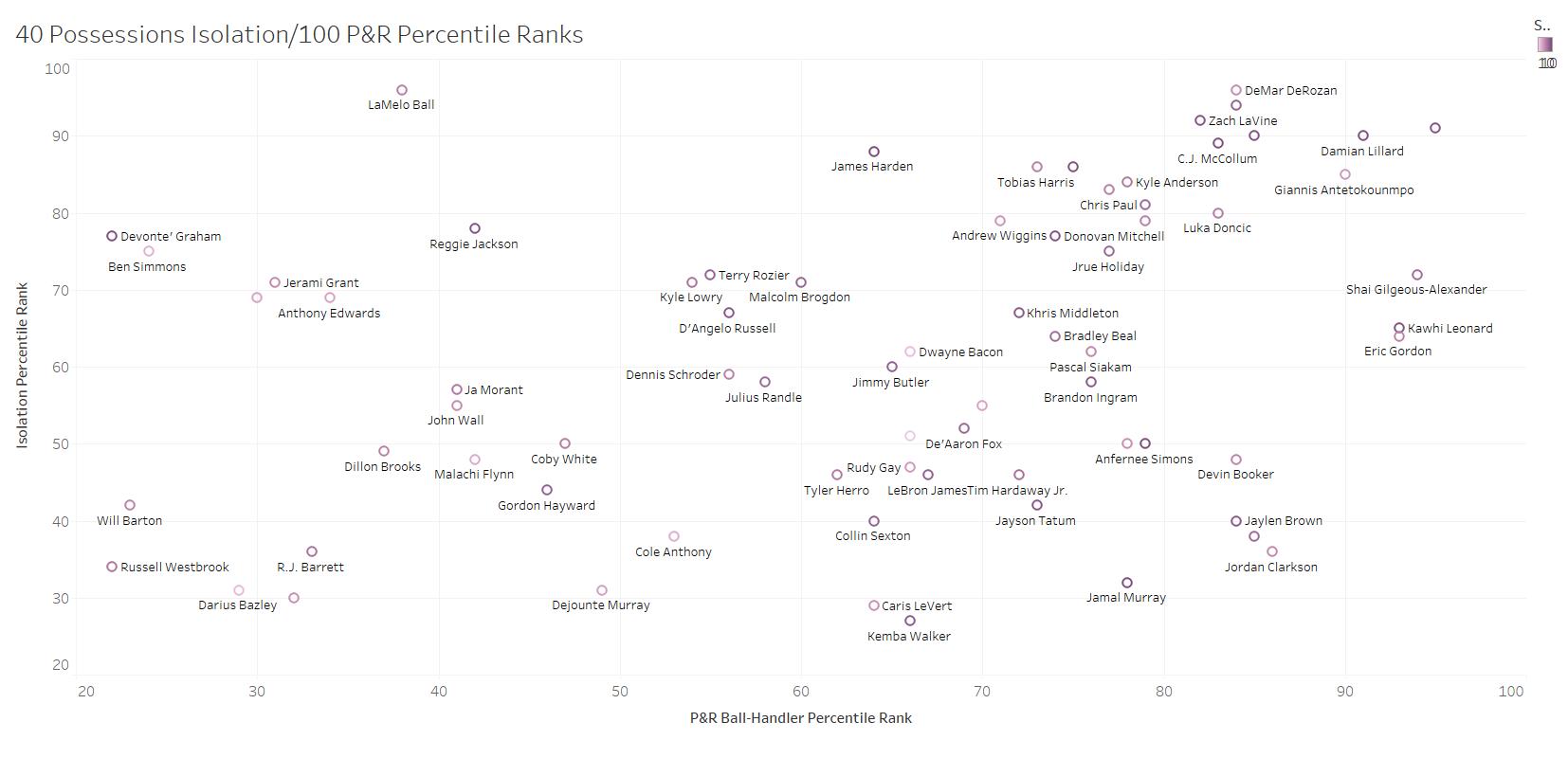
When evaluating “Tier 2” targets, our standards are relaxed. Instead of looking for the very elite in P&R and isolation, we are lowering our threshold and sample size. The graph below shows players who:
- Have at least 100 possessions as P&R ball handler
- Have at least 40 possessions of isolation
- Sorted by percentile–we’re specifically interested in players above average in both
Take a look at some of the players here:
Target #4: Collin Sexton (Under Contract-22 years old entering 2021-22 season)
2020-21 Stats (Per 36): 24.9 PPG, 4.5 APG, 3.2 RPG, 47.5% FG, 37.1% 3-PT, 81.5% FT
When lowering our standards to expand targets, Collin Sexton does come into play as an option. Sexton’s isolation performance is below our desired threshold (he ranked in the 40th percentile), but remember: these statistics are heavily influenced by making or missing shots. Looking at a year-over-year sample helps remove some variance and in 2019-20, Sexton was in the 80th percentile in isolation situations. Sexton has been an effective pick-and-roll player throughout his career, but his scoring punch is extremely impressive. Sexton averaged 24.3 PPG on 47.5% FG, very impressive marks for a 22-year old lead guard. Sexton is an efficient scorer who has improved every season, with his biggest leap coming in terms of his free throw rate and aggressiveness this past year. Sexton actively put pressure on the rim with the 7th most drives in the NBA last season. Sexton has established himself as a terrific three-level scorer who could be a beautiful offensive complement to Luka.
Despite the continued growth from Sexton, I do have enough concerns to knock him down a peg. First, while Sexton’s poor isolation shooting hurt his numbers, I do wonder how pure of a shot creator he really is. When taking a shot off 2+ dribbles, Sexton’s efficiency plummeted this past season. Take a look at the graph below for some evidence:

This trend held true during the 2019-20 season as well, indicating to me that, as Sexton is forced into more isolation heavy possessions, he does tend to become less and less efficient. That is not surprising, but it does contribute to his ranking as a “Tier 2” target, perhaps lower than some people had hoped or expected. A reasonable counterargument to this would be to emphasize how Sexton would not be forced into as much individual playmaking as he was in Cleveland. It’s a fair judgment to consider, but I still think better options exist for Dallas in the pure secondary creator mold. For example, Mike Conley had a greater percentage of his baskets unassisted than Sexton last year.
In addition to my hesitancy to anoint Sexton as a true secondary creator, I have three additional concerns. First, Sexton’s lack of passing has come under heavy criticism during his time in Cleveland. Sexton made 49.2 passes per game last season, a number that was fairly low given his usage rate. The Mavericks do not need more ball stopping players, especially an individual whose efficiency really drops as he dribbles more. Second, Sexton is an awful defender; his DLEBRON ranking was 119th out of 130 shooting guards. Tim Hardaway Jr. (123rd) was nearby, but Sexton’s poor defense is a hamper compared to other targets. I will say, I have admired Sexton’s competitive fire since his college days and don’t believe this is an effort issue. Lastly (and this is where my lack of insider knowledge hurts), why is Cleveland rumored to be shopping Sexton? The Cavaliers are mired in a deep rebuild and their best asset is on the market, despite being only 22 years old. It seems like a pretty damning assessment of Cleveland’s view on Sexton, although that is just conjecture on my end.
I will add this for Sexton: I had him as my #1 point guard prospect in the 2018 Draft, a take that has aged rather poorly. Despite that, Sexton has developed into a very good NBA player who deserves more recognition. Better options exist for Dallas, but matching Luka’s timeline with Sexton’s is intriguing. Sexton would have to be acquired via trade and while a Kevin Love/Sexton for Porzingis deal works, I think it’s unlikely. It sure feels like Dallas doesn’t have enough to acquire Sexton without incorporating a third team.
Target #5: Kyle Lowry (UFA-35 years old entering the 2021-22 season)
2020-21 Stats (Per 36): 17.8 PPG, 7.6 APG, 5.6 RPG, 43.6% FG, 39.6% 3-PT, 87.5% FT
Kyle Lowry has been another popular name in Mavs’ circles, although I am a bit lower on him as a potential fit compared to other players. Lowry is in a similar mold to Mike Conley: he’s a veteran presence who is a very good, but not elite playmaker, but terrific shooter. Lowry has ranked above average in terms of isolation and P&R over the past two seasons, but when forced to shoot off 2+ dribbles, his efficiency was rather poor. Lowry’s eFG% on 3-6 dribbles was 45.8% and for 7+ dribbles, it was 41.5%, both inefficient numbers compared to some of the other targets on our list. Lowry’s elite 3-PT shooting is certainly a major draw: he was 41.6% on catch and shoot and 37.7% on pull ups this past season.
When comparing Lowry with Conley, I think Lowry has the slight edge in his half court playmaking, but Conley is the superior defender. Lowry is no slouch on that end himself; he ranked 25th in DLEBRON among 106 point guards, which is still an impressive mark. However, he does not provide the same impact that Conley does. Lowry’s durability is an advantage compared to Conley, but I believe Conley is a better fit in Dallas even with the injury concerns, illustrating his higher ranking. I have seen a lot of individuals mention how Lowry could have a Chris Paul type of impact in Dallas, but truthfully, I really don’t buy that. Paul is a significantly better half court shot creator/playmaker than Lowry and overall, a much better player. Yes, there is a parallel between their veteran status, but that’s about it. Lowry will be 35 years old entering the season and if Dallas’ main justification for offering him a substantial contract is hoping to replicate Chris Paul/Phoenix, that is poor justification.
Overall, I’d put Dallas’ chances at landing Lowry as slim. Sure, the Mavericks in theory could do a Porzingis S&T for Lowry, a deal that could make sense. But, at this stage of his career, Lowry seems intent on playing for certain destinations, namely Miami, Philadelphia, or Los Angeles (and I guess Toronto, but I would be stunned if he returns). A Ben Simmons/Kyle Lowry S&T makes sense for both sides and Miami has been heavily rumored as well.
Extra Targets to Note:
Target #6: Spencer Dinwiddie (UFA-28 years old entering 2021-22 season)
2019-20 Stats* (Per 36): 23.8 PPG, 7.8 APG, 4.0 RPG, 41.5% FG, 30.8% 3-PT, 77.8% FT
Spencer Dinwiddie has been a hot name in the Mavericks’ rumor mill, as multiple reports over the past few weeks have indicated some interest. Personally, I have quite a few reservations about Dinwiddie, but his game still does deserve some consideration.
For our data, we are basing it off the 2019-20 season and past, as Dinwiddie missed basically all of last season with a torn ACL. Dinwiddie was an above average isolation and P&R player that year, ranking in the 69th and 62nd percentiles, respectively. The problem is the majority of Dinwiddie’s offense is rooted in inefficient shots and overall, Dinwiddie is a below average shooter. Dinwiddie’s career 3-PT mark is just 31.8%, well below the league average marks that usually hover around 35.5%. Dinwiddie’s ability to create his own shot/make plays for others is intriguing, but his ability to do it effectively is where the issue arises. While many players on our list saw their effectiveness drop with increased dribbles, Dinwiddie’s shooting is not impressive at any number of dribbles. Take a look at his chart below:

Dinwiddie’s below average shooting hampers him, but he is an impressive playmaker with a good track record of AST/TO ratio and at getting to the foul line at similar rates to DeMar DeRozan. Dinwiddie’s defense is also around league average for a guard and his 6’5 frame could unlock versatile lineups for Dallas.
Even with these pluses for Dinwiddie, I’m still very hesitant to endorse him for the Mavericks. Dinwiddie’s knee injury seems unlikely to effect his contract, but I don’t believe he’s worth $18-20 million annually. Better options certainly exist and while Dinwiddie’s scoring numbers and attainability are attractive, it does not mean his full game will properly elevate the Mavericks.
Target #7: Dennis Schroder (UFA-28 years old entering 2021-22 season)
2020-21 Stats (Per 36): 17.3 PPG, 6.5 APG, 3.9 RPG, 43.7% FG, 33.5% 3-PT, 84.8% FT
Dennis Schroder is another player who fulfills our relaxed criteria above; his rankings were a touch below Dinwiddie’s (59th in isolation, 56th in P&R), but Schroder was a phenomenal isolation player with Oklahoma City just a year earlier. Schroder has a quick first step and his finishing around the rim has greatly improved over the past two seasons. Schroder’s rough postseason has surely hurt his stock entering free agency, but his track record does indicate a potential 20+ PPG scorer.
Schroder’s defense has been maligned for much of his career, but he has improved on that end as of late. Schroder ranked 65th out of 130 qualifiers in DLEBRON and often took on tough assignments for the Lakers. Schroder’s game offers Dallas a different dynamic they’ve rarely had. He’s lightning quick, presses 94 feet, and takes on a bit of an agitator role. That’s not to say Schroder has my endorsement as a priority target for the Mavericks, but I do think his style could fit well in Dallas.
With Schroder’s advantages come some concerns as well. Schroder’s shooting for his career has been incredibly inconsistent. Schroder was solid on spot ups this past season, but particularly poor off the dribble. For his career, he’s just a 33.7% 3-PT shooter; yes, he is slightly better than Dinwiddie, but I almost trust Dinwiddie’s jumper more. Schroder is also not as efficient as a playmaker as Dinwiddie either, boasting a lower assist/turnover ratio and a higher turnover rate. At his best, Schroder can be an impactful, spark plug type player. At his worst, he’s an inefficient shot creator who does not actively help the roster. That type of volatility makes me pause on fully advocating for a Schroder-to-Dallas movement.
Another obstacle to landing Schroder is the Los Angeles Lakers’ cap situation. Recent reports have indicated the Lakers view Schroder as their best asset to upgrade the roster in a sign-and-trade. What can Dallas offer in a potential S&T? Now, it doesn’t matter if Dallas and Schroder agree to a deal, but remember, Schroder turned down a 4-year, $84 million extension during the season with the Lakers. His contract is probably going to be in the $16-18 million range annually. It just feels tough to 1) desire that type of salary for Schroder, and 2) work out a potential S&T so Dallas has extra cap after a Schroder deal.
Bonus Names
- Reggie Jackson: Reggie Jackson earned the nickname “Mr. June” for his incredible play this past postseason. It was tough to watch Jackson’s performance and say he couldn’t help Dallas, but I wonder how much stock should be put into his great playoff run. Jackson had a great year overall with the Clippers, including knocking down 45.3% of his catch and shoot threes while being effective in the pick-and-roll. However, Jackson struggled in P&R last season and for his career, has not shown the consistent ability to operate as an efficient and effective secondary creator. He should be considered, but his postseason run likely inflated his salary.
- Derrick Rose: No, it is not the early 2010s anymore, but Derrick Rose is still an effective playmaker. Rose has been extremely efficient in terms of isolation and P&R the past two seasons, although his sample size is a tad small. Still, Rose’s ability to create off the dribble while maintaining solid effectiveness adds a lot of credence to his half court creation ability. At his best, Rose is an ideal sixth man, however, not the secondary creator Dallas can rely on.
Overall, Dallas really has to land one of McCollum or DeRozan for me to feel confident that Dallas will take a substantial step forward in the postseason next year. Adding one of Conley, Sexton, or Lowry has me confident Dallas will definitely improve, but I still think they’d be a step below championship aspirations. With McCollum/DeRozan, I think that changes.
Need #2: Find a Complementary Pairing to the Shot Creator
This specific need is what can jolt Dallas from a very improved roster to a legitimate championship threat. While adding McCollum/DeRozan, or really, any of the aforementioned top five targets, would elevate the Mavericks by a significant degree, adding another high-caliber player vaults them. Now, Dallas’ cap situation poses a major hurdle to accomplishing this, as we’ve already outlined the issues they may face to even acquire DeMar DeRozan via free agency. However, there are options to clear the cap that I’ll outline again here:
- Use Porzingis as the method to acquiring the scorer, preferably McCollum/DeRozan OR, use Porzingis as the method to acquiring the complement via S&T
- Trade Josh Richardson, Trey Burke, and Willie Cauley-Stein while taking minimum salary back
- Trade Maxi Kleber for a draft pick and free up his $8M
The first option is the most realistic, but other options are also in play. Dallas could also utilize Richardson as a legitimate trade chip to add a player. Yes, he’s coming off a rough season, but he did battle COVID-19 and started out the year strong. I’d bet he has some value on the market.
Tier 1 Targets
Target #1: John Collins (RFA-24 years old entering 2021-22 season)
2020-21 Stats (Per 36): 21.6 PPG, 9.1 RPG, 1.5 APG, 55.6% FG, 39.9% 3-PT, 83.3% FT
The Dallas Mavericks have been heavily connected to John Collins for nearly a year now and he remains a strong fit. The Atlanta Hawks’ owner in a recent interview with The Athletic hinted at their inability to retain everyone on their roster, which boosted fans’ hopes that Collins may be attainable. I still think Atlanta is more likely to trade Clint Capela and/or Danilo Gallinari to keep their primary core intact, but a gaudy offer sheet could force Atlanta’s hand.
Collins is a fantastic player, but he must come to Dallas in conjunction with a shot creator. Simply adding Collins, who would come at the expense of Tim Hardaway Jr., would not significantly boost Dallas, in large part because their half court offensive creation does not improve. Yes, Collins is highly effective in the post (66th percentile, 1.01 PPP), but the Mavericks’ offense shouldn’t revert to Collins post ups as their secondary form of half court offense. Collins is an efficient 3-PT shooter, but has never been a high volume guy either. Collins, overall, is a really efficient half court scorer who takes good shots (55.1% eFG on jumpers is elite), and he’s a tremendous lob threat as well. But, without another playmaker alongside Luka, his value would be muddled. However, that is the case for all of the players in this section, indicating the complementary nature of this need.
One thing that really impressed me was Collins’ postseason run. Collins was Atlanta’s “heart and soul” and showed great toughness and competitive spirit. He never backed down from the competition, hit big shots, and embraced doing the dirty work. Collins’ defense has dramatically improved since entering the league and was 53rd among 109 qualified power forwards in DLEBRON this past season. Collins’ rim protection is solid too, boasting a good block rate despite playing further away from the basket. Alongside a secondary shot creator, Collins would be an ideal third option for Dallas.
Now, the major hurdle is it’s tough to envision a scenario how Dallas acquires a shot creator and John Collins. However, if the Hawks feel they cannot re-sign everyone, one potential is a Collins S&T, where Dallas could trade Josh Richardson and Maxi Kleber to Atlanta for Collins. This makes some sense for Atlanta, as Richardson can give them some additional perimeter defense while they were reported to have interest in Kleber a few seasons ago. It’s fun to dream, so what about a summer where Dallas trades Porzingis for McCollum, and then Richardson/Kleber in a S&T for Collins? It’s a cap maneuvering that is possible; these are the type of aggressive moves/cap tricks Dallas should aim to pull this summer. Dallas could theoretically do both trades and still have $15-20 million in cap space to play with. It’s why utilizing KP as a trade chip unlocks massive roster potential.
Target #2A: Tim Hardaway Jr. (UFA-29 years old entering 2021-22 season)
2020-21 Stats (Per 36): 21.1 PPG, 4.2 RPG, 2.3 APG, 44.7% FG, 39.1% 3-PT, 81.6% FT
I detailed my thoughts on Tim Hardaway Jr. in Part 1 and I believe his positioning on this list further illustrates them here. Hardaway Jr. has not shown the ability to be that true secondary creator and considering his poor defense, I’m not exactly sure how he meshes on a championship roster. However, THJ is a perfect complement for a veteran guard like Conley or Lowry, meaning that alongside one of those two, he should be a priority for Dallas to retain. Hardaway has really improved during his two full seasons with the Mavericks; he’s had two fantastic years in P&R and has hovered around league average in isolation. THJ’s shooting has seen a major jump as well and he saw huge improvements in his shooting efficiency off the dribble, boasting an eFG% of 50.3% on 3-6 dribbles and 55.8% on 7+ dribbles. Hardaway Jr. is an extremely valuable offensive performer for the Mavericks.
However, with that being said, should Hardaway Jr.’s growth stand in Dallas’ way of landing McCollum or DeRozan? The answer should be no. And, in that regard, I struggle to see a way where a Doncic, McCollum/DeRozan, Hardaway Jr. lineup survives defensively. This dilemma is what makes Hardaway Jr.’s future with the Mavericks so tough to gauge. He ranked 123rd out of 130 shooting guards in DLEBRON last season. Tim’s offense is great and he’s an extremely low turnover player, but the only realistic path for Dallas to build a championship roster with him seems to be by landing either Conley/Lowry. Personally, I’d be more inclined to swing for McCollum/DeRozan and find a better complement for one of those two, rather than try and find a complement for Hardaway.
An advantage for Dallas is they own Hardaway Jr.’s Bird Rights if they maintain his $28 million cap hold. Essentially, Hardaway Jr.’s Bird Rights act in this manner; Dallas has $21 million in cap space, if THJ signs for $18 million, it only eats away $10 million of Dallas’ cap space due to Bird Rights ($28 mil cap hold – $18 mil salary). The added flexibility of THJ’s Bird Rights has me list him above Norman Powell.
Another avenue for Dallas to consider is a sign-and-trade. If Dallas whiffs on everything and Hardaway Jr. departs, he could be utilized as a S&T chip to bring a talented player back. If the THJ/Miami Heat rumors are legitimate, the Mavericks could do a double S&T and potentially land Duncan Robinson. If the THJ/Indiana Pacers rumors have legs, the Mavericks could S&T Hardaway Jr. to Indiana for Doug McDermott, T.J. McConnell, or T.J. Warren.
Target #2B: Norman Powell (UFA-28 years old entering 2021-22 season)
2020-21 Stats (Per 36): 20.9 PPG, 3.5 RPG, 2.1 APG, 47.7% FG, 41.1% 3-PT, 87.1% FT
Overall, Norman Powell and Tim Hardaway Jr. have fairly similar games. This past season, Powell as an elite isolation player, albeit, on an extremely small sample size. However, Powell’s main skill is his phenomenal 3-PT shooter. Powell shot 43.2% on catch and shoot threes and 36.8% on pull up threes this past season. His track record indicates he was not just a beneficiary of the increased shooting percentages with limited capacity crowds, either. Powell has shot 40.0%, 39.9% and 41.1% the past three seasons from deep. With Luka Doncic feeding him passes, it’s not unrealistic to envision Powell potentially reaching 42-43% as a 3-PT shooter, which would further elevate his elite shooting status.
Unlike Hardaway Jr., however, Powell is slightly less effective on more dribbles, where his eFG% was wildly low on 2 dribbles and 7+. A lot of that is shooting variance since, on 3-6 dribbles, his eFG% was quite high. All three of those probably were a bit extreme due to a one year sample. Powell is also a higher turnover player and has similar defensive deficiencies, ranking 86th in DLEBRON among 99 small forwards. However, Powell is highly active on defense and in the past, has been part of fantastic defensive teams in Toronto. Powell had a high number of deflections this past season and, although he’s 6’3, he’s stocky and moves well laterally. Hardaway Jr. competes well defensively even though his numbers are poor, and truthfully, Powell is similar, although I’d argue he’s better on that end of the court.
With the news today surrounding Damian Lillard’s future in Portland, I’m not sure what Powell’s future looks like. Regardless, there should be plenty of opportunities for Dallas to pick off some talented guys. While Lillard is the pipe dream and McCollum should be the realistic dream, Powell’s shooting and potential isolation improvements give me hope he could be a blossoming player. However, like with Hardaway Jr., the road block exists. The Portland lineups of Powell, McCollum, and Lillard were horrible defensively and it’s tough envisioning how Dallas’ potential Powell, McCollum/DeRozan, Doncic lineup is much better. Powell is an ideal fit with Conley or Lowry, but considering the cap advantages Dallas gets from retaining THJ, Hardaway edges him out on the list.
Target #3: Andrew Wiggins (Under Contract-26 years old entering 2021-22 season)
2020-21 Stats (Per 36): 20.1 PPG, 5.3 RPG, 2.5 APG, 47.7% FG, 38.0% 3-PT, 71.4% FT
Andrew Wiggins is a polarizing name. Many people are quick to think he’s been a bust as the #1 overall pick given his sky high expectations entering the league and that his contract is horrible. However, that is not true. Wiggins was quietly fantastic for the Warriors last season. While there should be questions regarding how legitimate his improvement is, or if it is a byproduct of Golden State’s system, Wiggins’ production this past year has made him a legitimate consideration in my opinion for the Mavericks.
Truthfully, there is a serious argument to be made that Wiggins should be thrown into the secondary shot creator need. That’s how good he was last season. Wiggins was just one of 17 players to record over 100+ possessions of isolation and P&R and rank in the top 30% in terms of PPP in both. The rest of the list? DeMar DeRozan, Kevin Durant, Zach LaVine, Steph Curry, Kyrie Irving, Damian Lillard, C.J. McCollum, Paul George, Giannis Antetokounmpo, Trae Young, Chris Paul, Luka Doncic, Zion Williamson, Donovan Mitchell, Jrue Holiday, and Shai Gilgeous-Alexander. That is elite company Andrew Wiggins was with this past season, making him a fantastic option for the Mavericks.
The debate surrounding Wiggins is how much is his improvement from Golden State’s system? In prior years, Wiggins was a below average isolation player and just average in P&R. We know shooting efficiency is the main driver and while Wiggins had a large sample size last season, did the league-wide shooting bump play a role? Ideally, I’d like to see Wiggins replicate this type of shot creation before making a move to get him. One specific concern is that although Wiggins’ scoring efficiency improved, his passing has not. The Warriors averaged the third most passes per game last season, but Wiggins’ assist rate has not improved and his assist/turnover ratio still leaves a lot to be desired. Wiggins’ eFG% last year was 54.3%, despite hovering around 48% for much of his career. I would argue that Golden State’s system made him better, but I also believe that playing with Luka Doncic can help Wiggins continue his growth. Take a look below at Wiggins’ shooting splits off dribbles this past season:

Wiggins was also well above average in pull up 3-PT% and slightly above average on catch and shoot. He really had a fantastic offensive season.
Another thing to mention, and in stark contrast from Hardaway Jr. and Powell, is that Wiggins is a terrific defender. Wiggins had the 61st highest DLEBRON ranking among 539 players and was 16th among 119 qualified power forwards. Wiggins’ length and lateral movement give him tremendous potential that he’s begun to fulfill with Golden State.
The biggest hurdle for acquiring Wiggins is his contract. Wiggins has 2 years and roughly $64 million remaining on his deal. Ironically, a Porzingis for Wiggins swap works perfectly, although I’d love if Dallas could get their hands on Damian Lee, Eric Paschall, or Mychal Mulder additionally via trade. Porzingis for Wiggins is a deal I’d be rather lukewarm on, especially since I think Wiggins is a perfect fit alongside McCollum/Doncic, yet the Mavericks likely can’t trade for both McCollum and Wiggins (unless they did a S&T of Hardaway Jr. and Richardson to Golden State, but now we’re just in pure fantasy land). The Warriors have been rumored to be interested in Porzingis and while I’m not solely on a Porzingis/Wiggins deal straight up, I would much rather prefer Wiggins to Kelly Oubre.
Tier 2 Targets:
Target #4: Evan Fournier (UFA-29 years old entering 2021-22 season)
2020-21 Stats (Per 36): 20.6 PPG, 4.1 APG, 3.7 RPG, 45.7% FG, 41.3% 3-PT, 78.8% FT
Another player in the Hardaway Jr./Powell mold, Evan Fournier is another guy under consideration, but a tick below. Fournier was an elite shooter this past season; he was one of only ten players to shoot 40% on both catch and shoot and pull up threes (min. of 50 attempts for both). Fournier’s numbers hold up over time as well, as he knocked in 42.8% of catch and shoot threes and 36.7% of pull up threes during the past season. Fournier also adds some playmaking chops that neither THJ nor Powell have, as he averaged 4.1 APG and has graded slightly above average in P&R settings.
While this all seems like Fournier should be ahead of Hardaway Jr. and Powell on our list, I do have some concerns. Fournier is still reliant on teammates to set him up for his best shots, as 63% of his shots were assisted while his eFG% plummeted amongst more dribbles. Powell had 66% of his shots assisted, but his eFG% had the high variance (illustrated earlier), while THJ’s improved upon more dribbles. I do think Fournier’s shot creation skill and ability to get to the line is intriguing, but ultimately, I believe THJ/Powell offer more overall scoring upside along with some much needed athleticism. Fournier’s defense is substantially better, however (38th in DLEBRON amongst 120 shooting guards).
Truthfully, I don’t view Fournier as a realistic target for Dallas, but he should be monitored. He has a lot of strengths as outlined above, but the Boston Celtics seem very likely to retain him since they cannot easily replace him. Plus, why would Dallas pay Fournier and incur a higher cap dent than retaining THJ on a similar contract with a smaller cap hit due to his Bird Rights?
Target #5: Devonte’ Graham (RFA-26 years old entering 2021-22 season)
2020-21 Stats (Per 36): 17.7 PPG, 6.4 APG, 3.2 RPG, 37.7% FG, 37.5% 3-PT, 84.2% FT
Devonte’ Graham is an underrated target for Dallas this summer. I haven’t heard any rumblings regarding Graham’s RFA status nor any Dallas interest, but that would be a mistake. Remember, Graham was a Most Improved Player candidate last season and while his off the dribble shooting plummeted this past season, he was still a good shooter.
Graham’s offensive output this past season is tough to wrap your head around. Graham has always been an incredibly poor finisher, but his P&R play took a massive dip this year, finishing in the 22nd percentile after being in the 64th percentile the year prior. Graham’s shooting decline off the dribble likely contributed to this, but it does lead me to believe he’s just an average secondary creator. However, Graham is a phenomenal shooter; he knocked down 42.3% of his catch and shoot threes and while his pull up game regressed, he was above average during 2019-20. If Graham can rediscover his dribble game from that season, he can be a really strong complementary weapon for Luka Doncic.
One aspect of Graham’s game I really appreciate is his playmaking. Outside of Luka and Jalen Brunson, does Dallas really have someone who can efficiently generate shots for others? Graham could be a huge boost there; he had the 11th best assist/turnover ratio amongst players who had 15+ MPG and 15+ games played. Graham’s assist total indicates this isn’t just a benefit of a low turnover player, either. Graham’s defense isn’t spectacular, but ranking 64th in DLEBRON among 106 point guards is not a pure liability either. Truthfully, I think Graham would slot well next to DeMar DeRozan and be a nice piece.
Ultimately, Graham’s game is not the most appealing, but the way in which Dallas could realistically acquire him fascinates me. The Hornets have lots of cap space this summer and have reportedly been interested in Kristaps Porzingis. Dallas could do a S&T, land Devonte’ Graham, and get P.J. Washington from Charlotte for Porzingis. It’s a fair trade for both sides since the Hornets already have LaMelo Ball and Terry Rozier, plus get their Washington replacement in Porzingis. For Dallas, they get Graham, Washington, a Dallas native who’s a fantastic defender, and, if Graham gets a 4/64 deal, would clear $12-13 million in space, giving them max room for DeRozan without having to worry about Josh Richardson’s option. A starting five of Graham, Luka, DeRozan, Dorian Finney-Smith, and P.J. Washington sounds quite intriguing to me. If Dallas then found suitors for Richardson, Burke, and Cauley-Stein, they could work their way into enough money for Richaun Holmes. How about that off-season?
Target #6: T.J. McConnell (UFA-29 years old entering 2021-22 season)
2020-21 Stats (Per 36): 11.9 PPG, 9.1 APG, 5.1 RPG, 55.9% FG, 31.3% 3-PT, 68.8% FT
I’ll admit, I absolutely love T.J. McConnell. Truthfully, he reminds me a lot of J.J. Barea due to his pesky style of play. McConnell is a terrific passer/playmaker, he thrives off mid-range/short shots, and plays elite defense. Yes, he’s not a name that’ll get Mavericks’ fans off their feet during the summer, but McConnell is a winning player who’d make Dallas better.
McConnell is a player I think Dallas has been lacking for a while, really, ever since J.J. Barea’s Achilles tear. McConnell is incredibly effective in the pick-and-roll, ranking in the 72nd percentile this season and 54th percentile a year ago. He has a career 32.8% assist rate and while he boasts an extremely high turnover rate (2nd highest in the league), he actually had the 15th best assist/turnover ratio in the league last season amongst players with 15+ MPG and 15+ games played. A large reason why McConnell is so successful is because of the pressure he puts on the rim. McConnell is always in attack mode; he averaged 12.1 drives per game last season and totaled 832 overall, easily the most in the league for a reserve. McConnell is also a terrific finisher for his size (63.3% at the rim for his career) and his in between game has improved, connecting on 57.0% and 54.5% of his shots within 3-10 feet of the rim over the past two seasons. Yes, McConnell doesn’t shoot many threes, but he’s elite from mid range in. His average shot distance was 8.4 feet from the basket last season, nearly unheard of from a guard.
For as good as McConnell’s offense is, it’s his defense that’s most impressive. McConnell ranked 16th among 106 point guards in DLEBRON, but it’s his activity that would be a huge boon to Dallas. McConnell had the highest steal percentage in the league last season and 245 total deflections, the 2nd most in the NBA despite coming off the bench. The Mavericks have perennially been below average in terms of steals/deflections, so McConnell could be a massive addition in that regard. He’s a high IQ, high energy player who would be an instant fan favorite with the Mavs. Sign me up.
McConnell is a UFA and Indiana is very unlikely to bring back all of McConnell, Doug McDermott, Jeremy Lamb, and T.J. Warren for next season. However, there is a road block: Rick Carlisle is Indiana’s new head coach and you know he’d love a player like McConnell. I’d be surprised if the Pacers let him go, but if they do, Dallas has to pounce.
Target #7: Lonzo Ball (RFA-24 years old entering 2021-22 season)
2020-21 Stats (Per 36): 16.5 PPG, 6.5 APG, 5.4 RPG, 41.4% FG, 37.8% 3-PT, 78.1% FT
It may seem surprising to see Lonzo Ball so low on this list, especially beneath Devonte’ Graham and T.J. McConnell. However, multiple factors are at play here. First, the roster flexibility the Graham S&T could give Dallas rises him up the list a bit, along with his shooting and solid playmaking. For McConnell, his projected salary is half of what Ball might get and I love his game. Lonzo Ball is a terrific player, but he’s not as good of an overall player as we may expect, especially for his price.
Truthfully, Ball is not the offensive creator that people think he is. Yes, Ball can dribble and shoot, but his game is not to create for himself off the bounce. That makes Ball a perfect complement for someone like DeMar DeRozan or C.J. McCollum, but how do you reach a realistic scenario where you get both of them? I struggled finding a solution to this with Andrew Wiggins, but I view Wiggins as a better asset, indicating his higher ranking on my list. With Ball, I struggle to see any sort of avenue and think his limited shot creation severely hinders a potential Mavericks’ lineup, especially if Luka gets blitzed.
A major reason why Ball lacks the half court offensive creation is his below average off the dribble game. Ball averaged only 5.0 drives per game this season, a poor mark considering the Pelicans ranked 7th in drives per game (and Lonzo is the starting point guard). Lonzo’s drives per game numbers were similar to Payton Pritchard, Cam Reddish, Grayson Allen, Svi Mykhailiuk, Isaac Okoro, his backup, Kira Lewis Jr., and Miles Bridges. Look how poor Lonzo performed when shooting off the dribble as well:
| No Dribbles | 70.3% 2-PT, 40.4% 3-PT |
| 1+ Dribble | 44.2% 2-PT, 31.3% 3-PT |
Obviously, there should be a contrast, but for the contrast to be that stark is a problem. Lonzo’s standstill shooting is encouraging: he knocked down 40.2% of his catch and shoot attempts and ranked in the 73rd percentile on spot ups, with relative consistency across years. Still, Ball is far from an elite half court weapon and given his anticipated price, I feel a bit uneasy. Remember, the Mavericks have tried to get a secondary playmaker the past two off seasons, going with Delon Wright and Josh Richardson. Both have failed in Dallas, in large part because they didn’t put pressure on the rim. Yes, Lonzo’s ideal role (and what we’re classifying him as) is a complementary piece to DeRozan or McCollum, but even then, you still need willing individual shot creators.
Lonzo’s major draws are his playmaking/passing and defense. Lonzo’s pick-and-roll has always been hot and cold (69th percentile this season, 11th percentile the year prior), but his assist/turnover ratio is pretty stellar. However, the prevailing thought is Lonzo could unlock Dallas’ transition offense, a belief I strongly disagree with. Ball has been horrible in transition the past two seasons, turning the ball over at an extremely high clip. Defensively, Ball’s reputation has outpaced his performance, as he hasn’t been elite in New Orleans. Ball was 31st among 106 point guards in DLEBRON, a really good mark, but not dynamite.
It may sound like I’m being overly pick on Ball, but truthfully, I do really like his game and think he’s a great player. Remember: I believe Dallas should be particularly strict with their personnel moves this off season because it could be their last chance to meaningfully upgrade their roster for a while. I have tried to be critical of every target and with Ball, there are too many glaring weaknesses in areas that have to be a strength. It would be wonderful if Dallas could magically wish the salary cap away and somehow land DeRozan/McCollum and Ball, but given his salary (like Wiggins) I just don’t deem it possible.
Extra Targets to Note:
Eric Gordon (Under Contract-32 years old entering 2020-21 season)
2020-21 Stats (Per 36): 21.9 PPG, 3.2 APG, 2.6 RPG, 43.3% FG, 32.9% 3-PT, 82.5% FT
Before you groan and say no, hear me out on Eric Gordon. Very quietly, Eric Gordon has been one of the best individual shot creators in the NBA over the past few seasons. Gordon was in the 93rd percentile in pick and roll this past season and the 64th percentile in isolation. Gordon was just one of 19 players to have 40+ isolation plays, 100+ P&R plays and rank in the 60th and 75th percentile in both (respectively). Not only that, but these marks hold up over a three year sample. During the 2019-20 season, Gordon was 82nd percentile in isolation and 88th in P&R and during the 2018-19 season, he was 80th in isolation and 69th in P&R. You cannot chalk that year-to-year consistency up to a “small sample”.
Take a look below at our graph for Gordon’s shooting eFG% by dribble amount:
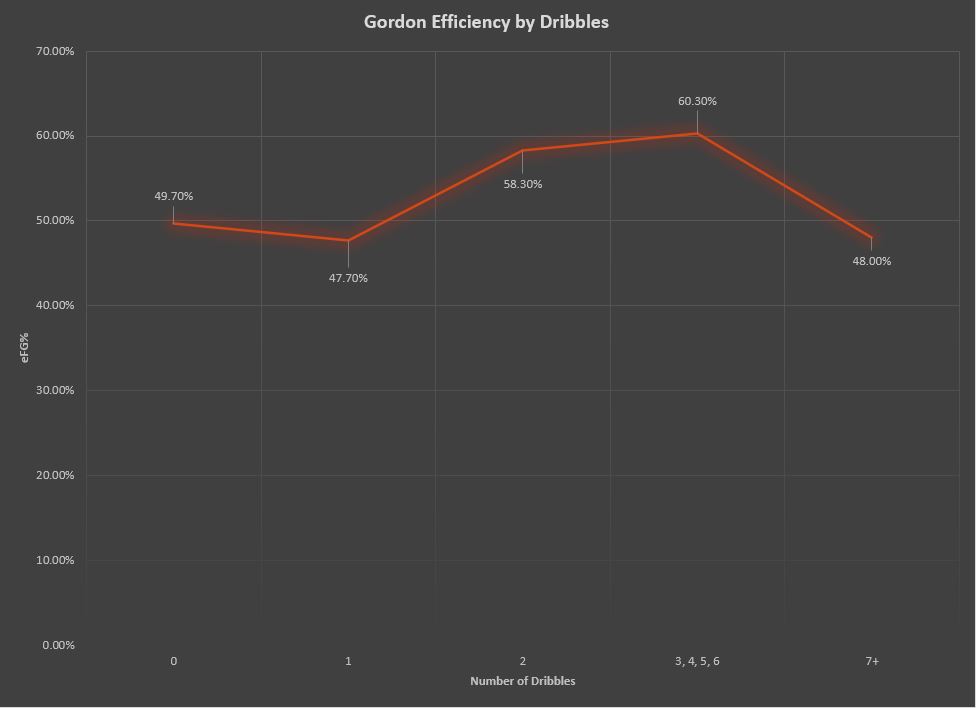
These are really impressive marks from Gordon and hold up over time. Truthfully, I think it illustrates how Houston has deployed him incorrectly. Gordon is not a great spot up shooter, but he is great with the ball in his hands. Dallas could give Gordon the opportunity to run the offense without Luka on the court and, when needed, Gordon can be a standstill shooter, albeit he is wildly overrated in that regard.
For as great as Gordon’s shot creation is, there are ample concerns. Gordon has never been a great passer/facilitator; he has a high turnover rate, AST/TO ratio around 1.00, and a below average pass rate when driving. Gordon has averaged 3+ assists one time since 2015-16. Gordon also really struggles defensively; he ranked 112th out of 130 shooting guards in DLEBRON. He’s been good in the past on that end, but took a huge step backwards this past season. Some may chalk it up to playing on a bad team, but considering Gordon’s age and injury history, I’m not sold. Additionally, Gordon’s 3-PT shooting, as alluded to, is overrated. Gordon shot 38.3% on catch and shoot threes two seasons ago, but since then, has been at 28.4% and 32.8%, well below league average. His pull up 3-PT shooting has been above average, but still not at an elite level.
Gordon’s contract with Houston and the Rockets’ timeline also makes it difficult to envision a trade match. Houston is likely looking to move Gordon for picks/young assets, while Dallas cannot offer that. If a three team trade were to come about, that’s a possibility, but other than that, I have a hard time seeing a deal, unless Houston would do Richardson for Gordon, which could cost Dallas $6-7 million in cap space.
Alec Burks (UFA-30 years old entering 2021-22 season)
2020-21 Stats (Per 36): 17.9 PPG, 6.5 RPG, 3.1 APG, 42.0% FG, 41.5% 3-PT, 85.6% FT
Alec Burks is a very under-the-radar player, but boy is he an efficient shooter. Burks knocked down 46.5% of his pull up threes and 38.2% of catch and shoot threes last season, both fantastic marks. His pull up three point percentage was the third highest in the league among qualified players. Burks does have a multi-year sample to add validity to those percentages being independent of the one year shooting bump. Burks does struggle finishing at the rim, but he’s effective off the bounce, boasting an eFG% above 50% on shots that were 0, 1, 2, or 7+ dribbles. Interestingly enough, 45% of Burks’ makes were unassisted, adding to the belief that he can consistently create his own shot, and do it at a fairly high clip. It is very easy to envision a role for Burks where, if Luka gets blitzed, Burks can get the pass and make a shot for himself off the dribble. It’s an area where Dorian Finney-Smith struggles, but Burks can thrive. They are good complements for each other and Burks fits seamlessly alongside some of the secondary creators I have mentioned.
Burks does add other value on the court as well. He’s an excellent rebounder for a guard, boasting a similar defensive rebounding rate to Maxi Kleber. Burks was also slightly above average defensively, ranking 58th in DLEBRON among 130 shooting guards. He is unrestricted and after a strong year with the cap flush Knicks, I’d be surprised if they let him walk. He’s not a top notch player to jolt Dallas into title contention, but he does make them better.
Bonus Names
- Jeremy Lamb: Briefly, Lamb was elite in isolation and P&R this past season. It was a small sample and year-to-year, it holds up a bit. Overall, I think he’s slightly above average in both and a very good catch and shoot shooter. Lamb can offer a little shot creation, but good standstill shooting, decent playmaking, and passable defense. He’s another name to consider. As mentioned, I don’t see how Indiana keeps all of McConnell, McDermott, Warren, and Lamb. If Carlisle wanted Dwight Powell, a Powell for Lamb swap works and even makes some sense for both parties.
- Goran Dragic: The biggest draw of Dragic to Dallas is his friendship with Luka. That shouldn’t be understated, but Dragic really struggled last season. It could have been due to his extremely shortened off season, but Dragic has a concerning injury history and is aging. He can still score on his own and was terrific in isolation and P&R just a year ago, but how real was his decline last season? He was horrible defensively, took a step back playmaking/finishing, and his shooting is not elite enough to justify major minutes. There’s still some hope Dragic can regain his form, but he shouldn’t be a priority.
- Talen Horton-Tucker: Talen Horton-Tucker is such a unique player. Horton-Tucker was above average in both isolation and P&R this past season, plus got more efficient when taking more dribbles. In 2-3 years, I think he could be a really nice bucket getter. However, that’s a risky gambit for Dallas to take as they have to press more urgency on winning now. Horton-Tucker’s shooting is poor and his offense is still just average or so compared to the entire league. I like his upside, especially defensively, but there are slightly safer options.
- Rudy Gay: I thought Rudy Gay would be higher, but after doing some analysis I think he’s more of an emergency target. Gay is still a nice player; throughout his career, he’s shown the ability to hit contested jumpers. Gay has been a good P&R player over the past few seasons, but his isolation play has been below average and his shooting has been hot and cold throughout his career. However, he can still get you a basket in the half court, making him a possibility.
- Victor Oladipo: In November, there were many Mavs’ fans dreaming of Oladipo. Now, it seems like nobody is seeking him out. Oladipo is such a tough player to realistically gauge utilizing data because he’s barely played the past two seasons. However, I’d totally take the chance on a one-year “prove it” type of deal if Dallas’ primary options fall through. The Oladipo of 2.5 years ago would’ve been the perfect fit alongside Doncic. I question if he can hit that level again, but if Dallas fails elsewhere, I’ll take the chance.
Need #3: Add More Shooting
For as bad as Dallas started out the year shooting the ball, they ended up faring pretty well from 3-PT range. The Mavericks were 18th in 3-PT% last season, which, while respectable, is a problem considering they had the 6th highest 3-PT rate in the league. Dallas was 23rd in wide open 3-PT%, further indicating the need for more shooting. Now, it is important to note that a lot of the players listed above can fill this specific need. For example, a guy like C.J. McCollum gives Dallas that secondary creator while adding more shooting. However, in this section, I’ll discuss players who are slightly more of the pure shooter type, with some ancillary skills as well.
Before we dive in, here’s a brief look at 3-PT% numbers to know. The league average 3-PT% last season was 36.7%, it was 37.8% on catch and shoot and 33.9% on pull ups. The Mavericks had just three shooters who, on a substantial sample, were above average in all three categories: Tim Hardaway Jr., Dorian Finney-Smith, and Kristaps Porzingis. That is a problem. Jalen Brunson, I should note, was 0.5% off from hitting the pull up requirement.
Another note to make is how real the Luka Doncic 3-PT% bump is. Last season, due to reduced crowd capacity (theory) and the prevalence of drop coverage (theory), players shot extremely well from 3-PT range. The league average increased by nearly 1%. That’s a huge jump. So, not only did players get a 3-PT% bump, on average, but when you play with Luka Doncic, you sometimes get a bump as well. It wasn’t the case for all Mavericks, but of the seven Mavericks with a legitimate sample size to work with, 71% shot better from deep with Luka passing them the ball (Josh Richardson and Jalen Brunson were the only exceptions). The notable splits included:
- Maxi Kleber: 44.7% off Luka passes, 39.0% without
- Dorian Finney-Smith: 39.8% off Luka passes, 39.1% without
- Tim Hardaway Jr.: 40.3% off Luka passes, 38.7% without
- Kristaps Porzingis: 39.1% off Luka passes, 37.0% without
- Trey Burke: 43.2% off Luka passes, 32.1% without
Yes, the Luka Doncic bump does exist, even if it seems small.
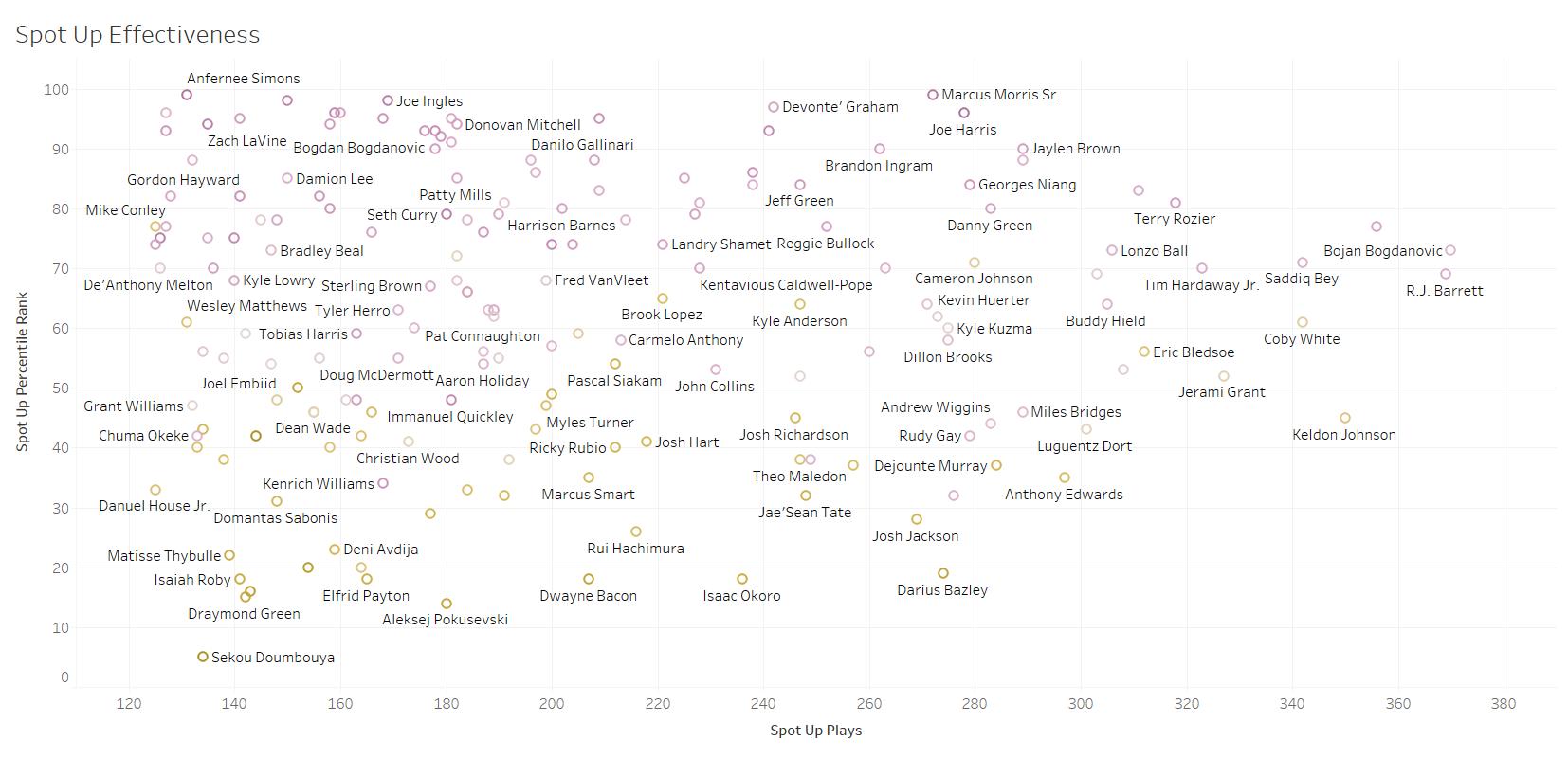
To augment my rankings, we have some visualizations to match. The first one is a simple spot up efficiency dashboard. This indicates the amount of spot up plays a player had and their percentile rank on said plays, with a minimum sample of 125 possessions:
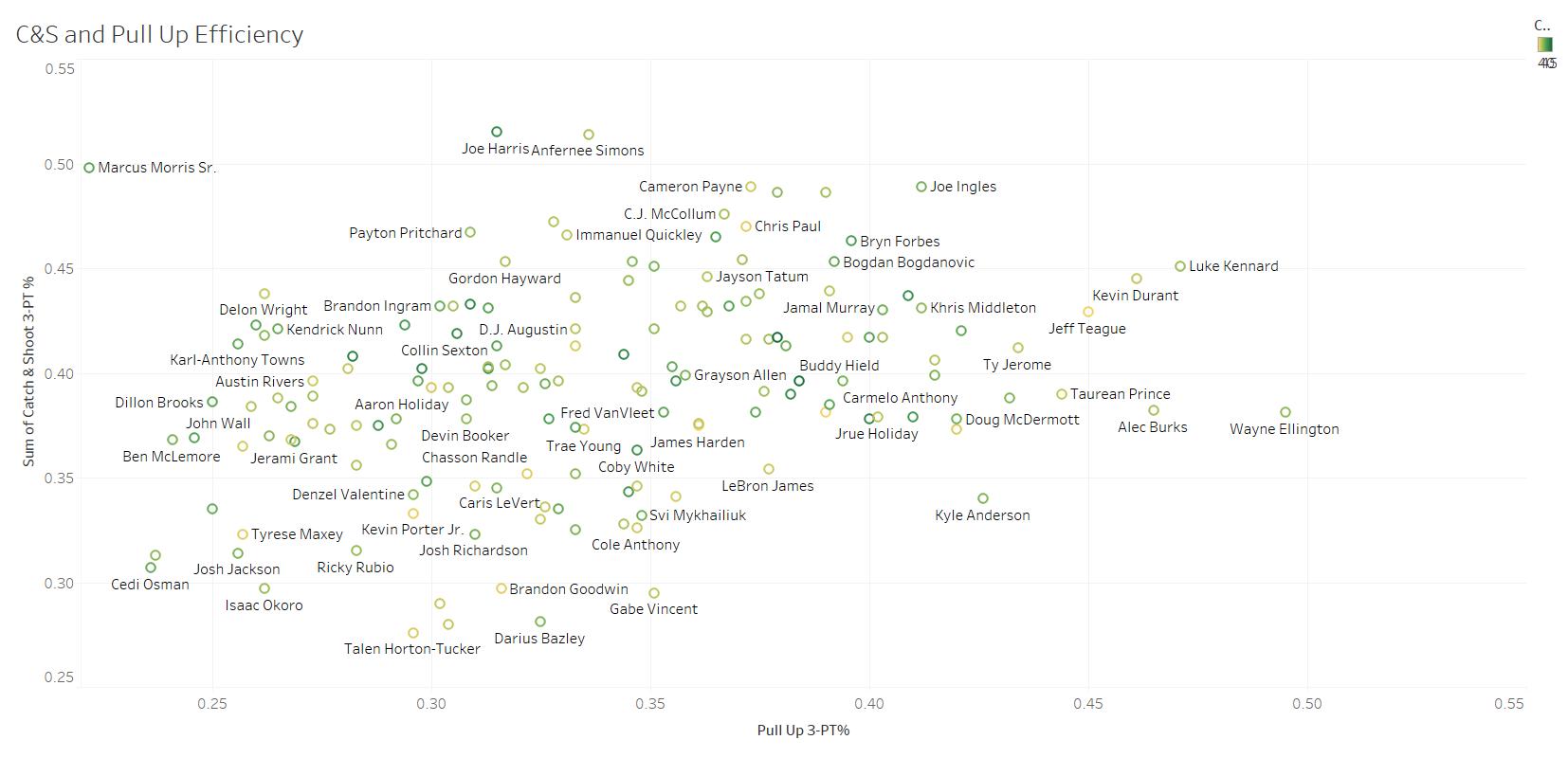
Below, we have a scatterplot of players’ catch and shoot 3-PT% and pull up 3-PT%:
And lastly, we have a visualization of all the above average shooters on both pull up and catch and shoot threes:
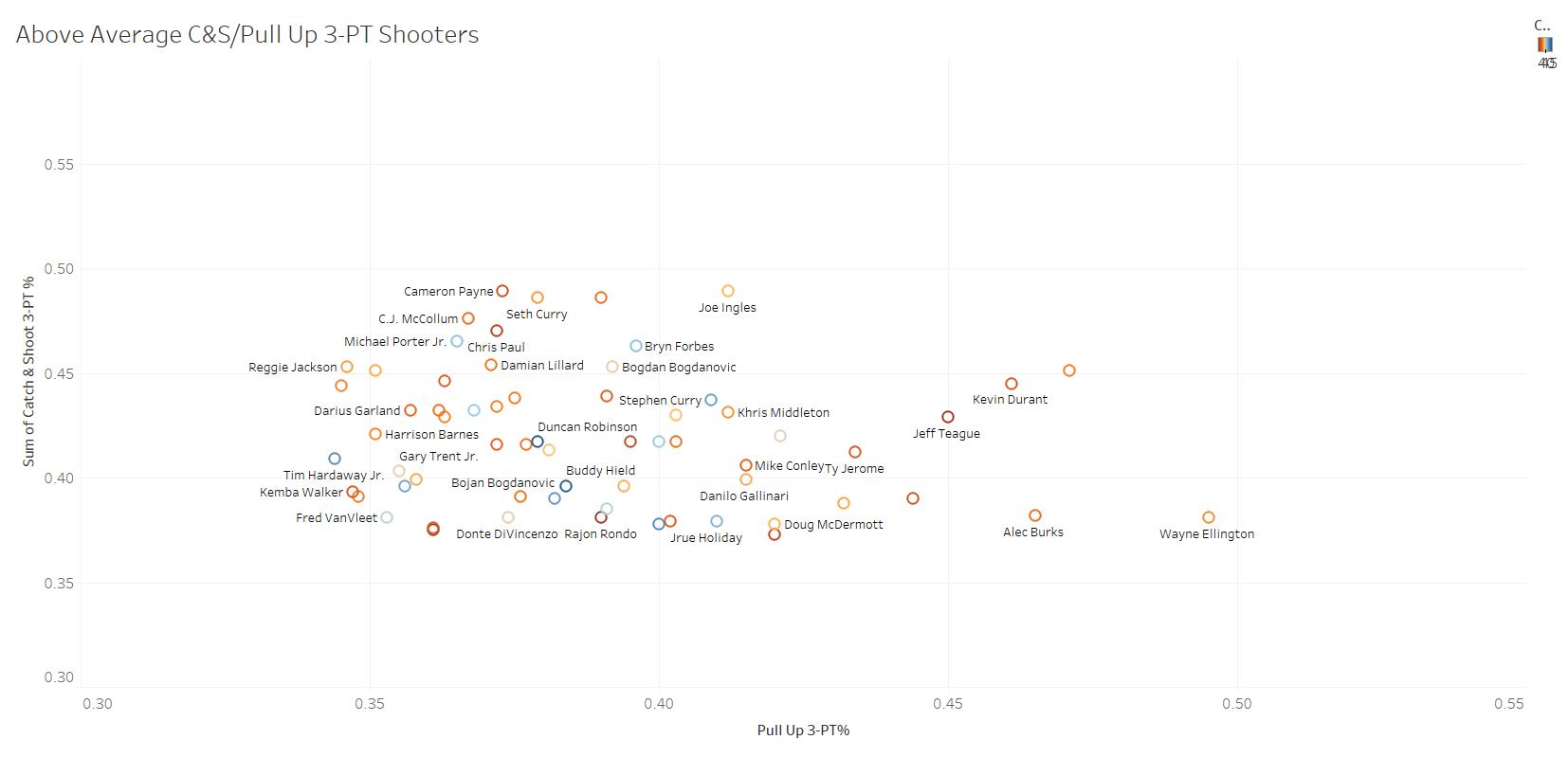
A lot of these names are constants throughout and may have already appeared throughout the article. Ultimately, however, many of the repeat names are the ones Dallas should be targeting. Let’s dive in:
Tier 1 Targets:
Target #1: Ty Jerome (Under Contract-24 years old entering 2021-22 season)
2020-21 Stats (Per 36): 16.1 PPG, 5.5 APG, 4.2 RPG, 44.6% FG, 42.3% 3-PT, 76.5% FT
When I ranked my prospects for the 2019 NBA Draft, I had Ty Jerome sixth on my final board. I absolutely loved Jerome’s game at Virginia; he was an elite pick-and-roll playmaker, fantastic shooter, and could thrive in a team defense. There were very little concerns I had about Jerome except for his below average athleticism. After a rocky rookie year, Jerome was quietly one of the best shooters in the NBA last season while providing excellent pick and roll play. Truthfully, Jerome is one of the best players Dallas could target this summer when filling in the roster.
This season, there were just ten players in the NBA who had 50+ 3-PT attempts on catch and shoot and pull ups that shot 40% on both. The list?
- Evan Fournier
- Kevin Durant
- Steph Curry
- Paul George
- Luke Kennard
- Khris Middleton
- Julius Randle
- Mike Conley
- Joe Ingles
- Ty Jerome
Jerome was at 41.2% on catch and shoot threes and 43.4% on pull up threes. He was elite this past season and while his pull up three volume was not much, his college performance and numbers indicate this wasn’t a fluke. Jerome shot 39.2% for his collegiate career and has simple mechanics with great balance. He may not be a player you necessarily run off screens consistently, but he can absolutely shoot the juice out of the ball.
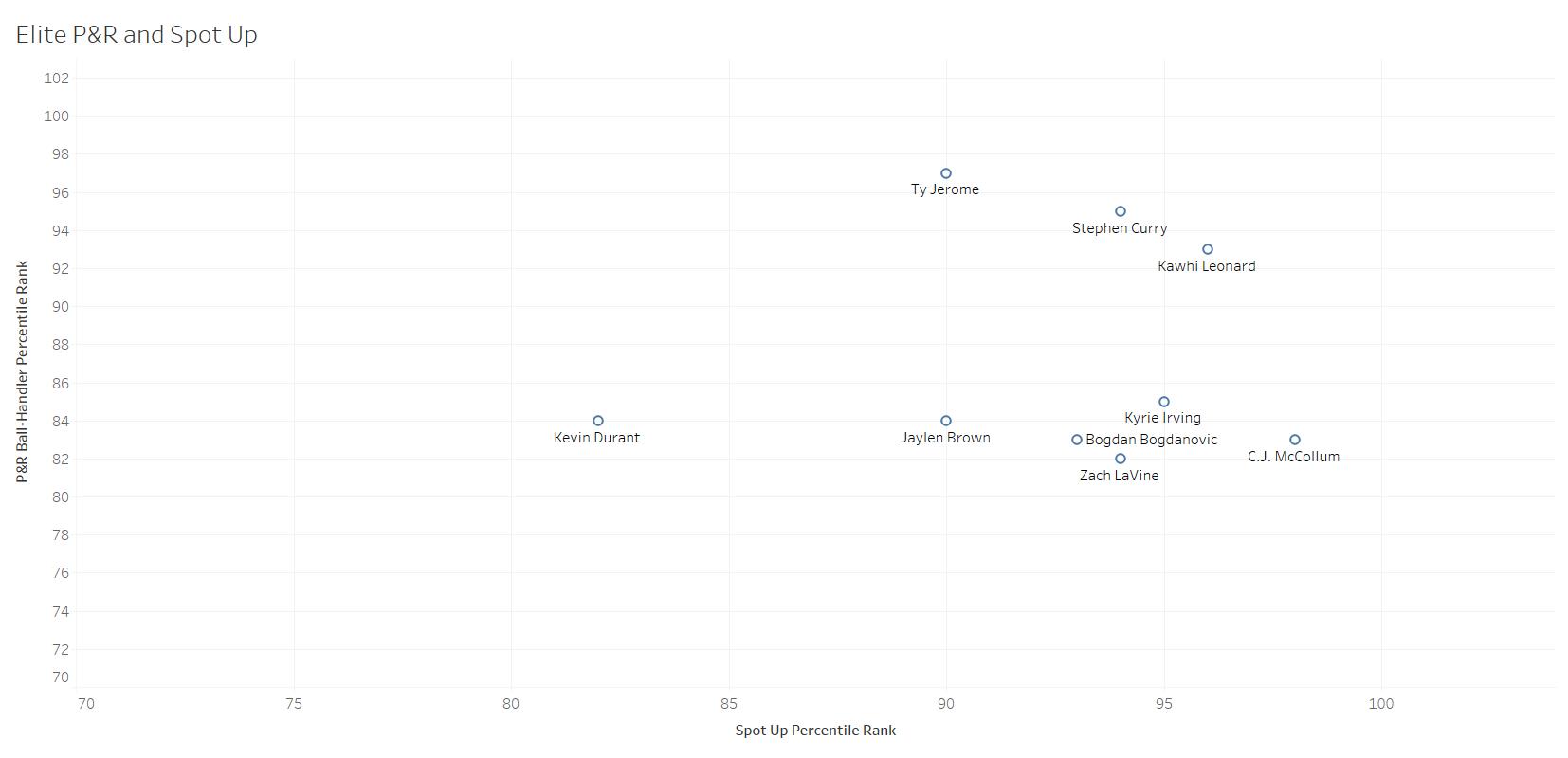
Not only is Jerome an elite shooter, but his additional playmaking skill earns him the #1 slot on this list. By far, my favorite stat of the article is this. Last season, there were only three players who had 100+ possessions as the P&R ball handler and in spot up situations that ranked in the top 10% of both. The list?
- Kawhi Leonard
- Steph Curry
- TY JEROME
Yes, that is right, I have found a stat where the only player in the same company as Kawhi Leonard and Stephen Curry is Ty Jerome. Jerome was in the 97th percentile in pick-and-roll a season ago, an elite mark. Now, he’s unlikely to remain that elite, but his college play once again indicates that Jerome’s P&R play is a strength of his. Only nine players were in the 80th percentile on both play types, as seen below:
Jerome offers more to his game than simply standstill shooting; he averaged 6.9 drives per game, an impressive number, and boasted a cool 2.55 assist/turnover ratio. Jerome also boasted an eFG% above 55% anytime he took a shot after 0-6 dribbles. That is insane efficiency. It’s likely not repeatable, but even with normal regression, he’s still an above average shooter with efficient, aggressive playmaking.
The biggest obstacle to acquiring Jerome is he’s under contract with the Oklahoma City Thunder. OKC wants picks and young prospects and Jerome qualifies. If Dallas were to swing a Kemba Walker trade I could see them getting Jerome included, but otherwise, it feels unlikely Dallas could get Jerome in a simple trade. It’ll likely take Dallas intervening as a third team in a deal to land Jerome, but I think the Mavericks should get insanely aggressive trying to acquire him. He’s coming off one of the most underrated seasons in the NBA.
Target #2: Duncan Robinson (RFA-27 years old entering 2021-22 season)
2020-21 Shooting Splits: 40.8% 3-PT, 41.7% catch and shoot, 37.9% pull up
Call me crazy for not having Duncan Robinson #1 here, but it speaks to how much I believe in Ty Jerome. Robinson, in his own right, would be an elite fit in Dallas. Robinson had a bit of a down year for his standards shooting which, compared to the NBA, is still an elite year. It is a bit odd that Robinson regressed a touch when the league improved overall, but Robinson remains one of the premier 3-PT shooters in the league. Those splits listed above are numbers teams are looking for.
My one concern with Duncan Robinson is that he cannot create his own offense at all. Just 14 of Robinson’s 315 made field goals were unassisted this past year; that is INSANE. Now, Robinson’s not asked to create his own offense and good luck blitzing Luka Doncic when Robinson is on the floor; quick ball movement against a trap will eventually find Robinson open in a corner when his man rotates, or, it’ll be a 3-on-1 for the Mavericks. Robinson’s shooting gravity, elite ability at maneuvering screens and DHOs, and deadly spot up shooting makes him a defensive nightmare to deal with on the court. Robinson is one of the best shooters in recent memory in the league and running him off screens with Luka would be so unfair.
Robinson does not add much else besides his shooting. Truthfully, it doesn’t really matter. He’s not a liability on defense and he competes hard. Robinson is a RFA and I’m fascinated in the possibility of a double S&T with Hardaway Jr., although a move like that likely means Dallas is not landing one of the aforementioned complements or secondary shot creators in free agency. Robinson would be one of my top overall targets, but the need for a secondary shot creator must take precedent.
Target #3: Bryn Forbes (UFA Pending PO-28 years old entering 2021-22 season)
2020-21 Shooting Splits: 45.2% 3-PT, 46.3% catch and shoot, 39.6% pull up
Bryn Forbes is currently in the NBA Finals, where he has helped his team get there through his elite 3-PT shooting. Forbes reminds me a bit of Seth Curry; no, he’s not the playmaker Curry is, but his shooting is quite similar. Check out the comparisons below:
| Overall 3-PT% | Catch and Shoot 3-PT% | Pull Up 3-PT% | |
| Bryn Forbes | 45.2% | 46.3% | 39.6% |
| Seth Curry | 45.0% | 48.6% | 37.9% |
This past season, Forbes’ shooting was eerily similar to Seth’s. Now, Forbes’ track record is not as elite, but the numbers are still way above league average. Forbes was 39.5% on catch and shoot and 39.6% on pull ups during the 2019-20 season, and 45.3% and 37.3% the year prior to that. Forbes can certainly run off screens like he does in Milwaukee, or thrive in a spot up role. Regardless, there is certainly a lot of value in his game and what he could provide to Dallas.
In addition to his shooting, Forbes has a nice off the dribble game. He’s got good touch on his floater and, on shots when he took 3-6 dribbles, had an eFG% of 57.1%. He’s a low turnover player who makes shots, something Dallas could use. Forbes is a poor defender, however, but he’s not in for defense. Most elite shooters hover around Forbes’ defensive range, including Buddy Hield. Forbes will likely opt out of his $2.5M player option and if so, Dallas should be angling for him. There are bigger priorities, but getting a player like Forbes is why clearing more cap space is so important. Forbes at an AAV of around $7 million would be great value, but can only be done with extra space.
Target #4: Doug McDermott (UFA-29 years old entering 2021-22 season)
2020-21 Shooting Splits: 38.8% 3-PT, 37.8% catch and shoot, 42.0% pull up
Like Duncan Robinson, Doug McDermott had a slightly down year from 3-PT range last season. McDermott’s catch and shoot number was the league average, something I found rather odd. However, McDermott’s track record is too strong to harp on that; he shot above 42.3% on catch and shoot threes the previous two seasons and for his career, is well above league average. A McDermott reunion in Dallas would be beautiful.
Last season was McDermott’s lowest 3-PT% since 2016-17 and he was still 2.1% better than league average. Talk about elite shooting. Imagining the shots he’d get around Luka Doncic is, like those of Jerome, Robinson, and Forbes, downright unfair. I think adding a shooter of their caliber can further unlock a level of offense we have yet to see from the Mavericks and frankly, yet to see in NBA history. McDermott is a killer on wide open threes, but he’s also exceptional even with tight coverage, shooting 35.3% and 41.6% on 3-PT field goals classified as “tight” by NBA.com over the past two seasons.
McDermott is limited in his game, however. McDermott is a nice, underrated cutter who showed some promise in that area during his Dallas tenure, but he’s a huge negative defensively and does not actively contribute on the glass. He plays hard and competes, but physical limitations hold him back. Also, with Rick Carlisle in town, I’d expect Indiana gets aggressive with keeping McDermott, especially owning his Bird Rights. Regardless, it’s worth a shot for Dallas and giving him $10M per year, maybe more, should be on the Mavericks’ minds.
Tier 2 Targets:
Target #5: Danny Green (UFA-34 years old entering 2021-22 season)
2020-21 Shooting Splits: 40.5% 3-PT, 41.9% catch and shoot
In this tier, we are drifting a bit away from guys who are elite in both catch and shoot and pull up threes. But, Danny Green is still under heavy consideration. Mavs’ fans remember getting baited into listening to Danny Green’s podcast thinking he was going to Dallas a few summers ago and hopefully that is avoided this summer. Dallas should be aiming higher, but Green is the ideal veteran, 3-and-D wing that can help any roster.
Green’s 3-and-D acumen is well-documented and even as he ages, his game has not dipped too much. Green hasn’t shot below 36.3% from deep since the 2015-16 season, which was a clear outlier since he shot 40%+ the three prior years. Green has been an elite shooter for much of his career and I think, in a way, he’s wildly underrated in that capacity. Green is effective in the corner as well, shooting a career 42.6% from there. Green also ranked 17th among 99 qualified small forwards in DLEBRON, indicating his strong defense. Don’t be mistaken, Green is not a guy you want creating his own shot. In that regard, Dallas needs to properly build a roster where his role is to catch and shoot and the roster enables him to thrive in that specific role and not play beyond it. That is key to a lot of the guys in “Tier 2” of this section and below. If Dallas can do that, Green would be fantastic. He’d be a bit of what Wesley Matthews was for Dallas and, for as much as people can remember, Matthews was pretty good for the Mavericks.
Target #6: JaMychal Green (UFA Pending PO-31 years old entering 2021-22 season)
2020-21 Shooting Splits: 39.9% 3-PT, 40.3% catch and shoot
If you know me, you knew this name was coming. I’ve been clamoring for the Mavericks to sign JaMychal Green for what is about to be four straight off-seasons (maybe three, but it’s been a while). It makes no sense how they haven’t gotten him already; he’s a tough, physical, rangy 3-and-D forward who’s a phenomenal rebounder. He fills the desire to add an “enforcer” type player who can also actively contribute in a positive way. There are better pure shooters on this list, but Green is definitely one of my favorites.
Over the past three seasons, Green has shown remarkable consistency from deep. He’s shot 40.7%, 38.7%, and 39.9% from three and, on catch and shoot, he’s at 41.1%, 38.8%, and 40.3%. Green was in the 60th percentile on spot ups this season and, for his career, is a 40.8% corner 3-PT shooter. One specific area I really like Green is his work on the glass. His rebounding numbers declined this season in Denver, which I think is more of an indication of Nikola Jokic/Michael Porter Jr.’s work on the glass than Green’s inactivity, but Green’s career defensive rebounding rate is 22.0%, which would have ranked 22nd in the NBA this season. Dallas’ defensive rebounding was way too inconsistent last season.
One specific reason why I’m more willing to trade Maxi Kleber this summer than in past years is because of 1) the pressing need for cap space, and 2) Green’s ability to be a functioning replacement. They shoot a similar percentage from deep, although Green is not working with the Luka Doncic boost, both play solid defense, but Green is a better rebounder (Maxi is the better overall defender, though). If Dallas did trade Kleber, Green could be the replacement at $2M or so cheaper, annually. Green could also opt in to his $5 million player option, but if he’s on the market, Dallas should be shooting for him, whether Kleber is on the roster or not.
Target #7: Lauri Markkanen (RFA-24 years old entering 2021-22 season)
2020-21 Shooting Splits: 40.2% 3-PT, 40.5% catch and shoot
It may come as a surprise to see Lauri Markkanen here, but for a pure shooter’s role, he’s likely to be expensive. I think the only realistic chance we see Markkanen in Dallas is if Porzingis gets traded, so for that, I think it’s unlikely Markkanen is a Maverick.
To be quick on Markkanen here, prior to last season, he’d been hovering around league average as a 3-PT shooter before seeing a notable spike in his production. I’m not sold on Markkanen maintaining a level of 40.0%+ from deep, even with getting passes from Luka Doncic. That’s not to say he won’t be above average, but I think a more realistic expectation is 38%. But, it’ll likely cost $13 million+ annually to get him, that does not seem like great value.
Now, Markkanen is more than a simple “pure shooter”. He can score a bit in the post (was dominant on 30 attempts this year), can cut a bit, and is active on the glass. But, Markkanen is a bad defender (98th out of 119 in DLEBRON), has declined as a rebounder, and has career 3-PT splits that are closer to average than elite. He’s a tough player to get a read on due to the weird circumstances of the 2020-21 season. I could envision him being a good fit in the right roster construction, but if Porzingis is traded, I’m likely advocating for Richaun Holmes over Markkanen.
Extra Targets to Note:
Target #8: Kendrick Nunn (RFA-26 years old entering 2021-22 season)
2020-21 Shooting Splits: 38.1% 3-PT, 42.1% catch and shoot
Kendrick Nunn makes an appearance here, but like other players, I am concerned over how legitimate his shooting improvement is. Nunn has only played two seasons, but last year, was 34.1% on catch and shoot and just 35.0% overall. Nunn does have some shot creation ability mixed in and is a fantastic finisher around the rim, giving him some additional upside other players in the list don’t have. But, as a shooter? I’m a bit concerned he’s closer to league average or slightly above.
Nunn does feel very attainable this summer, however, and his market will be super interesting. Nunn accumulated some DNP-CDs in the postseason last year and his tenure in Miami has been a bit rocky with his minutes. I doubt any team feels comfortable giving Nunn a substantial contract, but for $7 million annually? I’d be very interested. Nunn is merely a consideration at this point and I have no clue what his market looks like. But, his shooting improvement combined with solid shot creation and defense puts him on the board.
Target #9: Patty Mills (UFA-33 years old entering 2021-22 season)
2020-21 Shooting Splits: 37.5% 3-PT, 40.2% catch and shoot
After watching Patty Mills torch the Mavericks for years, it sure would be nice to have him on our side in those Mavericks/Spurs games. I’ve always admired Mills’ competitiveness and spirit, and adding his championship pedigree and veteran presence could really work wonders for the Mavericks. Mills took a step back this season, but has looked good for Australia in the Olympic exhibition games. Mills has been an effective P&R playmaker for two of the past three seasons and has always been a solid finisher around the rim.
Mills is another player with a long track record of shooting success, even if this past season was a bit of a down year for his standards. Mills has shot at least 37.2% from deep ever since the 2015-16 season and, for his career, is a 45.2% corner 3-PT shooter. Mills’ shot creation ability has faded as he’s aged, but the majority of his shots are catch and shoot and he’d likely, if everything goes according to plan, always be playing with a primary ball handler. I get the defensive concerns and Mills’ off the dribble play, but his shooting and experience would be huge for the Mavericks.
Bonus Names
- Malik Monk: It sounds repetitive, but Malik Monk is another player who saw a noticeable jump in his 3-PT accuracy last year. It’s tough to tell how legitimate the growth is, but Monk did have a reputation as a shooter entering the league and, as a rookie, shot well. Monk was just one of 61 players who shot above average on catch and shoot and pull up threes a season ago. He could be on the verge of a legitimate breakout, as he was effective creating his own shot as well as standstill threes. However, his inconsistent history gives me pause. He’s certainly an option and, if he’s willing to take the Room Exception, could be a phenomenal value for the Mavericks.
- Otto Porter Jr.: A popular name amongst Mavs’ fans, Porter Jr. is a quintessential 3-and-D player. OPJ is a career 40.2% 3-PT shooter and has shot north of 40% on catch and shoot threes the past three seasons. The major concern here is his durability. OPJ has played in just 98 games over the past three seasons. When healthy, he’s effective, the problem is he’s never healthy. He’s another Room Exception candidate, but I’m not risking a multi-year deal.
- Bobby Portis: The fan favorite in Milwaukee, Bobby Portis has made himself some money in the postseason. He shot lights out from 3-PT range this season (47.1%) and is an elite rebounder. However, regression is surely coming; even with his torrid season, he’s just a 38.0% 3-PT shooter for his career and some team is likely to overpay for him this summer based on his year. I’m not paying extra for likely regression, even if Portis’ competitive fire, rebounding, and good shooting (regardless of regression) is enticing.
- Reggie Bullock: Bullock is another popular name, but I am a bit more mild on him. Bob Myers’ comments about how in the playoffs, that three feet of space becomes three inches for shooters is meaningful and, unlike other pure shooters, I’m not sure Bullock is good enough in that role to justify making him a legitimate target for Dallas. Bullock is a career 39.2% 3-PT shooter, but has been inconsistent as of late, albeit his struggles one year were due to injury. Bullock is a solid defender and not a horrible option, but further down my list.
- Sterling Brown: Another player with an unnatural 3-PT% jump, Brown does garner some consideration. Brown had never shot better than 36.9% from deep before canning 42.3% of his 3-PT attempts this past year. I don’t buy that improvement, but, if he could hover around 37-38%, he has value. Brown is a great defender and rebounder. I also think there is some connections here: Brown played under Jason Kidd in Milwaukee and went to school at SMU. That means very little, but could be a reason why Brown/Dallas is a match.
Need #4: Add a Rim Running, Shot Blocking Big
This need has to be fulfilled regardless of whether Kristaps Porzingis is on the roster or not. Dallas’ lack of rim protection was exposed by the Clippers at times when they put an assault on the rim. If Porzingis can rediscover his 2019-20 health and defensive impact, it’s not as pressing of a need. But, if not, Dallas needs this player. Also, this player, in theory, should be an upgraded version of Willie Cauley-Stein.
Target #1: Richaun Holmes (UFA-28 years old entering 2021-22 season)
2020-21 Stats (Per 36): 17.6 PPG, 10.2 RPG, 1.9 BPG, 63.7% FG, 79.4% FT
Richaun Holmes should only be under consideration if the Mavericks trade Kristaps. Otherwise, Dallas will be investing a ton of money into their frontcourt and particularly, in two guys who cannot create their own shots in the half court. But, if Porzingis is moved, Holmes becomes one of my top overall targets. He’s a mobile, athletic defender who puts pressure on the rim and has a great short roll game. I’ve been a huge fan of Holmes for a while and would love to see him on the Mavericks, just not in tandem with Porzingis.
Among players with 100+ possessions as a roller, Holmes was 5th best in terms of PPP. His elite navigation of screens, angles, and lobs makes him a terrific P&R partner with Luka, who is arguably the best P&R passer in the game. Holmes shot 72% within five feet of the basket, 50.5% from 5-9 feet away, and 66.4% 10-14 feet away due to his impressive floater game. Holmes overall shot 61.9% on floaters, an incredible mark. Holmes thrives in these settings also because of his screening ability; he ranked very well in screen assists.
Defensively, Holmes is a menace around the rim, but is also mobile enough to switch when necessary. Holmes had the 7th lowest defended field goal percentage last season and the 11th highest block rate. BBall-Index’s metric was not as kind, ranking him 41st among 99 center qualifiers in DLEBRON, but that’s still an above average mark. Holmes also competes on the glass, ranking in the top-25 in terms of offensive and defensive rebounding percentage.
Sacramento is capped on what they can offer Holmes, so there is certainly some opportunity for Dallas to scoop him up if they offload Porzingis for a secondary shot creator. A 4/68 contract seems reasonable for both sides, dependent on Porzingis’ future.
Target #2: Nerlens Noel (UFA-27 years old entering 2021-22 season)
2020-21 Stats (Per 36): 7.5 PPG, 9.5 RPG, 3.3 BPG, 61.4% FG, 71.4% FT
A Nerlens Noel reunion in Dallas would be quite the story, but it doesn’t seem far fetched, especially with Rick Carlisle gone. Ian Begley of SNY reported the Mavs are, “among teams expected to have interest in Noel”. Frankly, it’s easy to see why. Noel is a premier defender in the league; he ranked 2nd in block percentage and 12th in steal percentage this past season. Noel also boasted the 9th lowest defended FG% in the league. He’s a bouncy athlete who can catch lobs and during his time in Dallas, he showed some offensive game while battling on the glass. Noel would be a terrific upgrade over Willie Cauley-Stein, but until Dallas clears more cap space, this is more of a hope than a desperate need.
Target #3: Jarred Vanderbilt (RFA-22 years old entering 2021-22 season)
2020-21 Stats (Per 36): 10.9 PPG, 11.6 RPG, 1.5 BPG, 60.6% FG, 55.9% FT
Another wildly underrated player, Jarred Vanderbilt is an elite defender who, I think, could fill the vertical spacer role as well. Vanderbilt boasted a 2.7% steal rate and 3.5% block rate last year, both extremely impressive marks that, if eligible, would have ranked 4th and 17th respectively. Vanderbilt also had the second highest DLEBRON ranking amongst power forwards and 11th highest overall. He can move on the perimeter, body inside, and rebound at an elite level. I doubt Minnesota lets him walk, but Vanderbilt could be due for a nice raise that may allow Dallas to sneak in.
Bonus Name
JaVale McGee: Make that Olympian JaVale McGee, but McGee is a player who, on a likely near minimum contract, fills Dallas’ need. He’s had a 7%+ block rate every year since 2016-17 and remains a good lob threat. McGee also provides good defense and I believe is an upgrade over WCS considering the price.
Need #5: Add a Veteran Presence
We are nearing 15,000 words so, if you’ve stuck with me, thank you. To keep it brief, I’ve listed a lot of players above who already fill the veteran presence need. I’ll just include a small list of other veterans on the market who may make some sense. Feel free to tweet at me (@DallasMavsWorld) or (@TheChirpSports) to discuss some of them more in depth.
- Jeff Teague
- Jeff Green
- Paul Millsap
- Andre Iguodala
- J.J. Redick (I bet he’s going East, however)
- P.J. Tucker
Wrap Up… and What is my Dream Summer?
One prevailing theme I hope I made clear throughout is that Dallas cannot win a championship without a true second guy who can create his own shot in the half court. Everything this summer has to be built around that prevailing strategy of building a team. Realistically, I think Dallas could make a play for both Bradley Beal and Zach LaVine next summer, but every Mavs’ fan (and the front office) should have learned their lesson: never save cap space for “what ifs” a following summer. This is basically use it or lose it space for Dallas anyways since Luka’s supermax will kick in next year and deplete their cap.
One other thing I did not mention is Jalen Brunson and a possible extension. Monte Morris is a comparable player who received a 3-year, $27 million extension from Denver. That seems like a reasonable starting point for both parties.
Now, what would be my dream scenario for Dallas this summer? It goes something like this:
Step 1: Trade Kristaps Porzingis for C.J. McCollum
This move nets Dallas their secondary shot creator. Once again, I don’t want to trade Porzingis for pennies on the dollar, but this is a move that I think is good value.
Step 2: If Atlanta is willing, S&T for Collins, send Kleber & Richardson Back
This is still relatively unrealistic I think, but in a dream scenario, I’ll include it. Atlanta gets something in return for John Collins and Dallas gets a perfect third option for Doncic and McCollum. Collins would be signed to a 4-year, $100 million deal.
Step 3: Salary Dump Trey Burke, Decline Willie Cauley-Stein’s Option
These moves get Dallas to $24.6M in cap space, even with already adding Collins and McCollum.
Step 4: Break Up Remaining Cap Amongst Three Players
Yes, this likely means Tim Hardaway Jr. is out the door, but with McCollum, the defensive woes would be too much. Dallas can sign a shooter for a different price. Three of my targets for the remaining $24.6M would be:
- T.J. McConnell: 3 years, $24 million
- JaMychal Green: 2 years, $12 million
- Alec Burks: 3 years, $24 million
Dallas’ cap situation would look something like this, with the assumption Tyler Bey gets one of the remaining three roster spots:
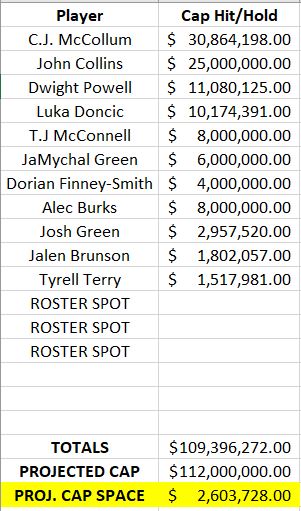
(The Mavs could also get JaVale McGee for the minimum at another spot)
As unrealistic as this might seem, I do believe it’s financially feasible, making this a possibility for the Mavericks. A starting five of Luka Doncic, C.J. McCollum, Dorian Finney-Smith, JaMychal Green, and John Collins sounds alright by me, especially with a bench unit that includes T.J. McConnell, Jalen Brunson, Alec Burks, and Dwight Powell. (It pains me to not have been able to brainstorm a good Ty Jerome trade).
Ultimately, Dallas’ summer will likely look vastly different than this, and that’s expected and ok! The process in roster strategy and building is more important. Seeing growth in that area would be a positive; adding that shot creator, finding the complement, and not being afraid to get bold with dealing off homegrown guys should be on the agenda, if necessary. Free agency is always fun and with the Mavericks, it’s always an adventure. Let’s see what they can do.
 The Chirp