
The Dallas Mavericks are entering what is likely to be the most consequential off-season of Luka Doncic’s tenure. Gone are the days where the Mavericks can label a competitive, first round exit as “promising”. Gone are the days where the expectation is to compete in the postseason. Luka Doncic’s greatness has accelerated Dallas’ timeline to the point where they should be in win-now mode every single season they employ him. With limited avenues to upgrade the roster after this off-season due to cap constraints and minimal appealing trade assets, it’s essential the Mavericks ace this summer. It started with replacing Donnie Nelson and Rick Carlisle, and it’ll continue through the NBA Draft and free agency; Dallas cannot afford any failures along the way.
The picture I have painted may seem ominous and may be even a *touch* dramatic, but ultimately, there is a ton of pressure on Mark Cuban to get this right. I’ve documented my thoughts on the hiring of Jason Kidd and Nico Harrison here, but based off Cuban’s track record of decision making and the moves/news over the past month, nothing the Mavericks have done gives me a ton of faith they’ll ace this exam. Ever since the Mavericks drafted Luka Doncic, they have failed in nearly every consequential decision they have had to make. Sure, there have been some bright spots, but far too many failures. It’s a damning assessment of Dallas’ inability to build a roster capable of advancing in the postseason while watching what the Atlanta Hawks and Phoenix Suns have been able to do in the playoffs. Phoenix had an edge over both teams by already having Devin Booker in town, but all three teams were, by and large, in a relatively similar position three years ago. Despite drafting the best player, the Dallas Mavericks are far behind both in terms of team success.
With Donnie Nelson/Rick Carlisle out and Nico Harrison/Jason Kidd in, there is a changing of the guard, even if I believe nothing has really changed overall. Dallas’ free agency or draft philosophy likely won’t change since Mark Cuban remains in charge, but, it should. In part 1 of our off-season primer, I’ll be laying out a general overview of Dallas’ roster headed into the summer, internal personnel decisions, and setting the stage for future pieces regarding specific free agency and trade targets. The goal? To take a deep look at the Mavericks’ roster and those around the NBA to find innovative ways to help Dallas reach a postseason level Luka Doncic is capable of.
Opening Remark: Team Building Strategies
The most important skill in the NBA is playmaking; if the last few seasons have taught us anything, it is that you need multiple players who can consistently and effectively get themselves a basket in a half court setting. Bob Myers, the President of Basketball Operations and General Manager for the Golden State Warriors, has terrific insight on the importance of versatile players in that type of mold. You can find it below:
Myers is absolutely correct and his comments ring particularly true with the Milwaukee Bucks, a team I’ll briefly touch on in a “case study”. The 2019-20 Milwaukee Bucks were an elite regular season team; they had the best record in basketball (56-17), the MVP and DPOY, and the best net rating by over three points. Yet, in the postseason, the Bucks got exposed, primarily for the reasons Myers mentioned: they had too many one-dimensional players, and relied upon two multi-dimensional guys to manufacture everything for them. In Milwaukee’s case, their multi-dimensional guys had flaws as well, namely Giannis Antetokounmpo’s poor shooting and struggles in the half court, and Khris Middleton’s inconsistency. The Bucks got dominated by the Miami Heat last year in the playoffs, but this season, they are in the NBA Finals. The Bucks made a concerted effort to, instead of just adding shooting around Antetokounmpo, add multi-dimensional players who could create offense for themselves, rather than solely shoot. It led to acquiring Jrue Holiday and nearly Bogdan Bogdanovic as well. If history is any indication, you cannot win the NBA Finals by having solely one player capable of creating their own offense in a half court setting and surrounding him with four shooters. The Bucks are a more recent example of a team trying and failing with that experiment.
The 2019-20 Milwaukee Bucks are a perfect example of what Dallas should avoid doing from a roster construction standpoint. It will be a colossal mistake if the Mavericks once again rely on Luka Doncic to manufacture all forms of offense in the postseason. Their series against the Clippers should be enough evidence that it is a poor strategy. The need for at least two guys to be able to create offense for themselves in the half court is essential. It needs to be Dallas’ first, second, and third priority. Luckily, the Mavericks already have one guy in Luka. They need to find the second guy. My reasoning for this is not solely rooted just in Milwaukee’s transformation. Their Finals opponent, the Phoenix Suns, have destroyed teams throughout the entire postseason in high pick-and-roll settings for Chris Paul and Devin Booker. Both players get their shots at will in the half court. During the 2019-20 regular season, the lineup that had the highest net rating was a group from Oklahoma City that consisted of Chris Paul, Dennis Schroder, Shai Gilgeous-Alexander, Danilo Gallinari, and Steven Adams. In that group, you have 3 or 4 guys who fit the bill of consistent, half court creator. Take a look at championship teams from 2015 on and how many individual “bucket getters” each team had in the half court:
- 2015: Golden State Warriors (Steph Curry, Klay Thompson)
- 2016: Cleveland Cavaliers (LeBron James, Kyrie Irving)
- 2017: Golden State Warriors (Steph Curry, Kevin Durant, Klay Thompson)
- 2018: Golden State Warriors (Steph Curry, Kevin Durant, Klay Thompson)
- 2019: Toronto Raptors (Kyle Lowry, Kawhi Leonard, Pascal Siakam)
- 2020: Los Angeles Lakers (LeBron James, Anthony Davis)
Not only do these teams each have two, individual, offensive creators, but each team has two elite guys in this mold. The Dallas Mavericks have one, but they are desperately missing the second. That second guy is the player who vaults the Mavericks from a first or second round exit into legitimate Finals contention. Obviously, there’s more to a championship roster than just those “two guys”, but those two guys are the essential building blocks that all championship teams have had over the past several seasons (and really, historically).
Aside from simply listing players, there is proof in the pudding that, in the postseason, teams revert more to isolation. Check below at our table showing the frequency of plays that isolation accounts for in the regular season versus the postseason:
| Iso Reg. Season % | Iso Postseason % | |
| 2020-21 Season | 6.98% | 9.42% |
| 2019-20 Season | 7.23% | 9.88% |
| 2018-19 Season | 7.11% | 7.81% |
While the 2019-20 postseason was a bit weird with the bubble, look at the drastic jumps in how often isolation is used in the postseason. While many view isolation as an inefficient form of offense, in the postseason, having effective isolation players is a necessity. Games are condensed more in the half court setting in the playoffs and having players who can get themselves a bucket consistently in a one-on-one situation are the most valuable commodity. The Mavericks cannot simply afford to just find guys who are capable of handling the ball and getting other guys shots in the half court; they have to find guys who can consistently and effectively create their own shot with minimal help. Those players are few and far between, but without a second guy outside of Luka, they will fall short of hoisting a championship.
A common refrain on Mavs’ Twitter is that Dallas cannot afford to be picky this off season because their current roster is not good enough. Personally, I completely disagree with that argument. That argument would have played well in 2019, when Dallas had copious amounts of cap space, two years of Luka on a rookie deal remaining, and plenty of time to experiment with fit, players, and lineups before their pressure to win increased. We know the Mavericks fumbled the ball then, but 2019 should have been the time for that attitude. Dallas should have been throwing money at a variety of players and looked to see what stuck. Now, the Mavericks do not have the luxury to take swings in free agency. Luka’s likely super max contract will kick in next year, severely restricting Dallas’ access to cap space for probably two summers. The Mavericks’ trade cupboard is rather bare as well due to the protections remaining on their first rounder owed to the Knicks and lack of appealing young prospects on the roster. Essentially, whatever team the Mavericks build this off season will likely be the team Dallas has for the next two seasons, except with some minor tweaks. In that sense, Dallas should be incredibly selective where they throw this money, because they won’t have opportunities to remedy bad fits (like Richardson and Delon Wright) or offset bad contracts. This concept further increases the pressure on Dallas to ace this summer.
Internal Personnel Decisions
Below, here is Dallas’ cap sheet entering this summer (data courtesy of Spotrac):
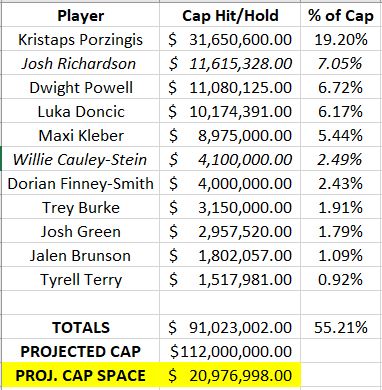
Dallas is projected to have around $21 million in cap space here, but that operates with two assumptions that put Dallas with their lowest total. First, it assumes Josh Richardson opts in to his $11.6M player option, something we have not heard any news about. Second, it assumes Dallas exercises their $4M team option for Willie Cauley-Stein. If Richardson opts out and Cauley-Stein’s option is declined, the Mavericks’ cap space balloons to $36.7 million, enough for a max slot.
Now, there are other reasonable avenues for Dallas to further expand their cap space. The Mavericks could look to offload Dwight Powell’s contract, a move that would free up another $11M in space. It seems like wishful thinking to believe a team will simply absorb Powell’s salary for nothing in return, so while a Powell trade isn’t out of the realm of possibilities, it very likely will bring salary back. However, if the Mavericks wanted to clear additional cap space, here are two logical avenues I could imagine:
Option 1: Trade Maxi Kleber
- Personally, I really like Maxi Kleber. He’s a mobile big who can defend on the perimeter, protect the rim, and shoot threes at a high clip. He’s a high character individual who gets along with teammates and has improved every season, although a rough bout with COVID-19 stunted his progress this past campaign. Really, the Mavericks should not be itching to trade Kleber, but, Kleber should not be the obstacle in the way that prevents Dallas from adding more impact players. If Kleber could net you a late first round pick from say, the New York Knicks, and you take no salary back, that’s a tempting deal.
Option 2: Trade Trey Burke
- This scenario is far easier to imagine and while it clears up minimal space (just $3M), it’s better than nothing. Trey Burke earned the nickname of “Bubble Burke” due to his great play in Orlando, but this past season was incredibly disappointing. Burke couldn’t consistently crack the rotation despite Dallas counting on him. Burke certainly had his moments, like his blowup game against Orlando in January and his tenacious defense on Steph Curry later in the year, but I think his inability to get minutes on a mediocre Dallas roster is telling. Burke probably has enough value that Dallas could dump him to a team without taking salary back, or he could be thrown in a deal with Josh Richardson if he opts in.
For me, a lot of these internal personnel decisions are fairly easy. Dallas cannot control Josh Richardson’s decision on his player option, but I highly doubt he’s on the team next year regardless. As we dive deeper into subsequent parts of the primer, I’ll develop some trade scenarios for Richardson in case he were to opt in. Dallas can control Willie Cauley-Stein’s future with the team, however, and I think they should decline his team option. $4 million of savings is not massive, but I don’t think Cauley-Stein is irreplaceable. Dallas was better with him on the court this season, but Dallas could find an upgrade at the same price. Cauley-Stein’s main skill is his vertical spacing, but he’s a rather poor finisher around the rim for a 7’0 big, he isn’t a great rim protector, and he is inconsistent. I’d also advocate for trading Trey Burke to free up some more space and if the Knicks offered the 21st pick for Maxi Kleber, I’d be very tempted to say yes. Declining Cauley-Stein’s option, and trading Burke and Kleber would lead to $37M of cap space (before Dallas’ signs the player they select with the 21st pick in this hypothetical scenario) even if Richardson remains a Maverick under his player option salary.
What About Kristaps Porzingis?
The future of Kristaps Porzingis is interesting and for most of June, I straddled the line between trading him and keeping him. I think my final verdict on Porzingis is this: he’s very unlikely ever to develop into that secondary scoring option we listed above, primarily because he’s not a good enough shot creator for himself. His handle is loose, he lacks lower body strength to impose his will over smaller players in the post, and he’s inefficient in one-on-one settings. 94% of Porzingis’ field goals this past year were assisted; he’s reliant on others to generate looks for him. Take a look below at Porzingis’ eFG% based on dribbles taken (data courtesy NBA.com’s tracking stats)
| Dribbles | eFG% |
| 0 dribbles (471 shot attempts) | 57.4% |
| 1 dribble (89 shot attempts) | 55.6% |
| 2 dribbles (81 shot attempts) | 45.7% |
| 3-6 dribbles (40 shot attempts) | 37.5% |
| 7+ dribbles (2 shot attempts) | 50.0% |
Now, I do think Porzingis is capable of rediscovering his form in Orlando, which is why I’m on the fence of trading him in a deal that will likely be for minimal value. If Porzingis can rediscover his lateral mobility, he has the ability to be impactful defensively. KP acting as a rim protector, something he’s done effectively in the past, makes him a valuable player. He would just need someone to always create baskets for him, but his elite shooting gravity and cutting ability makes it relatively easy to do so. Depending on the offers, I wouldn’t be opposed to trading him, but not for pennies on the dollar. With that in mind, I’ll suggest some Porzingis trades, but will operate under the assumption that Porzingis will be a Maverick next season.
Off-Season Planning: Building a Shopping List
For a team that was an underdog in the postseason and pushed their foe to seven games, it feels a bit odd that the Mavericks have so many needs to address entering the 2021-22 season. Yet, that’s what happens when Luka Doncic is on your roster: you overachieve. I’ve already addressed the importance of adding at least one secondary shot creator and multiple needs can be fulfilled by one player, but the Mavericks’ roster is lacking. They need more shot creation, they need more half court “bucket getters”, they need better wing depth, and they need more frontcourt athleticism. Below, I have identified five key needs (for simplification):
#1: Find a Secondary Shot Creator
#2: Find a Complementary Pairing to the Shot Creator
#3: Add More Shooting
#4: Add a Rim Running, Shot Blocking Big
#5: Add a Veteran Presence
Some other needs will surely be mixed in; they could include finding Maxi Kleber’s hypothetical replacement if he were to be traded (I’ll touch on that), a potential Boban Marjanovic replacement, and more.
Dallas’ Impending Free Agents
The Dallas Mavericks, for certain, will have five free agents this summer: Tim Hardaway Jr. (UFA), J.J. Redick (UFA), Boban Marjanovic (UFA), Tyler Bey (RFA), and Nate Hinton (RFA). Nicolo Melli is returning to the EuroLeague, and the aforementioned Josh Richardson and Willie Cauley-Stein both have options, which puts their status into limbo. Here’s some rapid fire takes around each player:
Tim Hardaway Jr. (UFA)
- Thought of as the “tax” in the Kristaps Porzingis trade, you would find ample individuals ready to label Tim Hardaway Jr. as the main piece the Dallas Mavericks got from the Knicks in their 2019 trade. Hardaway Jr. was terrific in his 2.5 seasons as a Maverick; he’s averaged 16.1 PPG on 44/39/81 shooting splits with low turnovers and high energy. THJ has reigned in a lot of his worst tendencies and became a productive, winning player who was also among the most consistent Mavericks. His heart and competitive nature is something I’d argue the Mavericks need more of on their roster. With all that being said, I do think Dallas shouldn’t be stubborn with keeping Hardaway Jr. around. The pros I listed above are huge and as a fan, it would be tough to see him go. However, there are upgrades available in free agency. That’s not to say I am advocating for Dallas to move on (that would be silly), but if the Mavericks had a better option come available, they should pull the trigger, even if it meant Hardaway Jr. leaving. Something else to consider as well is, if Dallas did clear out a lot more space, they could potentially add two impact free agents with AAVs of around $20 million, which would lessen the need to bring Hardaway Jr. back. Simply put, I’d love to have him back, but the desire to keep him should not prevent us from seeking out an upgrade.
J.J. Redick (UFA)
- J.J. Redick’s fit in Dallas is pure; his ability to run off screens and be such a lethal threat to shoot unlocked a lot of offensive potential with Luka Doncic. The problem was Redick was rarely healthy this past season and had a high turnover rate in those situations. I like Redick’s locker room presence a lot and he’s a cool guy, but I would be stunned if he was in Dallas next season. Redick’s desire to play in the northeast and near his family is well-documented, making it likely he’s not looking to return. Now, the Mavericks should certainly be looking to add a shooter of his caliber in free agency, but I doubt it’ll be him.
Boban Marjanovic (UFA)
- The most lovable player in the NBA is hitting free agency and to me, this is an easy one. While I think the Mavericks could add a player with a different skillset here, Boban Marjanovic’s friendship with Luka Doncic makes me very inclined to keep him. Ensuring Luka’s happiness is essential and keeping Boban around helps. Plus, Marjanovic is extremely productive in select matchups and is a solid NBA player; it’s not like his presence drags down the roster.
Tyler Bey & Nate Hinton (RFA)
- Tyler Bey and Nate Hinton were on two-way contracts a year ago, letting them hit restricted free agency here. Neither player should be aggressively sought after and, when Rick Carlisle was still the head coach, he said he anticipated “all four rookies” playing in Vegas (Josh Green, Tyrell Terry, Bey, and Hinton). I would be intrigued about converting Bey into a regular contract, as his performance in the G League Bubble was extremely impressive. Nate Hinton is a bench mob all-star and should return as well as one Two-Way guy.
That’s just a taste of what awaits the Dallas Mavericks this summer. With free agency drawing closer every day, the anticipation for changes allows us fans to grow more and more anxious. Stay tuned for the second part of our primer, which will touch on specific players to fill the five needs I outlined above.
 The Chirp