
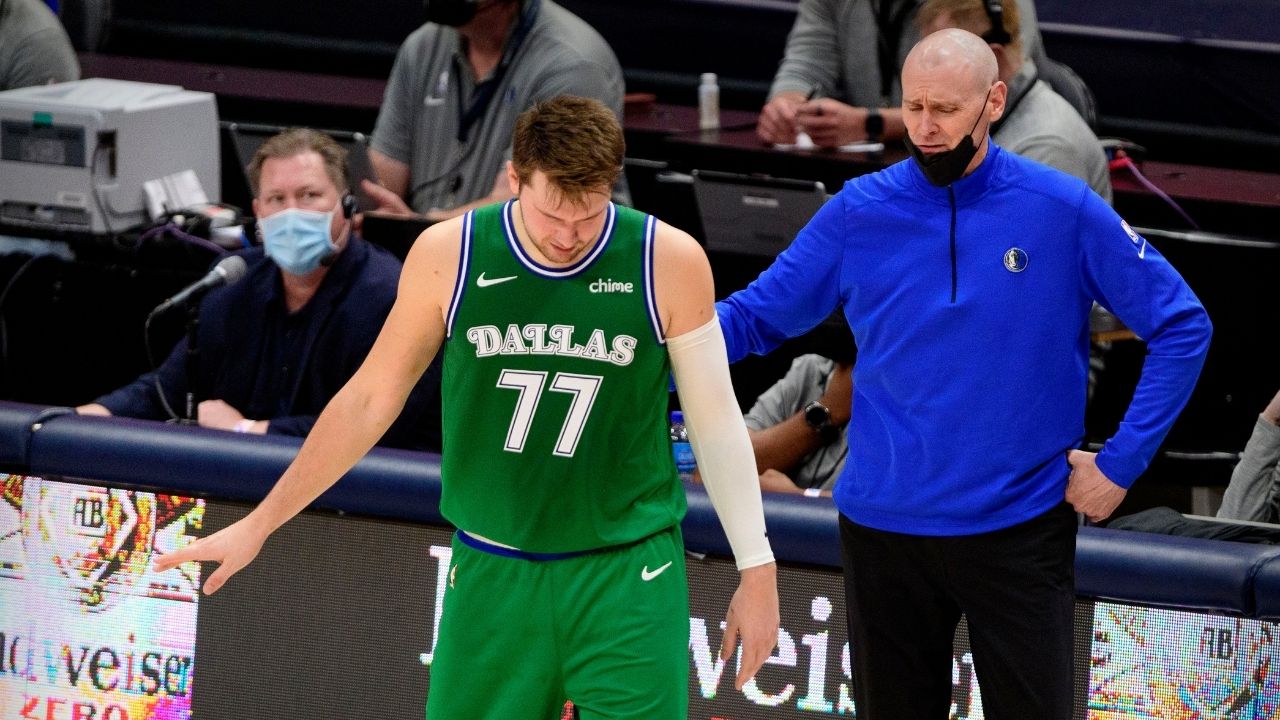
The Mavericks fought hard in their seven game series against the Los Angeles Clippers, but ultimately, Game 7 exposed something we knew all along: Dallas’ supporting cast around Luka Doncic simply isn’t good enough. The 2020-21 season for the Dallas Mavericks was certainly a rollercoaster ride; the team started 9-14 as they lost multiple key players due to COVID protocols, only to battle back from the 14th spot in the Western Conference to finish 5th, with a 33-16 record since that start. The Mavericks finished the year 10th in net rating and were just 0.1 away from being 9th. It’s disappointing that Dallas went as far this season as they did last, but if you told the majority of Mavericks’ fans on February 2nd that Dallas would push the Clippers to seven games in the first round, I’d guess many would have been impressed and would have taken that result. Now, it just feels like a missed opportunity.
Even with such a disappointing end to the season, there were certainly some positives to take away from the season. First and foremost, the continued growth of Luka Doncic. If Luka didn’t establish himself as a top-5 player in the world during the series against the Clippers, then I’m not sure what else he needs to do. In the series, Luka averaged 35.7 PPG, 10.3 APG, and 7.9 RPG on a shooting line of 49/39/53. Sure, he has to improve his free throw shooting, but Luka Doncic was nothing short of sensational this series. He was beyond special and gave the Mavericks a chance to win every single game. He accounted for 80%+ of the team’s field goals in Game 5, he created 77 points in Game 7, the most by a player ever in a Game 7 (according to Elias Sports Bureau). Luka’s growth into a lethal three-level scorer is an understated development; his mid-range game was dominant all series as he continued to adopt Dirk Nowitzki’s patented one-legged fade. For as frustrating as this season was at times, it would be wise for us all to take a step back (no pun intended) and admire how fantastic Luka was, even with all the turbulence going on.
When looking at this series against the Los Angeles Clippers, the talent differential was painfully obvious. Anytime Luka was just “ok”, Dallas had no chance to win the game. Dallas’ second best player throughout the series was Tim Hardaway Jr. and he averaged 17.0 PPG on only 40% shooting. Kristaps Porzingis, who is being paid a max contract, had his shortcomings exacerbated by the Los Angeles Clippers. Dorian Finney-Smith performed admirably and once again proved his value as an integral glue guy, but the Clippers often made him a playmaker in Games 6 & 7 and he struggled. There’s no denying this is a very important summer for the Mavericks, as it’s their last meaningful chance to upgrade the roster before their cap situation gets messy with Luka’s impending max rookie extension. Dallas will have roughly $20-30M in cap space, but they only get to max space if Josh Richardson opts out and Tim Hardaway Jr. departs.
I think the Mavericks showed a lot this season, even if the end result was undesirable. In Game 7, Nicolas Batum, Terance Mann, Marcus Morris, Luke Kennard, and Reggie Jackson combined to take 58.5% of the Clippers shot attempts. The problem? They made 52% of their shots, including going 16/29 from beyond the arc. Dallas’ game plan was undoubtedly a success, even if the numbers showed the Clippers tore up their zone defense. However, if you’re forcing five role players to beat you, especially when your opponent has Paul George and Kawhi Leonard, you live with it. The Mavericks’ role players, unfortunately, couldn’t replicate that type of production, although Dorian Finney-Smith truly had an awesome Game 7 (18 points, 10 rebounds, 4/7 3-PT shooting). Tim Hardaway Jr., Jalen Brunson, Finney-Smith, and Porzingis made just 45% of their shots, which isn’t a bad mark, but those players are more significant contributors than those of the Clippers. Seeing stats like this make me scratch my head at the criticism Rick Carlisle gets; sure, I certainly didn’t agree with everything he did, but we’re only in the position to complain about his Game 7 decisions because of his earlier adjustments and game plans. It is mind-boggling how the lineup that won Dallas Game 5 (Luka, Dorian, Tim, Kristaps, Dwight Powell) didn’t play another minute together the rest of the series, but ultimately, Rick gave his team a chance to win. He needs a better roster just as much as Luka. Mark Cuban said on Sunday he wouldn’t consider a coaching change and as of now, I agree with that assessment. However, if Dallas’ sputters again in the postseason next year with an improved roster, I’m not sure I’d still be on board.
I’m not sure any team has a more consequential off-season upcoming than the Dallas Mavericks. Maybe one could make the case that the Portland Trail Blazers earn this undesirable award, but there’s no denying the pressure on Dallas. You can only say a first-round exit is “promising” for so long before it becomes a disappointment. I think Dallas pushing the Clippers to seven games this year classifies as promising still, but a first-round exit next year is simply disappointing. It illustrates three years of stagnation despite having one of the five best players in the world. A first-round exit, barring a drastic injury, likely illustrates more front office failure as well. The goal in Dallas should be championship, but anything short of at least a Western Conference Semifinals appearance would be a colossal failure. No sugarcoating it.
Dallas has a lot of questions to answer this off-season. Here’s some of the biggest I see:
How do they Add More Talent to the Roster?
In sports, there are three ways to alter your roster: via the draft, free agency, or the trade block. The Mavericks have zero draft picks and have never bought a second round pick, making the draft seem like a very unlikely route they take this summer. I’m always a fan of sneaking into the end of the second round and paying for a pick, but the Mavericks clearly don’t view things the same. That leaves Dallas with two options: free agency, where they will be one of the few teams with cap space and the trade block, where Dallas has limited assets.
Dallas’ front office has drawn the ire of plenty of Mavericks’ fans over the past decade. It all started with Mark Cuban infamously breaking up the 2011 title team in pursuit of a superstar. Dallas whiffed every single summer; Deron Williams, Carmelo Anthony, Chris Paul, Dwight Howard, and more all shunned the Mavericks. While Dallas did bring in some solid players, like Chandler Parsons, Wesley Matthews, Monta Ellis, and Harrison Barnes, all were far from being franchise-changing pieces. The Mavericks finally thought they landed their “big fish” in DeAndre Jordan, only for him to pull one of the craziest moves in free agent history, by reneging on the promise to sign with Dallas. The Mavericks did eventually get Jordan, except they got a washed-up version who didn’t play defense. Dallas has failed over and over again to add impact players in free agency. For those of you who follow me on Twitter, you’ll know I’ve been a defender of the front office, in large part because I think fans jump to extreme conclusions off 10% of the information. I find it impossible to believe the Mavericks displayed no interest in Bojan Bogdanovic and Malcolm Brogdon two summers ago, for example, yet many fans seem to think because the Mavericks didn’t sign either player, they didn’t try. Discourse like that isn’t productive in evaluating a front office in my opinion, but I am also at the point where defending the front office isn’t necessarily possible anymore. (Also, I think a lot of fans criticizing the front office’s moves six months after the fact, when they don’t work out, is a bit silly considering many fans loved the move six months prior).
Dallas’ inability to meaningfully upgrade the roster the past two years was painfully obvious against the Clippers. Luka Doncic played well enough to lead the Mavericks past them, but he didn’t have enough around him. The Mavericks have made attempts to add the talent, they’ve just failed. The Kristaps Porzingis trade is one Dallas was smart for making, but the fact it’s quickly becoming known as the “Tim Hardaway Jr. Trade” highlights the problem. It’s not the front office’s fault that Kristaps tore his meniscus in the postseason, an injury that seemingly has had a huge impact on his lateral movement. But, they did take the risk on an injury-prone big. The front office has also gone 0/2 in trying to find a secondary playmaker alongside Doncic, as the moves for Delon Wright and Josh Richardson have both failed in miserable fashion. I think there’s a few reasons for those failures, but perhaps the biggest is that the Mavericks acquired two players who simply are average NBA players at best. Josh Richardson contracting COVID-19 early in the season perhaps derailed his campaign (I still remember him smothering Jamal Murray in the 4th quarter of that Nuggets game), but him and Wright had similar flaws that didn’t mesh in Rick Carlisle’s flow offense. Both were hesitant, indecisive playmakers who didn’t shoot well, neither succeeded as an on-ball defender, and both stopped the ball movement. There’s a lot of pressure to add more players who can create a play with the ball in their hands and a large part of it is because the Clippers exploited that weakness.
I’ll detail some free agent targets in a later article, but Dallas’ past failures in the summer have been a major problem. That has to change; no longer can the Mavericks simply pivot to the following year. Their cap sheet will be too clogged with Luka’s massive rookie extension, Kristaps’ max deal (assuming he’s still on the roster), and other contracts to make substantial moves. It’s a big free agency period coming up.
What is Kristaps’ Future in Dallas?
Yesterday, I had a hunch that Kristaps Porzingis has played his last game in a Dallas Mavericks uniform. Since then, we’ve had a flurry of articles released about the Mavericks and media day today. Tim MacMahon from ESPN detailed an article where Porzingis, “Has been frustrated, often feeling more like an afterthought than a co-star as Doncic dominates the ball and the spotlight, sources told ESPN,”. Later in that same paragraph, MacMahon mentions how Porzingis, in his postgame interviews, has made “thinly veiled references” to some of this as well. Yikes.
Yet, despite all of this, I did see one quote from Porzingis today that gave me some belief that maybe it could work in Dallas. Here it is:
The one thing I’ve always appreciated about Porzingis is his answers to the media and whether this is good public relations or not, this is a thoughtful answer. Fans have the right to be frustrated with Porzingis’ level of play this season, especially if he’s upset he’s not a bigger part of the offense. But, there also needs to be a lot of looking in the mirror; Porzingis was effectively schemed out of the series against the Los Angeles Clippers despite being six inches taller than any player Los Angeles started. The Clippers were able to turn the tide of the series and go small in large part because Dallas’ 7’3 supposed “co-star” couldn’t take advantage of the size mismatch. That’s a major problem. Porzingis’ handle is well below average, he’s not strong enough to exert his size inside, and his knee injuries have made him look slow and unable to move laterally on either end of the court. Porzingis excels in two areas offensively: pick and pop and cutting. The Porzingis/Doncic duo is electric in pick-and-pop situations, but when the Clippers can switch every screen and not be punished by Porzingis’ size, the effectiveness of those plays is diminished. Porzingis has to add strength to bully switches and I’d recommend adding the “Dirk fade” into his repertoire. Porzingis should work plenty this off-season with Dirk and the Mavericks’ staff on improving his post game so that, in the future, he’ll be able to punish switches more effectively.
Porzingis’ awareness of his flaws is a good start and truthfully, I’m not sure how much I buy into any friction him and Doncic have. This has been a super weird year, especially with the COVID-19 protocols limiting a lot of the typical interaction players have. Doncic and Porzingis can certainly coexist and I think another off-season together could really work wonders for both of them, especially if they commit to getting closer with each other and building up their chemistry. Yet, I think the series against the Clippers has also shown that Porzingis is simply not good enough to be the second option on a team wanting to win a championship. Maybe having a healthy off-season could change things a bit; after all, it was only 12 months ago Porzingis was dominating in Orlando. I’m still teetering on whether or not to be fully in favor of trading Porzingis or not, but there are a few things clear for me:
- Porzingis should not be deemed untouchable. If Dallas gets good value for him, they shouldn’t hesitate to pull the trigger.
- Porzingis shouldn’t be moved just for the sake of moving him. Ex: Porzingis for Kemba Walker. I’ll take my chances on Porzingis/Doncic figuring it out before I invest the same money into an aging point guard with bad knees.
- If Porzingis wants to be the co-star, he has to improve and force Dallas to get him more involved. This isn’t an issue of Doncic or the Mavericks not wanting to move the ball and get him involved. It’s an issue of Porzingis not being good enough to warrant high usage.
If you forced me to choose right now, I’d probably lean towards keeping Porzingis and seeing what he can do with a healthy off-season and more time to rehab the knee. He adapted to a smaller role in an admirable way during the postseason, he played hard, and played some of his best defense of the year over the three final games. I’m also not convinced the Mavericks can do better than Kemba Walker for Porzingis in a trade, but if a player like Myles Turner could be had, then it’s time to move on.
How Attached is Dallas to this Roster?
This is the final question I have for the Mavericks this off-season and to be honest, this is a big one. In Dirk Nowitzki’s final years, Dallas experienced an insane amount of turnover every season it seemed. Dallas went for the “plan powder” route of always having loads of cap space in case a star wanted to come. The stars never came and they failed, but it did lead to new players seemingly every year. There were very few holdovers aside from Dirk and J.J. Barea. That’s a massive difference from the past 2-3 years, where the Mavericks have had seemingly very little turnover. The starting lineup Dallas trotted out is not too different from the one last season and the core players are not different from Luka’s rookie year. I’ll argue Dallas has overcorrected their mistake of excess turnover during Dirk’s final years into too little turnover during Luka’s early years.
Looking at Dallas’ roster, here’s the simple truth: the only player that should be deemed untouchable is Luka Doncic. That’s it. Now, I’ve seen enough from multiple other players that I want them back, namely Dorian Finney-Smith, Tim Hardaway Jr., Jalen Brunson, and the three drafted rookies (Josh Green, Tyrell Terry, Tyler Bey), but if Dallas has the opportunity to add some talent if it means letting some of those guys go, then so be it. Dallas’ player development is underrated, but I do believe a lot of it is scheme dependent on players buying into Rick Carlisle. There’s a track record of players who thrive in Dallas but struggle elsewhere (and there’s also a track record of players who fail miserably in Dallas). For the most part, I can’t find many examples of players who performed significantly better since leaving Dallas. Jae Crowder is one example and maybe Harrison Barnes is another, although I wouldn’t argue he performed significantly better, but he has improved. However, look at some of the guys who succeeded in Dallas: Monta Ellis, Chandler Parsons, Brandan Wright, Raymond Felton, J.J. Barea, and more. I’m likely forgetting some obvious names too, but players who buy into Rick Carlisle’s vision usually perform very well with the Mavericks. I think over the past few seasons, Dallas has gotten too smitten with some of their homegrown guys and it’s prevented them from making impact moves, since they believe the answer is already on the roster. Maxi Kleber is a terrific role player who battled COVID-19 and lingering injuries all year. Isn’t it a bit concerning that, with Kleber clearly not at 100%, Dallas had no other combo forwards to turn to? Isn’t it concerning that the Mavericks didn’t have anybody else they felt confident in defending Kawhi Leonard to turn to? I’ve advocated for the Mavericks to sign JaMychal Green for seemingly three years in a row now, but Dallas has yet to do so. Now, this isn’t solely a JaMychal Green thing, but I do believe Dallas has been shy about signing particular players because they think they have a better option in-house. That’s not true.
I think we’ll see quickly how attached the Mavericks’ front office is to some of their homegrown successes. I would urge the Mavericks not to get overzealous in wheeling and dealing however; remember, this team was top-10 in net rating despite a brutal start. Yes, Luka Doncic’s greatness accounts for a large chunk of that, but there is some tangible evidence that the Mavericks are a really good basketball team. The Los Angeles Clippers were the odds-on favorite to come out of the Western Conference. In theory, the Mavericks got unlucky even facing them in the first round. How differently do we view their season, and this roster, if Dallas had faced Denver and advanced? That shouldn’t be the what-if the front office utilizes to defend running back a similar roster, but it does add some caution that Dallas doesn’t necessarily need to blow everything up. They just need to properly retool and not be afraid to make some tough decisions and guys they like internally.
 The Chirp