
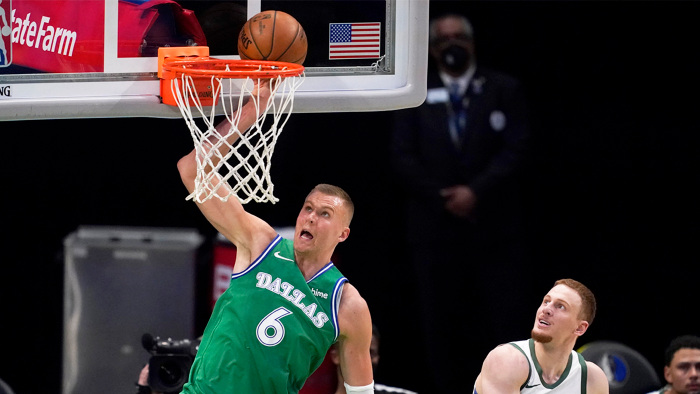
When the Dallas Mavericks stole homecourt advantage by going up 2-0 on the Los Angeles Clippers, many wondered if this was yet another disappointing postseason performance for a title hopeful. Things certainly seemed bleak for L.A., especially when they fell behind 30-11 with a raucous American Airlines Center crowd breaking decibel levels in Dallas. Yet, despite all the adversity the Clippers faced to start the series, they have taken back homecourt advantage and head home tied 2-2. Not only that, but they have steamrolled the Mavericks recently; ever since L.A. fell behind 30-11 in Game 3, they have outscored Dallas 213-157, good for a +56 margin. The Clippers haven’t just beaten the Mavericks, they have thoroughly outclassed them over the last 88 minutes of the series. Yet, we know in the postseason, you can never get too high nor can you get too low. This series is sure to swing some more, but it is now Dallas’ turn to battle through some adversity and adjust.
In the opening games at the Staples Center, one thing was notably obvious: Dallas’ desire to relentlessly attack Ivica Zubac on defense. Zubac, for his career, has actually been a really good defender, especially around the rim. However, he isn’t the most nimble player in space and coupled with Luka Doncic’s massive improvement into a lethal three-level scorer this season, no longer can Zubac hope that Doncic settles for jumpers. Doncic is capable of knocking down one-legged fades, mid-ranges, and of course, the patented step back, at incredibly efficient clips. The Mavericks were running Zubac off the court; in the two home games, Zubac was a -13 in Game 1 and a -16 in Game 2. Not only were the Mavericks picking on Zubac, but they also went after Patrick Beverley, whose defensive reputation vastly outpaces his actual performance. The Clippers started both Beverley and Zubac to start the series and Luka could essentially pick his poison of who to target. So far, in the series, Luka is 13/22 with 33 points when defended by Zubac, and 2/5 with 6 points when defended by Beverley, although the team has generated 14 total points when Beverley is defending Doncic in the 4:20 that has occurred (according to NBA.com’s stats).
However, when the series shifted to Dallas, the Clippers adjusted in multiple ways, but one primarily was going small. Nicolas Batum, who played just 19 minutes in Game 2, played 27 minutes in Game 3 and earned the start in Game 4. In the two games in Dallas, Batum was a +7 and +27, respectively. Batum has looked terrific all series; he has extremely active hands, moves his feet defensively, and has been hot from deep, as he’s connecting on 38.9% of his 3-PT attempts. The Clippers also removed Patrick Beverley from the starting lineup to opt for Reggie Jackson, another move that has paid off. According to NBA.com’s stats, Jackson has gotten cooked when on Doncic, but because of the small ball the Clippers have embraced, they are able to hedge and recover more when Jackson is placed in the pick-and-roll. During the entire series, Jackson is averaging 12.0 PPG (3rd on the team), but his ability to penetrate and hit open threes has been key. Jackson has knocked down 41.2% of his threes that have been classified as “wide open” by NBA.com.
The Mavericks stuck it to the Clippers in Games 1 & 2 in large part due to extremely hot, and unsustainable, shooting. Dallas knocked down 47% of the threes in Game 1 and 53% in Game 2; in fact, they knocked down 51% in Game 3 as well, although they lost in large part because of a good shooting night from Los Angeles and a pitiful 18/47 performance on 2-PT shots. Yet, one thing that has been painfully evident in Dallas is that the Mavericks’ defense simply isn’t good enough to combat a mediocre shooting night, let alone a poor one. The Clippers are attacking the basket at will with very little, if any, perimeter resistance. This series certainly isn’t over, but thinking the Mavericks can lose Game 5 and still win the series is somewhat wishful thinking. What adjustments can Dallas make that could turn the tide?
Adjustment #1: Lineup/Rotation Tweak
For much of the year, the Dallas Mavericks ran out a starting lineup of Luka Doncic, Josh Richardson, Dorian Finney-Smith, Maxi Kleber, and Kristaps Porzingis. Towards the end of the year, however, Rick Carlisle tinkered with that group and by the end of the year, Dallas was primarily starting Luka Doncic, Tim Hardaway Jr., Dorian Finney-Smith, Dwight Powell, and Kristaps Porzingis. The latter starting five was lethal offensively; they posted a 127.3 offensive rating, but they were brutal defensively, with a 125.3 defensive rating. The logic of starting Kleber makes perfect sense, especially since he really lost his starting spot due to injury. However, the entire rotation needs some tinkering.
To start, I’m not necessarily a proponent of a starting lineup change at this point. Dallas’ starting unit is posting a 128.2 offensive rating (beyond elite) and a solid 114.6 defensive rating, good for +13.6 net. That’s a really impressive mark, especially considering that lineup is essentially mirroring what is the Clippers’ starting five, which includes Kawhi Leonard and Paul George. However, that offensive rating is partially inflated by Dallas’ red-hot shooting; that group has an eFG% of 64.9%, which won’t last. The group plays painfully slow (95.62 possessions per game) and while the game does slow down in the postseason, it shouldn’t be that slow. Dallas’ half court offense was stymied on Sunday and coupled with their inability to get stops in the first half, it’s easy to see why they were blown out.
My solution? Tweak the rotation a bit. In my opinion, playoff rotations get unnaturally short some time and in Dallas’ case, I think it’s bit them a bit. Kristaps Porzingis has not been effective in this series and while he played well in Game 4, Dallas needs to have some additional mobility at center to mix up defensive looks against the Clippers. Far too often, when LAC went five out, they simply had Kawhi Leonard and Paul George go to work, forcing Dallas to help. Porzingis is too slow to rotate properly and it leads to open threes, as we saw in Game 3 when Marcus Morris made a living from the corner. Willie Cauley-Stein posted an elite net rating all year and in this series, when replacing Porzingis with Cauley-Stein, the starting five has a +45.4 net rating. Yes, it is a small sample size, but Cauley-Stein’s added mobility is a huge plus. Dwight Powell is another option, primarily due to his ability to trap screen-and-rolls on the perimeter. Powell is a poor rim-protector and doesn’t give Dallas much in one-on-one defensive settings, but he’s highly active and is their most mobile option. Powell really come on strong at the end of the year as he was more and more recovered from his Achilles injury, so giving him some extra burn should also be considered. But, if the Mavericks are serious about improving their defense, they cannot continue to trot out the same combinations. Take a look below at key three-man lineups and their respective offensive and defensive ratings:
| Lineup | Defensive Rating | Net Rating |
| Kristaps Porzingis, Tim Hardaway Jr., Maxi Kleber | 127.7 | -2.7 |
| Kristaps Porzingis, Dorian Finney-Smith, Maxi Kleber | 126.6 | +1.3 |
| Kristaps Porzingis, Maxi Kleber, Luka Doncic | 124.0 | +1.3 |
| Kristaps Porzingis, Tim Hardaway Jr., Jalen Brunson | 145.1 | -41.3 |
One other candidate I’d like to see get some run is Josh Green. Dallas’ effort level is heavily correlated with their shooting performance; when they struggle from the perimeter, they appear sluggish and disengaged. Green is a quintessential hustle guy at this stage of his career and his energy, plus his defensive intensity is sorely needed. The Mavericks have gotten beat off the dribble consistently in Games 3 & 4 and with the Clippers going five out, it takes nearly a flawless defensive effort to properly help and rotate off drives. Green’s athleticism and hustle can fill a role here and considering how he came on strong to end the year, I don’t think the moment is too big for him. Dallas acquired Josh Richardson in large part because they didn’t believe last year’s roster was good enough defensively. Richardson has largely disappointed in Dallas and even when he’s in, Dallas is primarily using him to defend Rajon Rondo and Reggie Jackson. Richardson slows the ball movement offensively and while he’s shot the ball well (42.9% from deep), his net rating is -30.3, one of the worst on the team. Richardson is only averaging 18.0 MPG, but really, I’d like to see Josh Green cut into that a little more and provide this team a spark.
Adjustment #2: Kristaps Porzingis to the Corner
Even dating back to February, I have been clamoring for Rick Carlisle to deploy Kristaps Porzingis in the corner more. I’ll dive into some clips and data in a bit, but the logic behind the positioning actually makes a lot of sense. Deploying centers in the “dunker spot” has become more and more popular. Essentially, when a guard drives to the rim, if the opposing center rotates over, the guard dumps the ball to the big in the “dunker spot” for an easy dunk. This essentially puts the opposing center in a 2-on-1 situation, where they either rotate over to contest the driving guard’s shot and give up a layup/dunk (unless their teammate properly recovers in time), or, they give up a layup to the driver. However, the beauty of having Kristaps Porzingis is his ability to space the floor and hit 3-PT shots at an extremely high clip. The corner can be thought almost as an “extended dunker spot”, and by deploying Porzingis there, you get all the benefits of the usual dunker spot, except with added spacing. Dallas’ pick-and-pop game with Doncic/Porzingis has been lethal all season, but with the Clippers using Kawhi Leonard as the primary defender on Porzingis (and switching nearly everything since going small), the Clippers are essentially daring Doncic to call for a pick-and-pop, knowing it’ll lead to Leonard on Doncic. This doesn’t always happen, but Porzingis’ inability to punish smaller players on switches makes Dallas more susceptible to an aggressive, switching team that has perimeter defenders capable of making things tough on Luka. There’s not many teams that truly have the array of defenders possible to do that, but the Clippers are unfortunately one of them.
When deploying Porzingis in more of an off-ball, “stand in the corner” role, Dallas can essentially scheme Kawhi Leonard out of the defensive game. Getting Doncic to the basket with a full head of steam is always the goal, but with Porzingis in the corner, his defender is essentially stuck; rotating means giving Porzingis, who shot 62.5% on corner threes this year and is a career 43.7% 3-PT shooter from the corner, a wide open look. Or, it frees up Porzingis to leak into the dunker spot and act as a vertical spacer, something that has worked beautifully this year. On cuts, Porzingis averaged 1.37 PPP this season, ranking in the 66th percentile. Moving Porzingis to the corner would essentially place him into a more passive offensive role, something he has publicly pushed back on and something the team seems to believe is a bad idea. However, I’d argue force feeding him the ball is even worse; placing him in the corner adds a whole new wrinkle to Dallas’ offense that, in my opinion, could make them much more difficult to stop.
At the 5:18 mark below is a clip of Porzingis in the corner during Game 3. The first one really stands out; Leonard moves down to help, and Doncic swings the ball to Porzingis. Leonard recognizes the threat, closes out too hard (off a nice KP pump fake) and it leads to an easy, wide-open mid range jumper. These are the shots Dallas can get from Porzingis in these types of sets; sure, he’s not actively being sought out by Doncic, but his mere presence and skillset allows for these types of looks:
Placing Porzingis, Dallas’ best corner 3-PT threat, in the corner and pairing him with a roller could be the key to beating the Clippers’ aggressive, switching style. Maxi Kleber could be the roll-man if needed (he averaged 1.23 PPP on those plays this year, ranking in the 76th percentile).
Adjustment #3: Switch More Defensively
Drop coverage has been a super popular defensive scheme over the past few years, particularly with analytics becoming more prominent in the NBA. Drop coverage is when the defense gets a screen-and-roll, the man defending the screener “drops” deep into the paint, preventing the P&R ball-handler the ability to drive by for a layup. Drop coverage is all about protecting the paint, which makes sense considering layups are the most efficient shots in the league. Drop coverage attempts to force the P&R ball-handler to settle for a dribble pull-up from three or mid-range, (likely above the break from three), which are the most inefficient shots. Dallas embraced drop coverage this year, to mixed results. As a whole, the league shot the three ball significantly better this year than in past years, which could partially be due to limited crowds. This immediately took away one benefit to drop coverage. However, Dallas’ drop coverage also doesn’t necessarily work because the Mavericks’ perimeter defenders aren’t good enough at getting around screens and recovering, while Kristaps Porzingis isn’t mobile enough to be slightly more aggressive in drop coverage settings. Porzingis isn’t the rim protecting threat he once was and overall, the scheme has busted far too often in Dallas. While they have forced opponents to take a large amount of above the break threes and mid-range jumpers, many have been lightly contested.
Ultimately, I think Dallas has to switch screen-and-rolls more often. Dallas has done a fair amount of switching this series, but I think they have to be willing to put Kristaps Porzingis on an island more often. Surprisingly, in the fourth quarter of Game 4, Dallas did switch more with Porzingis and ultimately, he held his own. By exposing Porzingis to switches, it essentially removes him from rotations, which has been his biggest area of weakness.
Adjustment #4: Luka Doncic to the Post More Often
If the Los Angeles Clippers are going to play small, Dallas has to find a way to punish them. Usually, that means exploiting how small they are by bullying a team inside. However, the Clippers’ elite perimeter defenders have made it difficult for the Mavericks to attack the paint since going small; among all playoff teams, Dallas has the lowest percentage of their total points coming inside the paint. Over the past two games, just 34.9% of their points are coming in the paint, a major concern considering how small the Clippers have gone. We know from history that Kristaps Porzingis is incapable of punishing smaller defenders with his size, but what about Luka Doncic? I think this is one edge Dallas hasn’t exploited as much that they could target over the next few games.
During the regular season, Luka averaged 1.09 PPP on post ups, ranking within the 84th percentile according to NBA.com’s stats. Simply put, Luka was elite when operating out of the post and while that was primarily against smaller defenders, that is the option against the Clippers. Ideally, the Mavericks want to pin Reggie Jackson on Doncic, but with the Clippers hard hedging every Jackson screen, Doncic and the Mavericks have a hard time earning that switch. Yet, in my opinion, the Mavericks could be targeting one other player on switches: Nicolas Batum.
Batum has played a bit of a free safety role defensively; in essence, when teams go small, many utilize the small-ball five in a free safety role where they primarily function as a rotator defensively, rather than actually defending somebody 1-on-1. Batum operating in a “rover” role is his strength, but forcing him into operating as a 1-on-1 defender harps on his weakness, which is his middling foot speed and quickness. Doncic has obviously dominated Ivica Zubac, Reggie Jackson, Patrick Beverley, and Rajon Rondo, but out of the next range of defenders, the player he has had the most success against has been Nic Batum. The Clippers actually started Batum on Porzingis last game and Dallas had success attacking that matchup, albeit in a limited sample size. If the Clippers go small, targeting Batum should be the priority.
Real-Time Update: Boban Starting
The Athletic’s Tim Cato just reported that Boban Marjanovic is expected to replace Maxi Kleber in the starting lineup, and oh boy, is this one heck of a counter. Rick Carlisle is essentially daring the Clippers to utilize a player 6’9 or smaller to defend Boban, but asking Boban and Kristaps to play defense together is a nightmare waiting to happen. I’m sure Carlisle has some defensive wrinkles up his sleeve; the Mavericks could go triangle and two zone defense, where Dorian Finney-Smith could defend Kawhi and Tim Hardaway Jr. could defend Paul George, but that is getting super wonky. Rick seems set on hoping that Boban’s size can force the Clippers out of their small ball, but I’m not sure if that is really true. However, I do like how the Mavericks aren’t trying to out small ball the Clippers; they don’t have the personnel to do it and would be playing right into Los Angeles’ hands. That would be a recipe for disaster.
This season, lineups that featured Porzingis and Marjanovic together garnered just one total minute! This is a really drastic lineup tweak that the Mavericks are enacting tonight, if the rumors are true. However, lineups of Luka and Boban dominated; that two-man group posted a 113.4 offensive rating and a 99.3 defensive rating, really impressive numbers. The two have really impressive chemistry and Boban’s presence should be a major boon to the half court offense (and, potentially force Porzingis into a catch and shoot role from the corner).
Now, the major concern with Boban being inserted is on the defensive end. If the Mavericks play traditional man-to-man, it’s likely Kristaps Porzingis will defend Marcus Morris and Boban Marjanovic will defend Nicolas Batum. This likely drifts the two of them away from the paint and in space and makes switching on defense impossible. However, I do think it could force Morris and Batum to make plays. If Dallas were smart, they’d go exclusively to zone defense or a triangle and two, forcing some of the Clippers’ role players to hit shots. Batum has shot well in the postseason, but Morris is way below his season average and Reggie Jackson, despite what seems to be a hot shooting series, is only connecting on 34.5% of his attempts from deep. Now, giving those guys wide open shots obviously isn’t ideal, but considering how lethal Kawhi Leonard has been, I’ll take my chances.
I’m not sure if Boban starting gives the Mavericks an edge at all, but it’s apparent when viewing their roster they don’t have an effective counter to small ball except forcing the opponent to guard Boban. If nothing else, it will be a ton of fun. But, it’s not hard to envision a scenario where the Clippers just obliterate the Mavericks in transition. L.A. has been by far the most effective transition team in the postseason and Boban/Kristaps together forces Dallas to keep this a half court game. I don’t expect Boban to get much run to be honest, but if he can dominate offensively for the first 3-4 minutes, it’ll force Ty Lue to make the first adjustment. That’s the chess match Dallas has to win.
 The Chirp