
Despite the challenges COVID-19 presented, we were able to have a heck of a college basketball season. Throughout the year, we have been carefully analyzing and scouting a ton of college players to help kick off our scouting season for this summer’s NBA Draft. Right now, it appears there’s a consensus top five, although many individuals have a different order of guys in between 2-5. After the top five, however, things get a bit messy. There’s a lot of players lumped together in that second tier, but pundits and scouts will be divided on who gets that top tier. Is it the high upsides of Keon Johnson, James Bouknight, and Jalen Johnson? Or, is it the safer picks like Corey Kispert, Scottie Barnes, and Franz Wagner?
Today, we’re excited to unveil our first NBA Draft Big Board, although it will be limited solely to collegiate prospects (and those who played in the G-League). Let’s break it down, starting with our top 30:
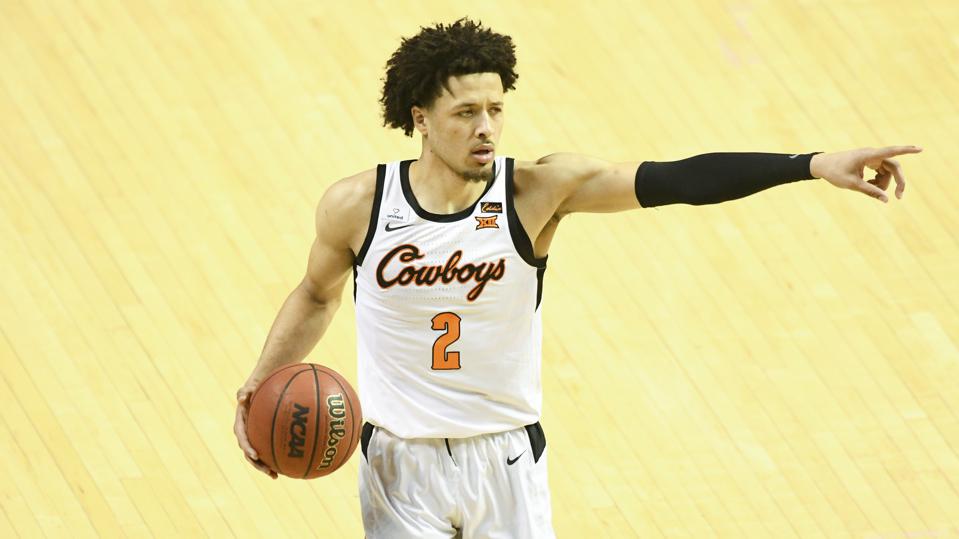
1. Guard: Cade Cunningham (Freshman–Oklahoma State)
Player Comparison: Shai Gilgeous-Alexander, LaMelo Ball
Breakdown: Truthfully, I’m not sure how scouts have a different player at #1. Cade Cunningham is the prototypical player teams dream about starting a franchise with. He has tremendous size (6’8) and is a terrific playmaker. Because of his size and passing skill, he’s naturally drawn some comparisons to Luka Doncic, although I’d argue Cunningham’s game more closely resembles that of Shai Gilgeous-Alexander, with some Doncic mixed in. Cunningham is a solid 3-PT shooter as well and his offensive game will surely pop with NBA spacing. He’s not flashy or an explosive athlete, but why should that prevent him from going #1? He’s fundamentally sound, has elite potential, and will make his teammates better. Plus, he has the clutch gene. This one isn’t too difficult, even with some terrific high-end prospects in the class.
2. Guard: Jalen Suggs (Freshman–Gonzaga)
Player Comparison: Zach LaVine, but more impactful defensively
Breakdown: Trying to slot in the guys I have 2-4 was incredibly difficult and I certainly have gone back-and-forth. I lean Jalen Suggs as #2 for a few reasons. First, is his impactful two-way play, even when he’s not dominating the ball. Suggs has certainly benefitted from playing on a loaded Gonzaga team, but he makes countless winning plays. Suggs had his fingerprints all over the final seven minutes of the UCLA game. He made one of the most incredible defensive plays I’ve seen, blocking big man Cody Riley at the rim, only to follow it with a filthy full-court bounce pass in transition. Oh, and did you see that ridiculous game winner from half-court, a shot that will be enshrined in NCAA history forever? Suggs has a terrific motor, is a premier athlete with great speed, and can be one of the best perimeter defenders in the NBA. Personally, I think Suggs’ best skill might be his defense. Offensively, Suggs shines as well, particularly as an improving passer but also with his ability to finish around the rim. His perimeter shot has been hit-or-miss this year, but his form is solid and he’s flashed enough from deep to be a reasonable threat. I’ve fallen in love with Suggs’ game and his personality throughout the year. I’d be stoked to hand over the keys to my franchise to a guy like him.
3. Big: Evan Mobley (Freshman–USC)
Player Comparison: Jaren Jackson Jr./Lite Anthony Davis
Breakdown: It seems that the majority of individuals have Evan Mobley slotted in at #2 and watching him play, it’s easy to see why. Mobley is such a fluid athlete; it’s astounding that he’s 7’0 tall considering how he moves like a guard. Mobley is a premier defender who is a menace around the rim; his length is tremendous and his shot-blocking instincts allow him to be a force inside. He needs to get tougher and bulk more to be a true dominant, inside presence, but as of now, he’s a prototypical defensive building block. He’s built to anchor a NBA defense. Offensively, there’s questions whether Mobley can ever be a go-to guy (if he does, you’re looking at Anthony Davis), but he’s got a nice shooting stroke and if nothing else, has the potential to be an elite vertical spacer. His ceiling is as high as anyone’s in the class.
4. Guard: Jalen Green (G League Ignite)
Player Comparison: Bradley Beal
Breakdown: Jalen Green is a fascinating prospect to me and for a while, I had him at #2 on my board. Green is still neck-and-neck with Suggs and Mobley, but ultimately, I have lowered Green a touch. Green has three-level scoring upside and showed it off in the G-League Bubble; he’s a serious threat from behind the arc with limitless range and he’s a bouncy athlete with the athleticism and strength to finish around the rim. Green’s physical tools give him plenty of defensive potential as well. Playing against a higher level of competition, Green was a bit inconsistent, but that was expected. He certainly established himself as a blue chip prospect and I think he has a higher ceiling than Jalen Suggs. If a team has to “settle” for Green, they’ll be incredibly happy.
5. Wing: Scottie Barnes (Freshman–Florida State)
Player Comparison: Andre Iguodala
Breakdown: It may seem surprising to see Scottie Barnes here, but after watching multiple Florida State games, I fall more and more in love with his game each time. Barnes’ best skill is his defense; he’s a complete game-wrecker on that end and his impact compares to that of Ben Simmons. I’m not sure Barnes ever gets to Simmons’ level, but he has terrific instincts, length, and agility to guard 1-5 and force turnovers. Offensively, Barnes doesn’t have a polished jump shot and is limited, but he’s a terrific passer who can run as a point forward. The versatility Barnes is able to provide will be a huge asset to the team that selects him. If his jumper develops, he can be a player who earns multiple All-Star selections. If not? He’s likely an All-Defense winner and can still make an All-Star team. He’s very good and very underrated.
6. Guard: James Bouknight (Sophomore–UConn)
Player Comparison: Physical Monta Ellis
Breakdown: Shout out to my twitter friend Reese Konkle for initially floating this comp back in February, but James Bouknight is an absolute bucket. His perimeter shot is a bit inconsistent, but what flashes in Bouknight’s game is his slashing ability. A powerful, physical athlete, Bouknight has an uncanny ability to absorb contact inside and finish. UConn’s spacing wasn’t great this past season, but envisioning Bouknight in an open floor with NBA-caliber shooters around him is a scary sight. Defensively, Bouknight needs to be a more impactful player, but he has the necessary physical tools to serve as a framework. He can certainly grow more on that end. At worst, I think Bouknight resembles a player similar to Jordan Clarkson. At best? You’re looking at Donovan Mitchell or a more physical version of Monta Ellis, who would be quite the player in the modern NBA.
7. Wing: Jonathan Kuminga (G League Ignite)
Player Comparison: Rudy Gay
Breakdown: It may be a bit surprising to see Jonathan Kuminga, a player many have as a consensus top five prospect, down at seven. However, when watching Kuminga during his G League stint, I saw a lot of potential, but I was always left wanting more on both ends. From a physical standpoint, Kuminga has the frame and athleticism to be an interchangeable forward in the NBA. Essentially, his versatility and the potential he provides is a perfect blueprint for what many teams look for on the wing. Offensively, Kuminga is raw and needs to improve his jumper and shot creation ability, although he’s shown flashes. Defensively, I often saw Kuminga operate with questionable technique. All the physical tools are here that with proper development, you’re looking at a player who resembles Harrison Barnes or Rudy Gay at minimum. However, his raw skills have him a bit lower on my board than others. I’d be ecstatic to grab him and he’s likely a candidate to rise through pre-draft information, but as of now, he’s a touch behind Barnes and Bouknight.
8. Forward: Jalen Johnson (Freshman–Duke)
Player Comparison: Aaron Gordon
Breakdown: Jalen Johnson had a bit of a turbulent freshman year at Duke. The Blue Devils were uncharacteristically poor this season (despite a rash of bad luck) and Johnson battled a foot injury for a decent chunk of the season before “opting out”. However, from watching Johnson, I think he has a clear-cut NBA role. His game eerily resembles Aaron Gordon; he’s a powerful athlete who functions best as a modern day four. Johnson can switch defensively, protect the rim, and is active on the glass. He has game-wrecking potential on that end. Offensively, is where the question marks come in. Johnson’s shot, while better than I expected, is still stiff and needs work. His slashing ability is solid and he showed some nice flashes as a passer, but I think he fits best as a short-roll threat who can be a dynamic cutter, similar to how we’re seeing Gordon being deployed in Denver. He’ll have to answer questions about opting out, as he did a similar thing in high school as well. If his character checks out, he’s definitely a top-10 guy in my book.
9. Guard: Davion Mitchell (Junior–Baylor)
Player Comparison: Kemba Walker with better defense
Breakdown: While Davion Mitchell shares some eerie similarities with Donovan Mitchell, I have one more to add: they’ll both likely be lottery picks. Davion has been a standout in the NCAA Tournament and has skyrocketed up my board. Watching him play, I don’t understand how he isn’t a surefire lottery pick. Offensively, Mitchell’s first step is deadly; he effortlessly blows by opposing guards and gets to the rim at will. He’s not afraid to stop on a dime for a mid-range jumper either and he has terrific vision. Every game in the tournament so far, Mitchell has taken over. Defensively, however, might be where Mitchell makes his best impact. Baylor Head Coach Scott Drew calls Mitchell “off night”, because the player he’s defending usually has an off night. Corny as it may be, it’s true. Mitchell has strong hands and is relentless in pressuring the ball. He has the foot speed to stay with quicker guards and the physicality to handle slightly bigger players as well. He won’t posterize any opponents and is a bit older, but those are silly, minor flaws to highlight. He’s going to be a terror in the NBA.
10. Guard: Jaden Springer (Freshman–Tennessee)
Player Comparison: Marcus Smart
Brreakdown: I’ll admit, I love Jaden Springer. While many big boards I see tend to have Springer’s teammate, Keon Johnson, above him, I think Springer’s defensive impact gives him the edge. While Springer is a guard, he defends like a big; he’s a terrific off-ball defender who makes crisp rotations and is strong enough to handle playing on the interior. Defensively, he reminds me a lot of Marcus Smart with his toughness and underrated athleticism to block shots and rotate. Offensively, Springer is a bit raw, but he boasted solid shooting numbers and has the potential to grow as a secondary facilitator for an offense. Ultimately, you’re looking at a high-energy backcourt player who impacts winning. He’s going to be a key glue guy for many winning teams.
11. Wing: Franz Wagner (Sophomore–Michigan)
Player Comparison: Chandler Parsons
Breakdown: Franz Wagner had a breakout sophomore campaign at Michigan and was arguably the team’s best player. Wagner’s best asset is his versatility, particularly on the defensive end of the court. While not the fastest player or most powerful athlete, Wagner has terrific positional size, technique, and instincts to switch on the perimeter and stay in front of his man. Wagner is a great team defender who is a major asset on that end of the court. Offensively, Wagner has a little bit of “point forward” in his game; he’s a nice pick-and-roll player and smart, solid passer as well. His 3-PT shot has shown some promise, but the results are lagging his actual form. Wagner has the potential to be a starting forward in the NBA who can contribute on both ends and get his teammates clean shots. That’s worthy of a lottery pick.
12. Guard: Keon Johnson (Freshman–Tennessee)
Player Comparison: Victor Oladipo
Breakdown: Keon Johnson is a player who I have seen skyrocket up boards and considering his improvements over the course of his freshman campaign, it is easy to see why. Johnson is an explosive, springy athlete who, despite his size and thin frame, has the potential to be an elite slasher at the NBA level. He has good shot creation skills and needs to improve upon the actual results, but the framework is there. He has an improving jump shot, decent mechanics, and a great ability to navigate traffic. Tennessee didn’t have great spacing this past year, but in the NBA, Johnson’s game should pop in an open court setting. Defensively, Johnson has the tools to be a plus defender. He’s quick, has good hands and instincts, and like many Tennessee players, is an excellent off-ball defender who understands rotations. Johnson is a bit raw, but he has the physical tools and flashes that any NBA team should take a chance on in the lottery.
13. Guard: Sharife Cooper (Freshman–Auburn)
Player Comparison: Trae Young without the jumper
Breakdown: Sharife Cooper is sure to be a polarizing prospect, as his game is quite unique. Cooper is an undersized, thin guard who has a questionable jump shot with an unorthodox form; he was a fine free throw shooter, but I’m not sure I envision him being an average 3-PT shooter with his form that almost has him leaning backwards. With that regard, it’s tough to pinpoint Cooper as a franchise player. However, Cooper’s passing ability and how effortless it is for him to slice through a defense keeps him in my top-14. Cooper made Auburn significantly better and when surrounded by shooters and lob threats, he’s an absolutely lethal playmaker. Defensively, Cooper is undersized and his effort fluctuates, but he has quick hands and, if willing, could be a pest who presses 94 feet. I’m not sure that’ll ever be Cooper’s game, but there’s some potential. I personally think Cooper has, at minimum, the potential to be an offensive spark off the bench who creates for teammates. If his shot develops, I think we could legitimately see Cooper reach Trae Young levels. That’s how gifted he is as a playmaker.
14. Wing: Corey Kispert (Senior–Gonzaga)
Player Comparison: Lite Gordon Hayward/Joe Harris
Breakdown: Corey Kispert’s NBA lookalike is Joe Harris, so is it really a surprise their games are similar as well? It’s easy to envision Kispert fitting in seamlessly to NBA offenses; he’s elite at running off screens and thrives with pin downs and curls. Kispert is a lights out 3-PT shooter with a picturesque stroke. He’s not a great athlete nor individual defender, but he’s a quality playmaker who functions well in a team setting. Kispert is an able ball-mover and fantastic cutter; his off-ball movement and shooting gravity could unlock a modern NBA offense. Kispert is a fine team defender and is unlikely to ever become a lockdown one-on-one guy, but that’s ok. His value is primarily on offense and if his game translates as expected, he’ll be a high impact guy.
15. Guard: Ayo Dosunmu (Junior–Illinois)
Player Comparison: Collin Sexton/C.J. McCollum
Breakdown: Ayo Dosunmu was the second best player in college basketball this season behind Luka Garza. Dosunmu’s overall game reminds me a lot of Collin Sexton; he’s a fierce competitor who’s a dynamic scorer off the dribble. Dosunmu isn’t a great athlete and may struggle against NBA length, but is ability to navigate angles, manage a dribble, and finish around the rim gives me confidence he’ll be an able scorer. Dosunmu’s passing took a major leap forward this year as well, further bolstering his value. Defensively, Dosunmu can get in a stance and is tough to get by. He’s unlikely to be a lockdown guy and because of his limited athleticism, his ceiling is somewhat capped. However, if he can produce like he has in college, he’s going to be an impactful sixth man for a winning team. Dosunmu’s leadership skills and desire to win gives him a nice bump on my board.
16. Wing: Moses Moody (Freshman–Arkansas)
Player Comparison: Less athletic Norman Powell
Breakdown: Moses Moody is a fascinating prospect for me to evaluate. Our love for Eric Musselman and Arkansas is well-known here at The Chirp, but Moody’s play in the NCAA Tournament was disappointing. Moody’s splits against better teams were troublesome, but it’s easy to envision Moody effortlessly fitting on any NBA team. At his best, Moody is a strong set shooter who is adept at hitting dribble pull-ups or coming off screens. Like many prospects on the list, he’s a guy who should pop in the open floor of the NBA. Defensively, Moody has to be tougher, but he’s got a 7’0 wingspan and had some impressive flashes. Moody fluctuates too much in and out of games to consider him as a top-12 pick and he far too often was unable to establish himself against better competition. In a secondary role, however, he figures to be a solid NBA contributor and a potential 3-and-D wing who connects on 40% of threes.
17. Big: Isaiah Jackson (Freshman–Kentucky)
Player Comparison: Mitchell Robinson
Breakdown: Throughout the year, Isaiah Jackson kept rising up my board. Jackson’s best skill is without a doubt his rim protection; he’s one of the better shot blockers that has played on the NCAA circuit the past few seasons. Jackson is foul prone, like many shot blockers are at a young age, but his potential defensive impact is huge. If he can refine his technique, he could be a guy to switch 1-5 and protect the rim. The small ball lineups he’d be able to provide would be devastating. Offensively, Jackson is a bit raw and unpolished. He’s capable of hitting some short floaters and his jumper isn’t horrible, but he’s certainly not a player you’d run a pick-and-pop for. Jackson isn’t the best vertical spacer either, but his ideal role would be similar to Clint Capela’s in Houston. Jackson has all the tools of a modern big, but his offensive limitations prevent him from being too high on my board.
18. Big: Kai Jones (Sophomore–Texas)
Player Comparison: Taller De’Andre Hunter
Breakdown: Early on in the year, I had Kai Jones inside my top ten. While it may seem troublesome that he’s fallen to #18, I should emphasize that I love Jones’ game. However, other players improved throughout the year and Jones’ offensive growth seemed to peak in the winter. Offensively, Jones is a bit raw and a bit of a wildcard. He’s not someone who projects to create his own shot at the NBA and he was a questionable decision-maker with a loose handle in college. Jones showed some 3-PT improvements this year, knocking down 38.5% of his 3-PT attempts, but that came on only 1.3 per game and he slowed down as the year progressed. Defensively is where Jones will make his money; he can effortlessly switch 1-5, play as a small-ball five, and jump passing lanes. Jones is a difference-maker defensively. I think Jones’ ceiling resembles a player like Robert Covington or De’Andre Hunter. If his playmaking can develop, he’s easily a top-10 prospect. The offensive stagnation worries me a bit, but I would have no issues with a team drafting him in the lottery. He’s got a high ceiling.
19. Guard: Tre Mann (Sophomore–Florida)
Player Comparison: Anfernee Simons
Breakdown: Another player flying up my board, Tre Mann is a really talented guard from Florida. Mann is lightning quick with three-level scoring potential and great size for a lead guard (6’5). Mann’s 3-PT shooting was particularly impressive this year, especially his ability to knock down shots off the dribble. Mann is a capable passer as well and flashed impressive ability for pocket passes and finding bigs in the pick-and-roll. Offensively, he’s a well-rounded prospect who figures, at nothing else, to be an impactful bench player. Defensively, Mann has great positional size, but he needs to be a bit stronger and have better defensive technique. The talent is there and ultimately how he develops as a defender could determine his ceiling.
20. Wing: Ziaire Williams (Freshman–Stanford)
Player Comparison: Cam Reddish
Rationale: It was a bit of a rough year for 5-star freshman Ziaire Williams, as he battled a few personal issues during a COVID-19 campaign. However, Williams garnered a ton of hype in high school and while his collegiate play was uneven, the flashes and potential is enough to consider him a first-round prospect. Williams has a clean shooting stroke and while his shot selection needs work, it’s easy to slot him in as a high-level floor spacer in the NBA. He’s improving as a playmaker, but like many raw wings, he needs to bulk up and get tougher to be a true on-ball threat as a driver. Defensively, Williams has serious upside. He’s a tremendously fluid athlete with great positional size and versatility. Williams is engaged and active; he can rotate off-ball, take charges, and has a high IQ on that end of the court. If Williams bulks up, he can certainly fulfill his ceiling. The landing spot will be important for Williams’ development, but I really like his game.
21. Wing: Josh Christopher (Freshman–Arizona State)
Player Comparison: Andrew Wiggins
Breakdown: Josh Christopher is an intriguing prospect; he entered Arizona State as the Sun Devils’ highest-ranked recruit since James Harden, although one could argue Christopher did not live up to the lofty expectations. Christopher dealt with nagging injuries and an entire Arizona State team that was sidetracked by COVID-19, personal issues, and injuries themselves. However, Christopher’s potential is worth taking a shot on. He’s a fluid athlete who’s a capable shot creator; it’s easy to envision him sliding in as a tertiary scorer on a good team. His efficiency needs improvement and he didn’t shoot as well as I expected, but the framework is there. Defensively, Christopher has all the physical tools to be an impact player. With the right coaching, he can fulfill his high two-way upside.
22. Guard: Jared Butler (Junior–Baylor)
Player Comparison: Derrick White
Breakdown: Another player from the National Champions, Jared Butler’s play seems to have solidified him as a first round prospect in my opinion. Butler’s best skill is his shooting; he has a pure stroke with great balance and deep range. Even though Butler got off to a shaky start in Indianapolis with his shot, he was red hot over the final two weekends. I think Butler functions best as an off-ball guard, as he isn’t the most dynamic playmaker or athlete. However, his success as a shooter and his passing skills will play well in the modern-NBA. Defensively, Butler can get after it, albeit not quite as well as his teammate Mitchell. Nevertheless, Butler is a stud defender in his own right with strong hands and a tough attitude. He reminds me a lot of Derrick White; while not the athlete White is, he’s a combo guard who can shoot and defend at a high level. That’s a valuable skillset in the NBA.
23. Big: Jeremiah Robinson-Earl (Sophomore–Villanova)
Player Comparison: Rui Hachimura
Breakdown: When watching Jeremiah Robinson-Earl, the thing that stands out most are his fundamentals. While not the most impressive athlete, JRE wins with his footwork, IQ, and skill. Offensively, he’s a capable mid-range shooter but primarily won down low in college. Considering he’s primarily a below the rim athlete, he’ll have to expand his range a bit, making his shooting a key swing skill. Defensively, JRE isn’t an imposing player, but he moves his feet, competes down low, and has a great mind for team defense. Like many Villanova players, Robinson-Earl will be a valuable NBA player with his instincts and commitment to technique. I’d be surprised if Robinson-Earl ever becomes an All-Star, but he’s a quality role player in the NBA. If his shot comes along, he could be an impactful starter.
24. Wing: Marcus Bagley (Freshman–Arizona State)
Player Comparison: Otto Porter Jr.
Breakdown: Like his teammate Josh Christopher, Marcus Bagley also experienced injuries during his freshman campaign which led to some struggles. However, Bagley has a well-defined skillset that makes him valuable; he’s a terrific 3-PT shooter, good rebounder, and has some defensive chops as well. Bagley is still young enough where it’s reasonable to think he could develop a dribble drive game as well, meaning he has some untapped potential remaining. Regardless, it’s easy to envision how Bagley fits in the modern NBA. Putting him in the corner for spacing would make him a valuable player, somewhat in the Otto Porter Jr. mold.
25. Wing: Isaiah Livers (Senior–Michigan)
Player Comparison: Harrison Barnes
Breakdown: It’s a shame we didn’t get to watch Isaiah Livers play in March due to a stress fracture, because I think he was a prime candidate to shoot up boards. Livers was instrumental in Michigan’s dominance this season. Livers is a versatile forward who is an elite 3-PT shooter (43.1% this past season, 41.2% for his career). Livers is a willing passer who is also an underrated athlete; considering his frame, he gives you multi-positional versatility and a player who could thrive in a variety of roles. Defensively, Livers is an impactful team defender who can switch and make plays. You’re not looking at a player with star potential here, but Livers is a guy who winning teams constantly seek out. A realistic projection for him is similar to how Harrison Barnes performed while with Golden State.
26. Guard: Cam Thomas (Freshman–LSU)
Player Comparison: J.R. Smith
Breakdown: While I’ve mentioned a few names as “polarizing”, I don’t think any prospect is more polarizing than Cam Thomas. For me, I am not a fan of Thomas’ style, although I understand the hype around him as well. Thomas’ game resembles that of a “bad shot taker, bad shot maker”. He lives for difficult shots, mainly of the step back variety, and is not a willing ball mover. He’s a microwave-type player who, when hot, can go for 30+ any night and be virtually unguardable, especially with his ability to get to the foul line. Thomas’ ability to generate his own shot makes him a first round prospect. Defensively, Thomas needs better engagement and effort. He has the requisite physical tools and athleticism to be a quality defender, but his commitment lacks. Ultimately, if Thomas shifts his defensive attitude and becomes a more willing passer, he’ll be a dynamic player in the NBA. If not, I fear he’ll be a high volume scorer on a lot of teams that don’t win many games.
27. Guard: Chris Duarte (Senior–Oregon)
Player Comparison: Malcolm Brogdon
Breakdown: Chris Duarte is a player that flies under-the-radar from playing in Oregon, but ultimately, he’s a really steady combo guard. Duarte can score from all three levels and is an efficient player. He doesn’t force things and is a really impressive shooter with playmaking chops as well. Defensively, Duarte can certainly an asset on that end of the court. No, he won’t lock down the opposing team’s best player, but he’s shown at Oregon the ability to hold his own on the perimeter and is likely to be at least average on that end of the court. Duarte seems like an easy player to plug and play immediately and contribute to a winning team. He’s a dark-horse prospect who I think is likely to shoot up my own board by the end of the process.
28. Wing: Herb Jones (Senior–Alabama)
Player Comparison: Gerald Wallace
Breakdown: Herb Jones was a player who established himself to me as a clear-cut first round prospect early in the year, but tailed off at the end. Offensively, Jones is a really unique player; he functions as a ball-handler and initiator, but isn’t a big-time scorer. Jones is a great passer, but he struggled around the rim as the year went along and doesn’t have a variety of dribble moves. Jones’ 3-PT shot started out hot and he showed improvement, but I’m not sold on him being an above average marksman in the NBA. Defensively is where Jones will make his money. He excels at rotations and is a physical, tough player who can stay in front of his man. Like Alabama overall, Jones’ play did regress as the year went along, but I saw enough that he is still slightly a top-30 prospect. That could change, but he’s a tough-nosed, team player who does a lot of simple things at a high level that impact winning.
29. Big: Day’Ron Sharpe (Freshman–North Carolina)
Player Comparison: Tristan Thompson
Breakdown: Day’Ron Sharpe is a player who jumped up my board by the end of the year. Offensively, Sharpe has a lot of skills similar to past North Carolina bigs. He’s a terrific, aggressive offensive rebounder who attacks the glass and has quick jumps. Sharpe doesn’t have much offensive range and isn’t a dominant athlete, but he’s extremely effective around the basket. Interestingly enough, he has really soft hands and nice instincts; he’s an impressive passer for a big and has a generally soft touch, even though his shooting is not a strength. Defensively, Sharpe isn’t particularly agile on the perimeter, but he’s a nice rim-protector who has shown some flashes of playing on the perimeter. While Sharpe is primarily a guy who can only play inside 12-feet of the basket, he’s a skilled big with a nice game, and some room to grow.
30. Guard: Miles McBride (Sophomore–West Virginia)
Player Comparison: Patrick Beverley
Breakdown: Miles McBride is another prospect I’ve really grown to like more and more. While different than most West Virginia guards, McBride has the same “pest” quality of past West Virginia players, namely Jevon Carter. McBride is willing to press 94 feet and is aggressive in pursuing steals. In a more structured half court defense, McBride’s impact may be slightly diminished, but I see a pretty defined role for him defending smaller guards and working in a pest role a la T.J. McConnell. Offensively, McBride can really shoot. He’s got some microwave potential off the bench and his game is conducive to changing the energy. He’s an impactful piece a team could snag at the bottom of Round 1.
 The Chirp