
A misconception when evaluating the talent gap in the NFL is individuals believe there are stark differences between a 6-10 team and an 11-5 team. The truth is that many games played across a NFL season are competitive. Last season, NFL teams on average had 8.34 of their games decided by one possession, which accounts to north of 50% of their games. The Seattle Seahawks and Detroit Lions had 75% of their games decided by one possession and only 13 teams had fewer than 50% of their games decided by one possession. Teams are more competitive than people believe and the gap between a team like the Green Bay Packers and the Dallas Cowboys was not as stark as their five win differential. Today, we’ll go for a deep dive into the importance of one-possession games in determining a win/loss record for a season, what teams were lucky and unlucky last season, and which teams should face a positive or negative regression in win total for the 2020 NFL Season.
One Possession Games By the Numbers
Last season, the five best performing teams in one-possession games were the Green Bay Packers, New Orleans Saints, Seattle Seahawks, Baltimore Ravens, and Houston Texans, all of whom were playoff clubs. Going back to 2018, the five best performing teams were the Los Angeles Rams, Los Angeles Chargers, Miami Dolphins, Dallas Cowboys, and New Orleans Saints, which is an 80% playoff rate. From looking at the past two years alone, there is a correlation between the performance a team has in their one-possession games and making the postseason. With that being said, teams can make the postseason when performing poorly or below average in one-possession games, but it is unlikely. In 2018, only two teams who performed “below average” in one-possession games made the postseason (Baltimore and Seattle), and in 2019, it was the same (Buffalo and Minnesota). As I’ve mentioned in a previous article, 2017 was a weird year in which a lot of predictive statistics were inaccurate in predicting playoff appearances, but even then, only four teams who performed below average in one-possession games made the postseason, accounting for just 33% of the field.
While performance in one-possession games has predictive power in determining a team’s success for an individual season, it is a high variance statistic that rarely follows a pattern from year-to-year. To get extremely statistical on you, the correlation between winning percentage in one-possession games from 2018 and 2019 was zero. While there are certain clubs that traditionally perform well in close games (New England and New Orleans), even the best teams deviate from year-to-year. For example, the Baltimore Ravens went from winning 42.9% of their one-possession games in 2018 to 83.3% in 2019. The Los Angeles Rams went from winning 85.7% of their one-possession games in 2018 to 50% in 2019. The biggest changes came from the Dallas Cowboys, who won 75% of their one-possession games in 2018 to a meager 14.3% in 2019, and Los Angeles Chargers, whose winning percentage dropped from 85.7% to 18.2%.
To further illustrate this point, let’s take a look at a quick chart to see teams who saw a change in their “playoff status” from 2018 to 2019, and their winning percentage in one-possession games:
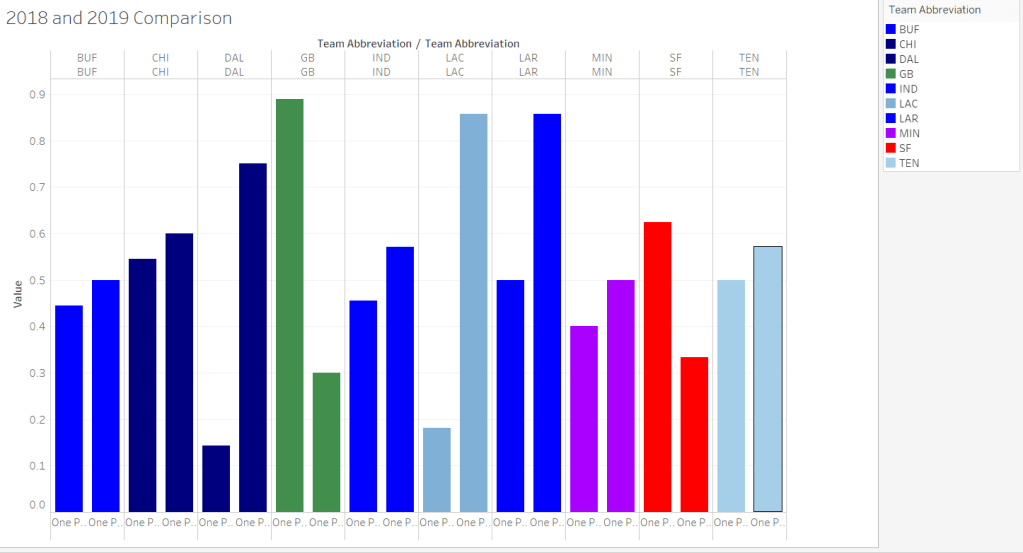
The 2019 win percentage in one-possession games is on the left, with the 2018 win percentage on the right. The clear thing to see is the stark difference in one-possession performances; for example, the Los Angeles Chargers, Dallas Cowboys, and Los Angeles Rams all witnessed a steep drop in their performance in that metric (and subsequently all missed the postseason), while Green Bay and San Francisco saw a huge rise, two teams that clinched a playoff berth. While this is not perfect (Buffalo, Minnesota, and Tennessee all performed worse in one possession games last season, yet made the playoffs), every single team who made the playoffs in 2018, yet missed the postseason in 2019, performed worse in one-possession games.
2018 One Possession Stats: How Did This Effect 2019 Performance?
While evaluating a team’s performance in one-possession games in a nutshell is important, there are other factors to examine as well. We’ve determined there is a strong relationship between one-possession game winning percentage and the number of wins a team has (which obviously is the best predictor for a playoff berth), but there’s another important factor to consider as well: how many one possession wins contributed to a team’s overall win total. This is a very interesting relationship to examine, as it would appear that if 90% of a team’s wins were the result of one-possession games, it is unlikely for that luck to be repeated. In essence, this should lead to a decline in performance the following season, holding all else equal. There does need to be adjustment built in, as, for example, a team goes 3-7 in one possession games, yet finishes the year 3-13 should not be judged the same as a team that goes 7-2 in one possession games, but finishes the year 7-9. We essentially want to aggregate three metrics together: one possession game winning percentage, dependency on one-possession games as a portion of the total win total, and the percentage of a team’s losses that were by one possession, to determine what teams have gotten lucky and are poised for a downturn, or what teams have gotten unlucky and are poised to bounce back.
For the 2018 season, here’s a table to illustrate teams that performed exceptionally well in one-possession games (“above average”) and who were exceptionally reliant on one-possession games as a portion of total wins (“above average”).
| Team Name | One Possession Win % | % of Total Wins by One Possession |
| Miami Dolphins | 77.78% | 100% |
| Dallas Cowboys | 75.00% | 90% |
| Washington Redskins | 66.67% | 57.14% |
In 2019, all three of these teams faced a reduction in their wins by multiple games, with Dallas and Miami each losing two more games and Washington losing four more. While Dallas was incredibly unlucky (they had 5th best scoring margin and missed the postseason), a big reason why was because of their poor performance in one-possession games, going just 1-6 in those contests. If Dallas had simply faced a more subtle regression in performance (let’s say they went 3-4 last year instead), they would have made the postseason. Miami is an interesting team because over their past two seasons, all of their wins have come through one possession games. To be honest, they’ve been fairly lucky to have gone 12-20 these past two seasons; for example, if they had won just 50% of their one possession games the past two years, Miami’s cumulative record over the 2018 and 2019 seasons would be 8-24.
Here’s a graphical look at where each team fell during the 2018 season:

While nothing is a perfect indicator of playoff appearances, number of wins, etc., one thing that is apparent is that teams with a below average reliance on wins from one-possession games had a greater chance to make the postseason. Ten of the playoff teams last season ranked below average in one-possession win reliance in 2018, with the only two exceptions being Philadelphia (who we already outlined got a little lucky in both 2018 and 2019), and San Francisco, who won only four games in 2019 and played with a backup quarterback for the majority of the season. To illustrate why this makes sense, think of it this way. If a team has 11 wins, and three are by one possession, it means that the team won by double digits (almost certainly) for the other eight games, which increases their scoring margin and is the best predictor of postseason appearances.
If we take a deeper dive, let’s combine one-possession reliance with the two most predictive variables of win totals: average scoring margin and game time leading. In 2018, what teams were overly reliant on one possession wins, had a negative scoring margin, and were below average in game time leading? We had the Arizona Cardinals, Atlanta Falcons, Cleveland Browns, Denver Broncos, Las Vegas Raiders, Miami Dolphins, New York Giants, San Francisco 49ers, Tampa Bay Buccaneers, and Washington Redskins. Just 10% of those teams made the postseason the following year (San Francisco, who once again had Jimmy Garoppolo injured for the majority of the season), while 50% of the teams declined in win total or remained flat. Of the 50% whose win totals increased, all except Las Vegas and San Francisco witnessed a head coaching change, with Arizona, Denver, and Tampa Bay all bringing in a new coach, and in the case of Arizona, Denver, and San Francisco, also brought in a new quarterback. The only team whose win total improved without any significant changes was the Raiders, who were a bit lucky last year themselves with 100% of their wins coming from one-possession games. To make this relationship even more evident, out of the ten total teams listed above, 70% of them have made a coaching change in the past two seasons. The only teams that haven’t are Atlanta (who is on the verge of making one), Las Vegas, and San Francisco. It seems like not only do teams who fit the above descriptors are more likely to disappoint the following year, but there is also a relationship in the likelihood they fire a coach.
When pivoting to 2019, here’s a list of the teams who had a negative scoring margin, ranked below average in game time leading, and were overly reliant on one possession victories:
- Arizona Cardinals
- Chicago Bears
- Houston Texans
- Miami Dolphins
- Pittsburgh Steelers
- Washington Redskins
It’s an interesting list and there’s a lot of intriguing factors included. For starters, Arizona, Miami, and Washington have made a coaching change within the past two seasons while Chicago, Houston, and Pittsburgh all have their head coaches on the hot seat. The New York Jets are a team that barely skated by making this list as well, but Adam Gase is another coach who has job security issues. Looking at these teams listed above, it’s apparent all got a little lucky last season, although it’s to varying degrees. Arizona is a tougher team to judge because they were vastly different with Kenyan Drake; to be truthful, if Drake was with Arizona for the entire season, the Cardinals likely would not be on this list. However, Chicago and Houston are two teams that are trending down and Washington’s roster is bare enough to potentially be the worst team in the NFL next season. If history is any indication, along with roster evaluation, it seems like at least Chicago and Houston could take a step backwards next season (Washington can’t get much worse than three wins, but they might). However, Pittsburgh and Miami are two teams who both fit the bill of having a new quarterback under center (potentially). Ben Roethlisberger should be healthy to start the year and the Steelers’ offense should be vastly improved with Big Ben under center, even if he’s not the same player he once was. We’ll touch more on Miami later, but I will saw that if Tua Tagovailoa wins the starting job, the team’s ceiling drastically changes.
Competitive Losses: One-Possession Losses and League Leaders
As we’ve mentioned repeatedly, winning percentage in one-possession games is a very indicative stat of a team’s success in the standings, but what about one-possession losses? After all, doesn’t it make sense to assume that if a majority of a team’s losses come in one-possession games, that they’re a highly competitive team whose losses could easily swing the other way? Focusing on one-possession losses as a proportion of a team’s total losses could provide us some greater insight into what teams are truly the most competitive and with a little more luck, could see even greater results.
Let’s start with the 2018 season. In 2018, five teams had 100% of their losses come from one-possession games: they were the Seattle Seahawks, Pittsburgh Steelers, Kansas City Chiefs, Houston Texans, and Chicago Bears, four of whom made the postseason (and Pittsburgh was eliminated the final week and had the requisite “data resume” to be a playoff team). In 2019, only two teams had 100% of their losses come from one-possession games: the Kansas City Chiefs and San Francisco 49ers, who just so happened to meet in the Super Bowl.
It is time to take a comprehensive look into predictive factors and what teams were truly lucky/unlucky in 2018, and how that translated into performance in 2019. In 2018, we’ll define “lucky” teams as ones who fulfill the following requirements:
- Below average in one-possession losses as a portion of total losses
- Above average in one-possession wins as a portion of total wins
- Above average in one-possession win percentage
- Below average in game time leading
In 2018, here were the teams who I would define as “lucky”
- Atlanta Falcons
- Las Vegas Raiders
- Washington Redskins
- Miami Dolphins
Outside of the Las Vegas Raiders, all of those teams either regressed or stayed constant record-wise. Interestingly enough, the Raiders, Redskins, and Dolphins all had 100% of their wins come from one-possession games in 2019 and all ranked above average in one-possession winning percentage. That luck will eventually run out and if thousands of simulations are run of the 2019 season, it’s likely they would have performed below their actual results.
On the flip side, here’s the list of teams I defined as “unlucky” in 2018, or ones with the opposite criteria as listed above:
- Seattle Seahawks
- Carolina Panthers
- Baltimore Ravens
All of these teams improved their win total except Carolina, who played the entire year with a backup quarterback. While Seattle was incredibly lucky in 2019, their win total still improved and Baltimore saw one of the most impressive jumps in the NFL last season. While extraneous factors cloud the picture, there does seem to be some merit in utilizing these criteria to predict teams from year-to-year, especially if they stay relatively similar personnel wise. (It should also be noted that considering Seattle was unlucky in 2018, being “lucky” in 2019 kind of makes sense based on the law of averages, which states that over a long period of time, you’ll end up around the mean overall. Having one “unlucky” season followed by a “lucky” season balances them out).
2019 Analysis and Making 2020 Predictions
With all the above analysis described in detail, it is finally time to pivot to the 2019 data and try to make predictions for the 2020 season. We’ll be utilizing the same “lucky” and “unlucky” labels and criteria, but I wanted to throw one more illustration in at the beginning. If every team would have performed to a .500 record in their one-possession games, here would’ve been the projected win totals last season based on our statistical model:
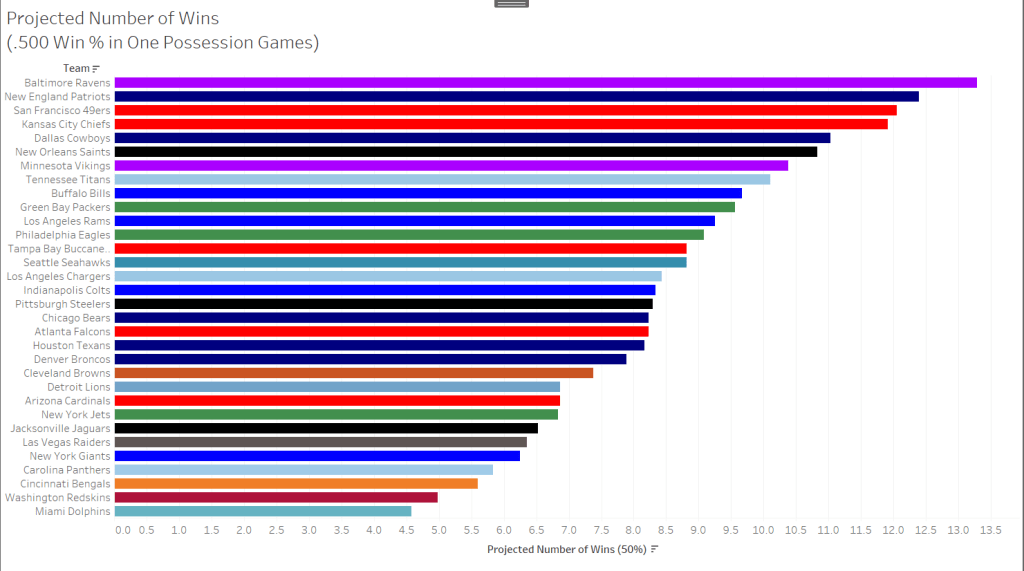
Here would have been the standings according to our model (playoff teams italicized):
AFC
- 1. Baltimore Ravens (13.28 wins)
- 2. New England Patriots (12.39 wins)
- 3. Kansas City Chiefs (11.92 wins)
- 4. Tennessee Titans (10.11 wins)
- 5. Buffalo Bills (9.66 wins)
- 6. Los Angeles Chargers (8.34 wins)
- 7. Indianapolis Colts (8.33 wins)
- 8. Pittsburgh Steelers (8.30 wins)
- 9. Houston Texans (8.16 wins)
- 10. Denver Broncos (7.89 wins)
- 11. Cleveland Browns (7.38 wins)
- 12. New York Jets (6.83 wins)
- 13. Jacksonville Jaguars (6.52 wins)
- 14. Las Vegas Raiders (6.35 wins)
- 15. Cincinnati Bengals (5.60 wins)
- 16. Miami Dolphins (4.58 wins)
NFC
- 1. San Francisco 49ers (12.05 wins)
- 2. Dallas Cowboys (11.03 wins)
- 3. New Orleans Saints (10.82 wins)
- 4. Minnesota Vikings (10.38 wins)
- 5. Green Bay Packers (9.56 wins)
- 6. Los Angeles Rams (9.25 wins)
- 7. Philadelphia Eagles (9.08 wins)
- 8. Tampa Bay Buccaneers (8.81 wins)
- 9. Seattle Seahawks (8.81 wins)
- 10. Chicago Bears (8.23 wins)
- 11. Atlanta Falcons (8.23 wins)
- 12. Detroit Lions (6.86 wins)
- 13. Arizona Cardinals (6.86 wins)
- 14. New York Giants (6.25 wins)
- 15. Carolina Panthers (5.84 wins)
- 16. Washington Redskins (4.99 wins)
Here’s a table of the five biggest risers and five biggest fallers:
| Team | Actual Wins | Predicted Wins | Difference |
| Detroit Lions | 3 | 6.86 | +3.86 |
| Cincinnati Bengals | 2 | 5.60 | +3.60 |
| Los Angeles Chargers | 5 | 8.43 | +3.43 |
| Dallas Cowboys | 8 | 11.03 | +3.03 |
| New York Giants | 4 | 6.25 | +2.25 |
| Green Bay Packers | 13 | 9.56 | -3.44 |
| Seattle Seahawks | 11 | 8.81 | -2.19 |
| New Orleans Saints | 13 | 10.82 | -2.18 |
| Houston Texans | 10 | 8.16 | -1.84 |
| San Francsco 49ers | 13 | 12.05 | -0.95 |
It’s logical that playoff teams see the steepest decline in wins while horrible teams see the steepest incline in wins; after all, we’ve already shown the relationship between one-possession winning percentage and number of wins. The biggest thing to examine is which teams would have been playoff teams if this uniformity was legitimate, and what teams would have fallen out. In the AFC, only one playoff spot swapped: the Los Angeles Chargers (who had the 6th pick in the draft) narrowly earned a playoff berth over the Indianapolis Colts in this model, while Houston slid from having the 4th seed in real life to finishing 9th in the simulation. In the NFC, the Dallas Cowboys jumped all the way to 2nd in the NFC after completely missing the postseason in real life, while the Los Angeles Rams also jumped in, with Philadelphia narrowly falling out along with Seattle, who tumbled from 5th to 9th.
As for 2019, here’s a look at teams that were “lucky” last season. Here’s a quick refresher of the criteria utilized:
- Below average in one possession losses as a portion of total losses
- Above average in one possession wins as a portion of total wins
- Above average in one possession win percentage
- Below average in game time leading
The 2019 lucky teams were:
- Houston Texans
- Seattle Seahawks
- Washington Redskins
- New York Jets
- Miami Dolphins
The 2019 unlucky teams were:
- Buffalo Bills
- Dallas Cowboys
- Tampa Bay Buccaneers
Conclusion
The truth is that every year in the NFL, there is to some degree a varying amount of luck. By simply adjusting every team’s winning percentage to 50 in one-possession games, the amount of shuffling going on in the standings alone was certainly eye opening. With a little bit of better luck in those games, whether it’s improved kicking, fewer turnovers in your own territory, or just better play-calling, a lot of unpredictable factors affect wins in one possession games. Based on those metrics listed, we have a few teams primed for a downturn. The Houston Texans performed closer to a 7-9 or 8-8 team last season, lost DeAndre Hopkins and D.J. Reader, had a middling draft, and failed to add any impact players to the roster to offset those losses. I would be astonished if the Texans were able to replicate anything close to their 10-6 record from a year ago. Remember, if Houston had won just 50% of their one-possession games, our model (which accounts for a team’s average scoring margin as well) had Houston at 8.16 wins. I think the Texans are going to be closer to a 6-10, 7-9 team this season, and their current win total of 7.5 seems fairly appropriate. Don’t fall into the trap of taking the over.
The Seattle Seahawks were another team to land on the “luck” matrix last season and a large reason why was their overreliance on one-possession wins and their strong performance (75% wins) in those games. Russell Wilson is a top-3 quarterback in the NFL, but even he cannot sustain this amount of luck from year-to-year. Over time, the Seahawks will eventually regress to the mean. Seattle made minimal upgrades in free agency (Greg Olsen, Bruce Irvin), and lost four offensive linemen and possibly Jadeveon Clowney as well. The Seahawks net talent took a step back and with just a more moderate performance in one-possession metrics, they’ll be a team resembling 8-8 or 9-7 rather than 11-5 and pushing for the NFC West title. Seattle’s current win total is at 9.5, a number I find way too high. Unless the Seahawks repeat their luck from a year ago, they seem to be a near lock to edge closer to resembling a .500 team. Our model had them as the second biggest “faller” when applying average performance in one-possession games and only had them at 8.81 wins; taking the under on 9.5 is a really savvy bet.
The Washington Redskins are really a tough team to gauge, because a 3-13 club really cannot perform much worse than a year ago. Here’s the truths about Washington: they only played six games that ended within one possession a year ago (near the bottom of the league) and they were third worst in the percentage of losses that came from one-possession games. Simply put, Washington was blown out in a lot of games last year, but compared to their overall performance, played better than expected in close games. The Redskins, on average, trailed for the most time out of any team in the NFL, they had the second lowest scoring margin, and failed to make many substantial upgrades. While Ron Rivera should help, along with Chase Young, Thomas Davis, Kendall Fuller, etc., their crop of offensive skill players is easily the worst in the NFL, Dwayne Haskins failed to show many flashes last season, and their offensive line is well below average. I think the Redskins are easily the worst team in the NFL next season and considering they are +600 to achieve that mantle, I think that’s a pretty shrewd bet to make.
Adam Gase might be the most overrated coach in the NFL. He was essentially Sean McVay before Sean McVay, as he was the hottest name on the coaching carousel it seemed like for several seasons in a row. Gase was lucky enough to be Peyton Manning’s offensive coordinator in Denver during his historic seasons and worked some good years with Jay Cutler in Chicago, but ever since Gase has become a head coach, he’s been horrible, especially regarding offense. Yet, Gase’s teams never seem to fully bottom out, primarily because they’ve always been among the luckiest in the NFL. In 2018, we mentioned Miami (who was coached by Gase) as a lucky team and we’ve identified Gase’s 2019 team, the Jets, as another. The Jets were 7-9 last year, but they went 5-2 in one-possession games and had the 2nd fewest percentage of losses as a result of one-possession games. For the majority of time last season, the Jets either won a close game, or more likely, were blown out. Now, with that being said, I do think the Jets improved this off-season. C.J. Mosley will be fully healthy, they added a cluster of offensive linemen to hopefully shore up their weakest link, their secondary got vastly better by adding Pierre Desir, Ashtyn Davis, and Quincy Wilson, and you hope Sam Darnold can continue to improve. With all that being said, New York got lucky last season, but I think their roster improvements will prevent a drastic drop-off this year. However, the Jets have a very tough schedule and, in all likelihood, will hover closer to a 5-11 or 6-10 team. It seems like their 6.5 win total is a bit too high for my liking.
Lastly, the final “lucky” team we’ve identified is Miami and this should not be a surprised. As I mentioned earlier, all of Miami’s wins the past two seasons have been in one-possession games. In the past two seasons, Miami’s record in one-possession games has been 12-4, which is frankly ridiculous considering how pitiful they should be (in games not decided by one possession, Miami is an absurd 0-16). Let me make this abundantly clear: if the final scoring differential is 10+ points, Miami loses. Not only that, but the Dolphins are performing at a rate well above average in one-possession wins. Remember, it’s a high variance statistic and over many seasons, we expect a team’s one-possession win percentage to sit right around the league average of 50%. Miami has been at 75% the past two years; if statistics tell us anything, they are due for a below average year in that metric. If Miami had won just 50% of their one-possession games a year ago, they were projected to be the worst team in the NFL by our model. Not only that, but Miami had the smallest percentage of their losses come from one-possession games. The Dolphins are a trendy darkhorse pick to possibly win the AFC East, but I strongly urge caution. Yes, they are the most improved team, adding Byron Jones, Kyle Van Noy, Shaq Lawson, Jordan Howard, Tua Tagovailoa, and overhauling their offensive line, but the team last season should have performed below 5-11. Even with all those improvements, I cannot see Miami getting above a 5-11 or 6-10 record this season in a best-case scenario, unless Tua Tagovailoa starts (which I’m not expecting). Miami’s win total is appropriately set at 6 in my opinion, but with +115 for the under, I do not hate that much at all. They were significantly worse than their 5-11 record from a year ago indicates and to be completely honest, if you really want a longshot bet, Miami at +1100 to have the worst record isn’t terrible in my opinion either.
As for unlucky teams, how about the Buffalo Bills? Buffalo went 10-6 last season, yet they hit all the metrics to be classified as “unlucky”. Buffalo was just 4-5 in one possession games, which means they were a stellar 6-1 in all other games, a very impressive mark. I do want to urge some caution with Buffalo, as they played one of the easiest schedules in the NFL last season and were below .500 against playoff teams, but even with that, their performance was still unlucky by our metrics. The Bills improved this off-season, trading for Stefon Diggs (who should greatly help Josh Allen, as Diggs is arguably the best deep ball receiver in the NFL and Allen has the lowest checkdown rate. Although Allen is the most inaccurate deep ball passer in the NFL, having Diggs is a major boost), signing Mario Addison, and having a good NFL Draft overall. The Bills should be considered at worst the co-favorite to win the AFC East and while a tougher schedule awaits, this is a team who was slightly better than their 10-6 record indicated (remember, they gave away a Week 17 loss to the Jets. If they played their starters, they would’ve went 11-5 and probably not be in this group). I’m not sure Buffalo vastly improves because of that Jets point I list, but at worst, Buffalo should hover around the same 10-6 mark again, even with a vastly stronger schedule. Their win total is currently at 8.5; I really like them to hit the over.
During our podcast and a prior article, I’ve harped on Dallas being the unluckiest team in the NFL last season, so I won’t repeat myself too much. According to our model, if Dallas had won 50% of their one-possession games, we projected the Cowboys to have had 11.03 wins last season, good for 2nd in the NFC and 5th in the NFL (based on the model). Dallas was 5th in scoring margin, 1st in yards per play, and had an average/slightly above average defense, yet missed the postseason. How is that possible? Simply put, Dallas was a statistical anomaly last season, but they also regressed to the mean following a 2018 season where they overachieved (as shown above). The Cowboys probably saw a net loss in talent, as losing Byron Jones, Robert Quinn, and Travis Frederick are gut-wrenching blows. However, the Cowboys are still a top-5 team on paper in my opinion, replaced all of their free agent departures in the NFL Draft, had a fantastic draft overall, and return a decent chunk of last year’s squad. Seeing some of the departures makes me a bit hesitant to predict Dallas to go 11-5, but if they performed average in one-possession games, we would be discussing this team vastly differently. The Cowboys should burst onto the scene big time next year and with a 9.5 win total and only a slight favorite to win the division, I think there’s certainly some value to be had in betting on Dallas to dominate. Call me crazy, but at +1700 to win the Super Bowl (all the other top-5 teams are +1200 or worse), I think there’s decent value to be had there. I’m not saying I think they’ll win the Super Bowl, but that’s a solid bet to take.
Lastly, another team we’ve mentioned about being “unlucky” was the Tampa Bay Buccaneers. Despite Jameis Winston’s inauguration into the 30/30 club, Tampa Bay performed at a level much closer to resembling a 9-7 team rather than a 7-9 one. The Buccaneers only had three notable losses in free agency: Jameis Winston, Breshad Perriman, and Carl Nassib. Considering Tampa Bay replaced Winston with Brady, added Rob Gronkowski which should increase their 12 personnel usage, upgraded their offensive line with Tristan Wirfs, and return their entire starting defense, it’s hard to even fathom how this team regresses, barring something unforeseen. Tampa Bay lost 67% of their games by one possession and you have to think with better ball security, the Bucs easily could have performed better in that metric. I’m slightly concerned about Tampa Bay’s defense, however. The Buccaneers had the top rushing defense in the NFL last season, but their passing defense was horrific before magically turning it around in the final five or six games. The Bucs’ secondary led the NFL in pass breakups last season and have a few budding young stars on defense, including cornerbacks Carlton Davis and Jamel Dean, linebacker Devin White, pass rusher Shaq Barrett, and defensive lineman Vita Vea. If all of those players can either maintain their end of season play, or continue to improve, Tampa Bay’s defense could be scary, as they still have Lavonte David (most underrated player in the NFL, and it’s not close), Jason Pierre-Paul (who was incredibly productive last year), and a slew of talented depth in the secondary and at linebacker. I think Tampa Bay could take the biggest leap among all NFL teams next season and the metrics point to a jump even if they had kept Jameis Winston and he threw 30 INTs again. That’s the crazy part. Watch out for the Buccaneers, they could be insanely good next season.
 The Chirp