
Each NFL season brings new challenges and alongside those new challenges also comes new hope. For many NFL teams who disappointed last year, the 2020 NFL Season is their dream of a turnaround, a campaign that can hopefully alter the direction of their franchise for the better. The symbolism surrounding the NFL Draft conveys a simple message, one of hope. When kickoff rolls around for the 2020 NFL Season, that hope will turn into tangible results, one way or another.
Over the next few weeks, we’ll be releasing a series of NFL articles surrounding in-depth analysis and research we have recently conducted. As mentioned in our inaugural posts on The Chirp, we aim for our content to be analytically-driven and to provide insights that cannot be gleaned from any other resource. In conjunction with our written content, we have launched a podcast (dubbed, “The Chirp”, an appropriate name if you ask me), where thoughts flow freely, hot takes emerge, and the name “the chirp” comes to fruition. If you would like to listen to our current library of episodes, the link to our buzz sprout page is here, and we are also available on Apple Podcasts and hopefully will also be on Spotify soon.
Starting off our off-season NFL articles is a classic style: trends among teams. What teams are primed for a bounce back season in 2020? Does a letdown or decline seem inevitable for others? We will address all those topics here with content you can only get from The Chirp.
Important Criteria in Team Evaluation
Average Scoring Margin
When looking at recent historical NFL data, two key variables stand out as valuable predictors in determining the amount of wins to expect for any given team. The first should not come as a surprise to many: average scoring margin. It makes sense that when a team has a positive scoring margin, they should, on average, win more games. After all, the fundamental principle of “winning” in nearly all sports is to outscore your opponent. Below are some visualizations of the past three seasons and each team’s average scoring margin–it should be noted that teams with a green bar were playoff teams and teams with a red bar were non-playoff teams.
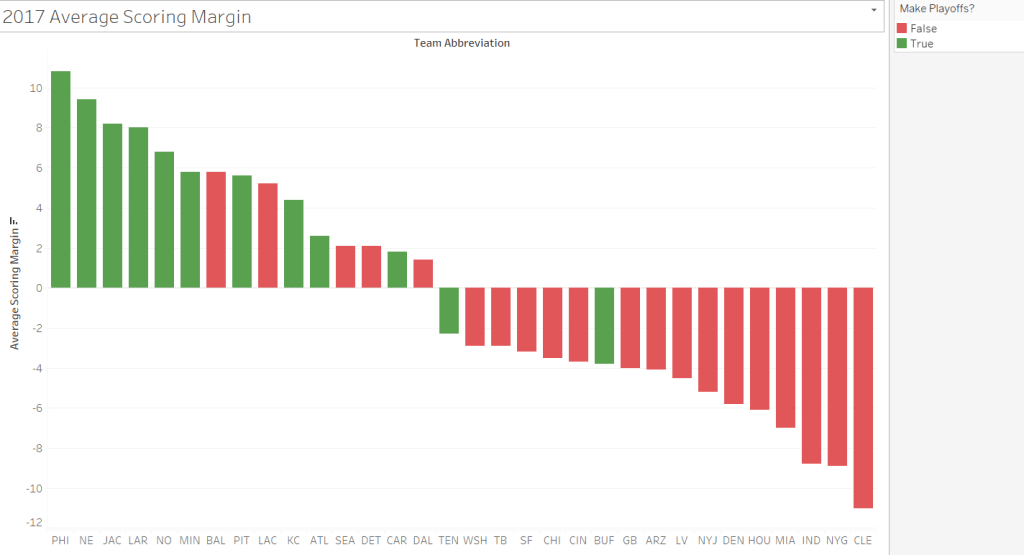

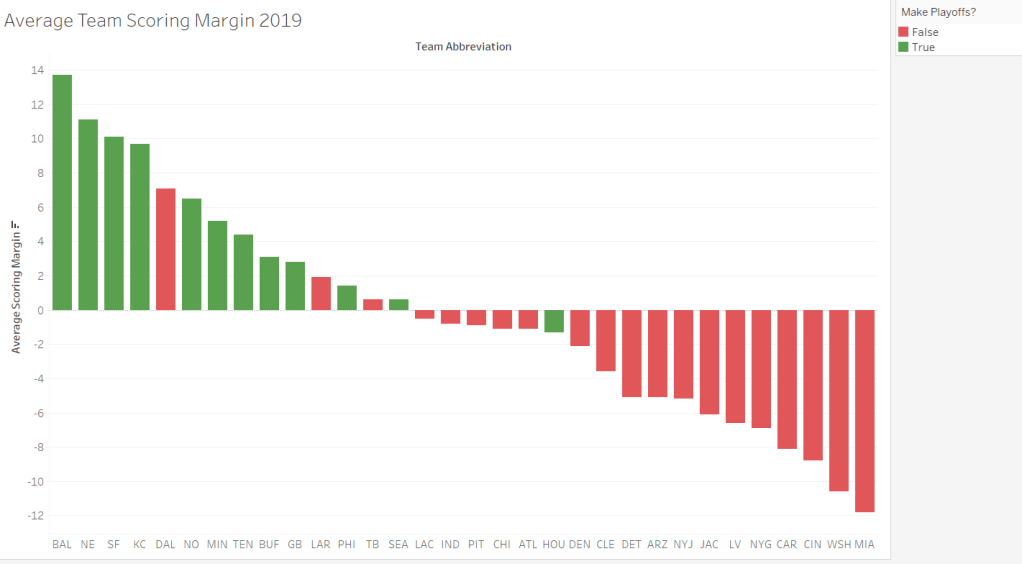
To begin with, a few observations jump out. Out of the 36 total playoff clubs from those three seasons, 33 of them had a positive scoring margin for a ridiculous 91.67% rate. So, yes, while it is possible to make the postseason with a negative scoring margin, it is highly unlikely. In 2017, both the Buffalo Bills and Tennessee Titans had a negative scoring margin, yet both clubs made the postseason. Frankly, I chalk this up to a lot of luck. Remember, the Baltimore Ravens choked away a playoff berth on the final day of the 2017 NFL Season when the Bengals had a miraculous 4th & 15 touchdown. The Ravens ranked 7th in scoring margin that season and as the data shows, were much more deserving of a playoff berth. The other team in contention for an AFC Wild Card spot was the Los Angeles Chargers, who ranked 9th in scoring margin, yet did not receive a berth due to tiebreaker rules. A major reason why the Chargers missed out was their poor performance in one-possession games: look at the performance disparities among Baltimore, Buffalo, Los Angeles, and Tennessee in one-possession games during the 2017 NFL Season:
| Team Name | Number of One-Possession Games | One-Possession Win Percentage | Percentage of Total Wins by One-Possession |
| Baltimore Ravens | 7 | 28.57% | 22.22% |
| Buffalo Bills | 8 | 75.00% | 66.67% |
| Los Angeles Chargers | 8 | 37.50% | 33.33% |
| Tennessee Titans | 10 | 60.00% | 66.67% |
As one can see, the Bills and Titans fared extraordinarily better in close games than either the Ravens or Chargers did, a key determinant in the final fate of all clubs. However, performance in one-possession games is a high variance statistic with a lot of variables involved, making it an unreliable method to consistently win games. This provides further evidence that while Buffalo and Tennessee may have been the playoff teams, if simulations were run hundreds of times, Baltimore and Los Angeles would have been the heavy favorites to have made the postseason. Baltimore and Los Angeles outscored their opponents the entire season (as a whole) and a majority of their wins were a result of a much more consistent statistic rather than one-possession wins, which a lot of time, can come down to luck.
In 2018, the scoring margin was much cleaner in its relation to playoff berths. 12 of the top 14 teams leading the metric made the postseason, with the only exceptions being Pittsburgh (10th) and Minnesota (12th). For Steelers fans, they can look no further than Ben Roethlisberger’s road woes against the pitiful Broncos and Raiders and their six losses in one-possession games. As for Minnesota, their scoring margin was fractionally better than Philadelphia and Dallas, the only two playoff teams behind them in the scoring margin metric. Average scoring margin is not a perfect predictor of playoff appearances, but it is usually highly reliable in prediction.
In 2019, the trend once again remained fairly true: 11 of the top 14 teams leading the metric made the postseason, with Houston being the only team with a negative scoring margin to sneak in.
Game Time Leading
When looking at the same historical data trends over the past three seasons, another variable is incredibly important in predicting wins/playoff berths: the percentage of the game a team is leading for. This seems rather intuitive; if a team leads the game for, let’s say, 50 out of 60 minutes, odds are they won the game. Exceptions do occur, but from pure probability, it would appear the more time a team leads for, the greater their chance to win. Chance is a volatile concept in sport, but in evaluating NFL teams and trying to take advantage of trends, understanding statistics and data is essential.
Once again, here are some visuals of the “game time leading” variable, ranging from 2017-2019:


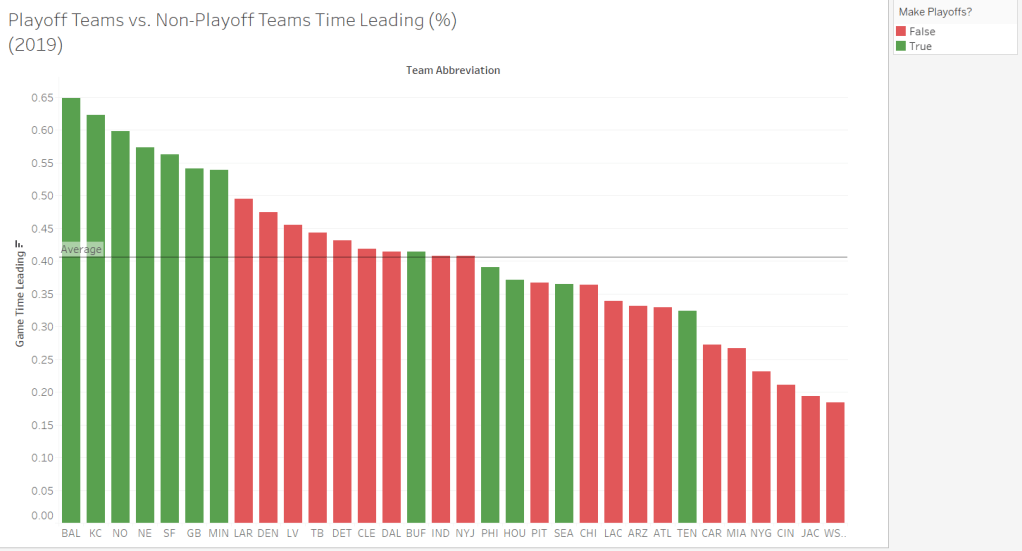
While this statistic as a whole is a bit messier, there is a strong correlation between “game time leading” and the number of wins a team has. This seemed true in 2017 and 2018 with a few exceptions, but there were many more exceptions in 2019, as 55.56% of the teams who ranked “above average or average” in this category were non-playoff teams.
Data Into Analysis: Teams Trending Up
Detroit Lions
The Detroit Lions finished a miserable 3-13 last season and had the 3rd overall pick in the NFL Draft, yet the simple truth is there is no way their record should have been that poor. When developing a model to predict wins for the 2019 NFL Season, the Lions were revealed to be the biggest underachiever; the model predicted Detroit to win 5.03 games, which is a 66.67% increase over their actual number. While Detroit had a negative scoring margin for the year, they ranked above average in game time leading, actually clocking in 12th overall in the metric.
So, what contributed to Detroit’s failures and why I am so bullish on Detroit to greatly improve record-wise in 2020? Well, let’s look to another indicative measure I touched on earlier: Detroit’s performance in one-possession games. All of Detroit’s wins were in one-possession games, but their overall win percentage in such games was 33.33%. Detroit tied Seattle in playing the most one-possession games in the NFL last season, but unlike Detroit, Seattle won 83.33% of their one-possession games. As mentioned, winning percentage in one-possession games is a messy statistic without clear correlations, making performance in these games come down to factors like luck, effective quarterback play, and sometimes, having the ball last. Just imagine how vastly different both team’s seasons would have been if each had won 50% of their one-possession games: Detroit would have had six wins despite Matthew Stafford missing half the season, and Seattle would have won only seven games. Instead, Detroit is thought of as a massive disappointment with Matt Patricia and Bob Quinn entering a make-or-break year, while Seattle is thought of as a possible Super Bowl contender. In simple statistical terms, there should be regression to the mean for both teams, making it more likely each team will get closer to winning 50% of those one-possession games (league average), which could drastically alter the win totals.
However, outside of the data/statistical jargon, there seems to be a clearer answer to why Detroit should improve: Matthew Stafford being fully healthy. Stafford only played in 50% of Detroit’s games a season ago and during that span, the Lions were 3-4-1 and their average scoring margin was -1.63, a sizeable improvement over their -5.1 mark for the season. Additionally, in the games Stafford played in, the Lions led for 50.2% of the game, which if applied to the whole season, would have led Detroit to be ranked 8th in the important metric. Detroit’s 3-4-1 record is also incredibly misleading and once again, poor luck played a major role in their losses. In their tie against Arizona, Detroit gave up 18 points in 14 minutes, 47 seconds. You could argue whether that is truly unlucky or just poor defense, but for 57.8% of the game, they were winning. In Detroit’s loss to Kansas City, Kerryon Johnson fumbled at the 1-yard line which turned into a 100-yard fumble recovery for a TD (14-point swing), and the Chiefs had to convert a 4th & 8 on their final drive to win the game. Against Green Bay, the Lions led for a ridiculous 90.2% of the game and lost, with two poor hands-to-the-face penalties hurting their matters even further. Lastly, in their loss to the Raiders, the Lions botched a snap inside Oakland’s 30-yard line and failed a 4th & 1 attempt to tie the game. As one can see, three of Detroit’s four losses with Stafford easily could have swung the other way; if simulations were run about those games, there would be a higher probability that Detroit would be 5-2-1 or 6-1-1 rather than 3-4-1.
It’s evident that when Matthew Stafford was healthy, the Lions were arguably a playoff team. With that being said, Detroit is a flawed team, but they should be vastly improved solely because of Stafford’s health (if he can remain healthy). Additionally, the Lions added Jeff Okudah (3rd overall pick) to their secondary along with Desmond Trufant. Even though Darius Slay is in Philadelphia, their secondary likely improved overall. Additionally, Detroit added a capable offensive lineman in Halapoulivaati Vaitai and defensive upgrades like Jaimie Collins, Reggie Ragland, and Danny Shelton. The Lions’ defense was among the worst in the NFL last season, but their poor quarterback play likely made the defense worse. It’s obvious the Lions were much better than their record indicated last season and they seem to be a strong bet to win seven or eight games if fully healthy.
Denver Broncos
From the off-season alone, it is no question the Denver Broncos drastically improved. While they did lose franchise stalwart Chris Harris Jr. in free agency, they did bring in A.J. Bouye to hopefully cushion the Harris loss a bit, but they fortified their roster in a variety of ways to infuse talent into the Mile High City. Most notably, the Broncos added Graham Glasgow and Melvin Gordon in free agency, but also brought in Jerry Jeudy and K.J. Hamler via the draft. Drew Lock, who was quite impressive as a starter last season (4-1 record), now has a much improved offense to work with and the talent might be top-10 in the NFL. Phillip Lindsay, Royce Freeman, Melvin Gordon, Courtland Sutton, Jerry Jeudy, K.J. Hamler, and Noah Fant is quite the array of skill players. It remains to be seen how good Denver’s defense will be, but the Broncos performed fairly well defensively last season, ranking #1 in red zone defense.
While Denver’s scoring margin for the year was negative, it was a different story under Drew Lock. The Broncos were +5 in the five games Lock played and, as shown for the entire season, ranked 9th in game time leading. For games Lock played, Denver led for 48.0% of the minutes, and if you take out their game against Kansas City, the Broncos led for 60.0% of the minutes, which, if sustainable for the whole season, would’ve ranked 3rd in the NFL. It’s clear Denver’s offense took a large step forwards from a talent standpoint this off-season, and if Vic Fangio can continue to improve the defensive performance, it’s reasonable to expect the Denver Broncos to push for 10 wins and a playoff berth.
Tampa Bay Buccaneers
The Tampa Bay Buccaneers are an obvious team trending upwards, but to tell the truth, even if Jameis Winston was returning to Tampa, I think the Buccaneers would still be on this list. Tampa Bay ranked 12th in the game time leading metric a season ago but also had a positive scoring margin last year. Out of the eleven teams who ranked above average in game time leading and had a positive scoring margin, 72.7% made the postseason, with the lone exceptions being the Dallas Cowboys, Los Angeles Rams, and Tampa Bay Buccaneers (that percentage was 91.67% in 2018 and 84.62% in 2017), illustrating how weird of a year 2019 was. Simply put, Dallas, Los Angeles, and Tampa Bay had the necessary “data resume” to make the postseason, but missed out. Arguably the two biggest reasons why the Buccaneers missed the playoffs were their negative turnover margin and poor performance in one-possession games. The Buccaneers had the 5th worst turnover margin in the NFL and were 3-6 in one-possession games. Tampa Bay easily could have been a 10-win team even with Jameis Winston’s 38 turnovers last season, which makes it unfathomable to believe that the team would somehow regress under Tom Brady, who had 30 fewer turnovers than Winston. If Brady’s history is any indication, then Tampa Bay will likely be much improved in one-possession games and in the turnover battle, two key metrics in predicting the number of wins a team has.
In addition to simply improving in those two metrics, the Buccaneers also improved their roster to an impressive degree. Tom Brady is an upgrade on nearly every quarterback in the NFL, Rob Gronkowski, even if he is at just 70% of his former self, is still a top-10 tight end, and their first-round pick Tristan Wirfs should be a massive upgrade on the offensive line. Tampa’s only noticeable free agent loss (outside of Winston) was Carl Nassib, who was a rotational pass rusher. The Buccaneers are better on-paper next season and with a positive regression to the mean in terms of luck, should be very well-positioned to be a playoff team next season.
Data Into Analysis: Teams Trending Down
Houston Texans
I’m not sure a team has had a more miserable off-season than the Houston Texans. After Houston barely snuck by Buffalo on Wild Card Weekend, it seemed apparent that perhaps the Texans weren’t as good as we thought. The star power is evident: Deshaun Watson, J.J. Watt, Laremy Tunsil, Whitney Mercilus, and DeAndre Hopkins (prior to this season), but Houston always seems to fall short. Now, with Bill O’Brien once again operating as a bad general manager, the Texans have faced a depletion of talent entering the season and with an improved division heading their way, things should be tough for Houston next season.
Looking at our two most important metrics, it seems apparent that the Texans were lucky to have won 10 games last season. For the year, Houston was outscored by their opponents and were below average in game time leading. Houston’s defense struggled for much of the year as well, but the team certainly regressed this off-season. Houston essentially swapped DeAndre Hopkins for David Johnson and Brandin Cooks, a trade that makes less sense by the day, and they lost run-stuffer D.J. Reader, which should make their already poor run defense even worse. Houston’s offense is still incredibly reliant on Deshaun Watson’s greatness, which seems to be a recipe for disaster. While Watson is a top-10 quarterback in the NFL and arguably in the elite tier, Bill O’Brien has not made his job any easier, trading away a top-5 wide receiver and relying on a myriad of injury-prone skill players for Watson to work with.
I’m not sure the Texans were a very good team to begin with last season, but their regression this off-season should certainly pop up in the win/loss record this year (barring something unforeseen or an incredible amount of luck). I think a very important note is that DeAndre Hopkins accounted for 31.2% of Watson’s completions last year, 30.2% of Watson’s yards, and 26.9% of Watson’s touchdown passes. Houston has a ton of production to replace, and they’re asking injury-prone receivers Will Fuller V and Brandin Cooks to pick up an incredibly amount of slack while hoping that a declining David Johnson can magically rediscover his 2015/2016 form. Houston’s offense, and specifically Deshaun Watson and DeAndre Hopkins, have to a large extent carried the Texans the past two seasons (much more so last year). Is it really wise to think Houston can maintain these 10-win seasons watching Hopkins depart? I do not believe so, and their failure to upgrade the rest of the roster should stick out like a sore thumb without the Watson/Hopkins duo present to cover it up. I would not be surprised at all if Houston only wins 5-6 games next season.
Seattle Seahawks
The Seattle Seahawks have had back-to-back resurgent seasons, reaching the postseason for two consecutive years after a rare miss the prior year. The reason why I call this a resurgence is because back in 2018, Seattle was mainly an afterthought, a quick fall from grace for a team many believed to be the next dynasty. Whether or not Seattle’s dynastic dreams were stolen away by Malcolm Butler is a debate for another day, but the Seahawks were another team who witnessed a mass exodus of the talented players who comprised the best teams of the decade. Out were Richard Sherman, Cliff Avril, Michael Bennett, Kam Chancellor, Brandon Browner, and Marshawn Lynch (Earl Thomas was still on the team, but destined to leave after contract disputes), and in were a bunch of unproven players. Yet, Pete Carroll worked his magic to win games and Russell Wilson once again proved how underrated he is. Last season, the Seahawks went an impressive 11-5 and almost won the division over the NFC’s representative in the Super Bowl, the San Francisco 49ers (they were just a yard short). However, the data points to a team that got far too lucky last season and seems primed for a down year.
As mentioned during the Detroit Lions segment, the Seattle Seahawks played 12 one-possession games last season and were victorious in 10 of those games, accounting for 90.9% of their wins. For a metric as volatile and luck-based as one-possession wins, it is a bit concerning that such a large chunk of Seattle’s success came in these games. Additionally, the Seahawks spent more time last season trailing than they did winning. It’s counterintuitive to believe that a team who trails for, on average, 43.8% of games and leads for, on average 36.4% of games, can not only make the postseason, but also win eleven games. Simply put, the Seahawks got lucky last season; a large part of their luck was because of Russell Wilson’s elite play and their dominance in the turnover battle, but a good chunk was also the fact that they performed extraordinarily well in one-possession games. If Seattle had been around league average in one-possession games, there’s a decent chance they would have won only seven games last season.
While I’m betting on Seattle’s wins regressing to the mean based on those metrics next season, it’s also important to note that the Seahawks did not improve this off-season to a marginal extent. Seattle lost four notable offensive linemen (George Fant, Justin Britt, D.J. Fluker, Germain Ifedi), and have yet to re-sign key defensive players like Jadeveon Clowney, Mychal Kendricks, and Ezekiel Ansah. Per usual, the Seahawks did little to add in free agency, signing Greg Olsen and Bruce Irvin, two solid moves, but both are unlikely to heavily move the needle. I’m not one to count Russell Wilson, Pete Carroll, and John Schneider out, but Seattle was one of the most overachieving teams in the NFL last year, failed to improve this off-season, and lacks the necessary talent around Russell Wilson and Bobby Wagner to truly be a threat in the NFC. I do not think they will take a steep decline, but I think a 9-7 or 8-8 season could certainly be in order, and frankly, seems more likely than replicating an 11-win season.
Green Bay Packers
The Green Bay Packers caught a ton of flak for their horrific performance at the 2020 NFL Draft, but that should not distract us from remembering that Green Bay was a 13-win team and one game away from a Super Bowl appearance a year ago. However, according to our model, Green Bay was our 3rd biggest overachiever last season and had remarkable success in one-possession games with a league-best 88.9% winning percentage in said games. If Green Bay faced a regression to the mean, they could have only won 10 games last season. Now, it is important to note that the Packers were 6th in our game time leading metric, so the team did perform fairly well overall and their 13 wins, while maybe a slight exaggeration, seems to be within reason. They were likely closer to being a 10-11 win team overall, however.
While I think Green Bay is on pace for a decline, I think it is mainly a combination of their luck and personnel changes. Green Bay lost two key players this off-season: offensive tackle Bryan Bulaga and linebacker Blake Martinez. Bulaga is a massive loss for Green Bay and while they signed Rick Wagner to replace him (a prime bounce-back candidate), Bulaga is by far the superior player and his loss is a downgrade to Rodgers’ performance. Martinez was Green Bay’s leading tackler and considering the Packers’ run defense was among the worst in the NFL, Martinez is a major loss. Green Bay saw a net loss of talent this off-season and their draft picks are unlikely to make major contributions this season, all of which should contribute to a reduction in wins.
Lastly, a final point is related to Green Bay’s offensive skill players. Outside of Davante Adams, Aaron Jones, and Jamaal Williams, Aaron Rodgers will have an unproven group of players to work with, including Allen Lazard, Marquez Valdes-Scantling, Jace Sternberger, Reggie Begelton, Equanimeous St. Brown, and Devin Funchess. Among those six receivers, they have combined for 285 career catches (and Funchess accounts for 164 of those). There’s a ton of inexperience for Rodgers to work with and while Green Bay’s schemes and Rodgers’ talent allow for separation, asking an aging Rodgers to put the team on his back yet again is not a wise strategy.
Some Extra Teams to Note
Other Teams Trending Up
Los Angeles Rams
-The Los Angeles Rams disappointed record-wise last season, but a myriad of factors played into that. The Rams played the toughest schedule in the NFL, saw massive regression in their ever-important running game, and got unlucky. The Rams ranked 8th in game time leading last season yet struggled at times to transform that into wins. Historically, that metric is highly valuable in determining playoff teams, meaning the Rams are in a prime position to bounce back regarding number of wins. I did not put the Rams in the above section solely because I think overall, they did not improve talent-wise this summer. I thought their draft was poor (although Cam Akers could be a difference-maker, even if he was a reach), their cap management was among the worst in the NFL, and they failed to upgrade or fortify their offensive line or front seven defensively. The Rams were not as bad as people believed last season and while they should face some positive regression in key areas due to the law of averages, I’m not sure their roster is good enough for them to perform much better than a slight improvement.
Dallas Cowboys
-The Dallas Cowboys are another team I believe are primed for a strong season next year. Dallas, like Los Angeles and Tampa, were the only three teams to have a positive scoring margin and above average game time leading yet miss the postseason. Dallas was pitiful in one-possession games, but with Brett Maher and Jason Garrett out, and Greg Zuerlein and Mike McCarthy in, that could quickly change. While at the end of his Green Bay tenure McCarthy was pass-heavy in his tendencies, his rushing attacks were consistently among the most efficient in the NFL. I’m expecting a massive year for Dallas’ offense and while the loss of Travis Frederick is huge, I think rookie Tyler Biadasz could be a capable replacement. However, like the Rams, I had a tough time listing Dallas in the above section because I’m not positive they greatly improved talent-wise. Dallas not only lost Frederick to retirement, but also saw Randall Cobb, Byron Jones, and Robert Quinn depart in free agency. Dallas did bring in CeeDee Lamb, Gerald McCoy, and Dontari Poe, but their pass rush took a massive hit with Quinn’s departure. Dallas’ data shows they were quietly one of the best teams in the NFL last season and while a solid chunk of that core returns (with a massive head coaching upgrade), I’m slightly less bullish on Dallas than I’d typically be solely because of some key losses as well.
Cleveland Browns
-The Cleveland Browns were yet another team that ranked above average in the game time leading metric, and while that statistic is not a sole predictor of playoff appearances, it is a fairly strong indicator of expected performance. Truth be told, Cleveland was likely only marginally better than their record indicated a year ago, but with more stability in place, a much improved offensive line, and what should be a revamped offensive system with greater emphasis on 12 personnel, I’m very high on the Cleveland Browns for next season. Kevin Stefanski, Cleveland’s new head coach who was Minnesota’s offensive coordinator last year, deployed 12 personnel the 2nd most in the NFL. In fact, the five teams with the highest percentage of 12 personnel plays all made the postseason last year, and that was true in 2018 as well. Cleveland should be more effective running the ball from 12 personnel with Nick Chubb, but their offensive line also greatly improved through the additions of Jedrick Wills and Jack Conklin, along with Austin Hooper at tight end who’s a solid blocker himself. Cleveland’s offense should take a sizeable step forwards next year in efficiency and I think their defense is fairly solid as well. I like them to push heavily for a Wild Card spot.
Other Teams Trending Down
Philadelphia Eagles
-Truthfully, I have a tough time placing Philadelphia in this group, but the Eagles have vastly overachieved the past two seasons. I really liked the addition of Darius Slay via trade this off-season and Javon Hargrave only adds to arguably the top defensive line in football, but overall, I’m not sure the Eagles improved by more than a marginal amount. Philadelphia lost key defensive players Malcolm Jenkins and Nigel Bradham and have currently not re-signed Jason Peters, who has been a mainstay on their dominant offensive line for years. Maybe the Eagles got slightly better and younger, but I think losing those veterans (who all can still play at a high level) will hurt. However, its also important to note that Philadelphia was below average in the game time leading metric not only last year, but also in 2018 (yet made the playoffs both years), and had one of the easiest schedules in the NFL last season. While Philadelphia does play a majority of their snaps in 12 personnel which does help, I’m in the league that the Eagles simply are not that good of a football team. They’re exceptional at dominating in December, taking advantage of other teams’ weaknesses, and have a knack for winning close games, but all of those are high variance with lots of luck involved. Philadelphia was dominant during their Super Bowl run in 2017, but since then, the metrics show they’ve been an average team. Having four games against the Giants and Redskins plus a game with the Bengals could get them easily to five wins, but outside of those, I’m not sure Philly can climb above .500 this season. Maybe I’m crazy for thinking that (after all, on paper, Philadelphia’s roster is easily top-10 in the NFL), but the execution has been shoddy for Philadelphia and I am not one to continuously bet on luck carrying a team.
Buffalo Bills
-This might be a hot take for many of you, as Buffalo seems to be the favorite to win the AFC East and even a dark-horse to make a deep postseason run. I think the Bills improved this off-season by adding Stefon Diggs, A.J. Epenesa, Mario Addison, and others, but Buffalo is yet another team that overperformed last season. Buffalo played the 3rd easiest schedule in the NFL, ranked barely above average in game time leading, and won a lot of games due to their strong defense. Buffalo’s defense remains strong, but as mentioned, they have a much tougher schedule this year, facing the NFC West in crossover matchups and the entire AFC West as well. Additionally, against teams that finished .500 or better last season, Buffalo’s regular season record was 3-4; they’re going to face stiffer competition next season and they did not consistently show they can beat the best teams. This does not mean Buffalo won’t win the division, but I’d be surprised if they match the win total from a year ago. The team got better this off-season which should help, but they overachieved last season (2nd biggest overachiever according to our model) and have a taller task next year.
 The Chirp